2010 Nobel Prize in Chemistry Announcement
Transcript
Read and summarize the transcript of this video on Glasp Reader (beta).
Install to Summarize YouTube Videos and Get Transcripts
Explore YouTube Video Summarizer or Get YouTube Transcript Extractor
Summary
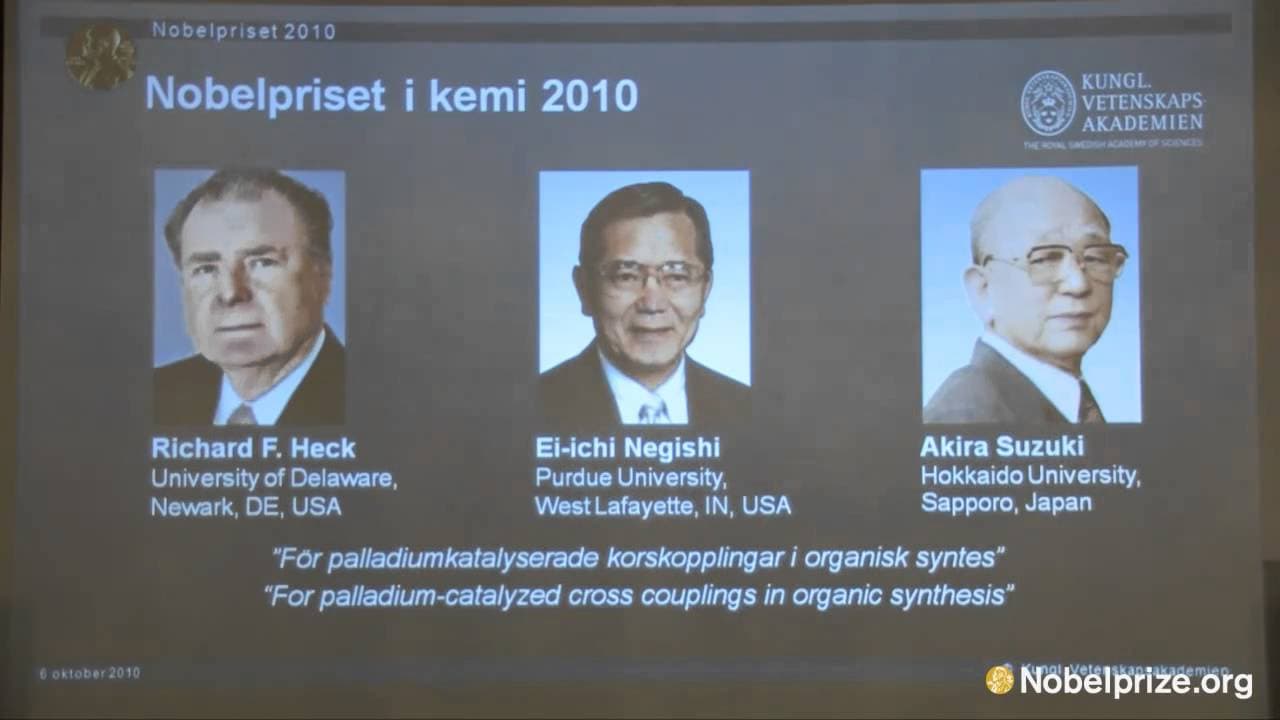
This year's Nobel Prize in Chemistry has been jointly awarded to Professor Richard Heck, Professor Ei-ichi Negishi, and Professor Akira Suzuki for their work in palladium-catalyzed cross couplings in organic synthesis. The Royal Swedish Academy of Sciences recognized their achievements in bringing great art to the field of chemistry.
Questions & Answers
Q: Could you explain what palladium-catalyzed cross couplings are?
Palladium-catalyzed cross couplings refer to a chemical reaction where a palladium catalyst is used to facilitate the coupling of two different organic molecules. This process allows for the creation of new carbon-carbon bonds, which are crucial in organic synthesis.
Q: Why is the development of palladium-catalyzed cross couplings significant in the field of chemistry?
The development of palladium-catalyzed cross couplings has revolutionized the field of organic synthesis. Previously, the formation of carbon-carbon bonds was a challenging and time-consuming process. With the use of palladium catalysts, chemists can now efficiently create these bonds, opening up new possibilities for the synthesis of complex organic molecules.
Q: How did Professor Richard Heck contribute to the field of palladium-catalyzed cross couplings?
Professor Richard Heck made groundbreaking contributions to the field by developing the Heck reaction. This reaction allows for the coupling of aryl halides with alkenes under mild reaction conditions. The Heck reaction has become a widely-used method for the synthesis of valuable organic compounds.
Q: What were the key contributions of Professor Ei-ichi Negishi to palladium-catalyzed cross couplings?
Professor Ei-ichi Negishi developed the Negishi coupling, which enables the coupling of organic halides with organozinc reagents. This reaction has proven to be highly versatile, allowing for the synthesis of a wide range of organic molecules. Negishi coupling has become an indispensable tool in the field of organic chemistry.
Q: Could you explain the role played by Professor Akira Suzuki in the development of palladium-catalyzed cross couplings?
Professor Akira Suzuki contributed significantly to the field by developing the Suzuki-Miyaura coupling. This reaction allows for the coupling of aryl and vinyl boronic acids with organic halides. The Suzuki-Miyaura coupling has gained widespread use in academia and industry due to its simplicity and broad applicability.
Q: How have palladium-catalyzed cross couplings impacted the synthesis of pharmaceuticals and other chemical compounds?
Palladium-catalyzed cross couplings have had a profound impact on the synthesis of pharmaceuticals and other chemical compounds. These reactions provide chemists with powerful tools to efficiently construct complex molecular structures, making the synthesis of drugs and valuable compounds more accessible and cost-effective.
Q: Are there any limitations or challenges associated with the use of palladium-catalyzed cross couplings?
While palladium-catalyzed cross couplings have revolutionized the field, there are still some limitations and challenges to consider. One limitation is the cost and availability of palladium, which can make these reactions expensive to perform on a large scale. There are also challenges related to controlling regioselectivity and stereoselectivity in some reactions, requiring further research and development.
Q: How do palladium-catalyzed cross couplings contribute to the development of sustainable chemistry?
Palladium-catalyzed cross couplings contribute to the development of sustainable chemistry by enabling more efficient and atom-economical reactions. These reactions minimize waste production and reduce the need for multiple steps, thereby conserving resources and energy. Additionally, the ability to construct complex molecules in a streamlined manner can accelerate the synthesis of greener and more sustainable materials.
Q: What are some potential future applications of palladium-catalyzed cross couplings?
The future applications of palladium-catalyzed cross couplings are vast. These reactions can be applied to the synthesis of natural products, pharmaceuticals, polymers, and other valuable compounds. Additionally, they can be utilized in the development of new materials with enhanced properties, such as improved catalysts, electronic devices, and functional materials.
Q: How does this year's Nobel Prize honor the field of chemistry and its contributions to society?
This year's Nobel Prize in Chemistry honors the significant contributions of Professor Richard Heck, Professor Ei-ichi Negishi, and Professor Akira Suzuki in the development of palladium-catalyzed cross couplings. Their work has not only advanced the field of chemistry but also had a profound impact on various industries, including pharmaceuticals, materials, and organic synthesis. This recognition highlights the importance of fundamental research in driving innovation and improving the quality of life for people globally.
Takeaways
The Nobel Laureates in Chemistry for 2010, Professors Richard Heck, Ei-ichi Negishi, and Akira Suzuki, were awarded for their groundbreaking work in palladium-catalyzed cross couplings in organic synthesis. Their contributions revolutionized the field, allowing for the efficient creation of carbon-carbon bonds and greatly impacting the synthesis of pharmaceuticals and other chemical compounds. These reactions have opened up new possibilities in sustainable chemistry and hold great promise for future applications in areas such as materials science and the development of functional materials. This Nobel Prize serves to honor the field of chemistry and its profound contributions to society.
Read in Other Languages (beta)
Share This Summary 📚
Summarize YouTube Videos and Get Video Transcripts with 1-Click
Try YouTube Summary with ChatGPT & Claude or YouTube Transcript Generator
Explore More Summaries from Nobel Prize 📚

Summarize YouTube Videos and Get Video Transcripts with 1-Click
Try YouTube Summary with ChatGPT & Claude or YouTube Transcript Generator