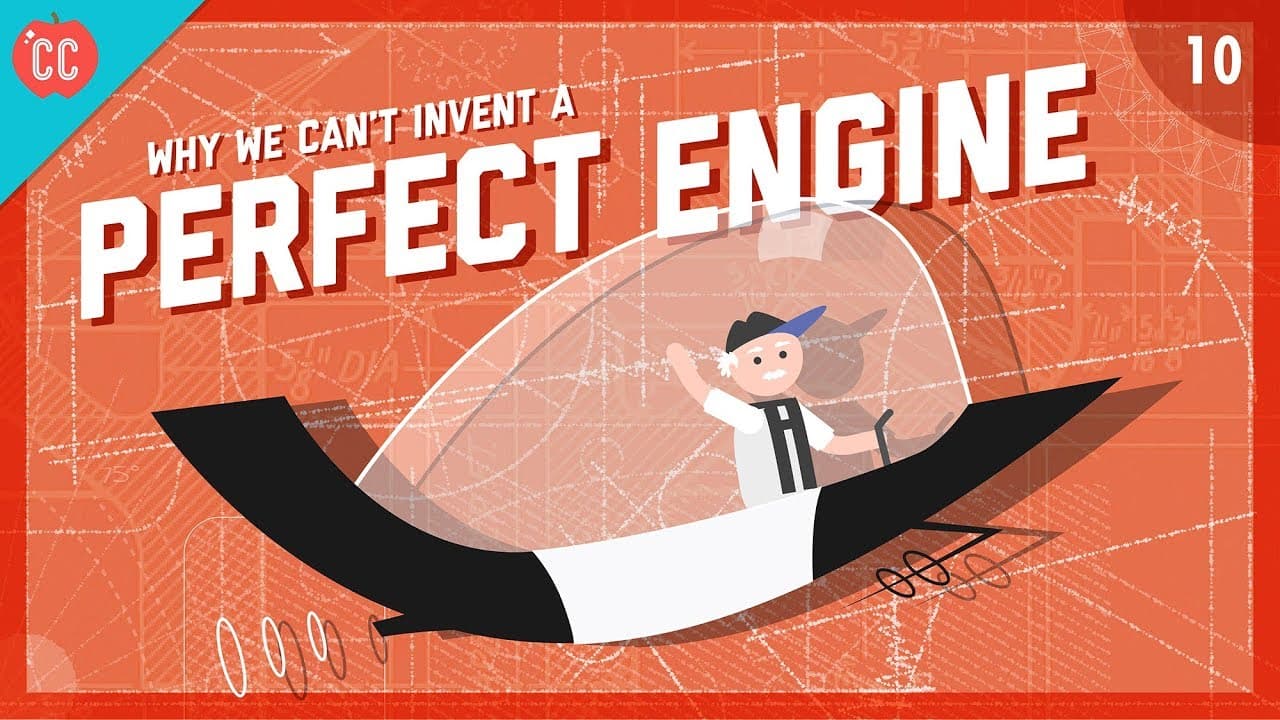
Why We Can't Invent a Perfect Engine: Crash Course Engineering #10
TL;DR
A perfect engine is impossible because the second law of thermodynamics prevents heat from being converted entirely into useful work. Road-going internal combustion engines are around 20% thermally efficient, automotive prototypes reach 40%, and an air-cooled gas turbine exceeds 61% combined-cycle efficiency. The Carnot cycle defines the theoretical benchmark engineers pursue, so read on to understand where every real engine loses usable energy.
Transcript
Thanks to CuriosityStream for supporting PBS Digital Studios. We’ve made some improvements in recent decades when it comes to how we power our society. But by and large, our world still runs on fossil fuels and nonrenewable energy. And as long as we’re dependent on these limited resources, we’ll need to design the most efficient ways to harvest the... Read More
Key Insights
- The second law of thermodynamics and entropy make it impossible to create a perfectly efficient engine, as energy transformations always involve some waste.
- Heat engines convert heat into work, but their efficiency is limited by thermodynamic laws, with current engines achieving up to 61% efficiency.
- Sadi Carnot developed the Carnot cycle, a theoretical model for the most efficient engine cycle, which remains unattainable in practice due to real-world inefficiencies.
- The Carnot cycle consists of four reversible processes, two isothermal and two adiabatic, that demonstrate the limits of engine efficiency.
- Entropy, introduced by Rudolf Clausius, quantifies the disorder in a system and explains why energy transformations lead to increased disorder.
- The concept of the heat death of the universe suggests that all energy will eventually become unusable heat, though this remains theoretical.
- Engineers strive to improve engine efficiency by modeling real systems closer to the Carnot cycle, but perfect efficiency remains unachievable.
- CuriosityStream supports educational content like Crash Course, offering documentaries and series on scientific developments and concepts.
Install to Summarize YouTube Videos and Get Transcripts
Explore YouTube Video Summarizer or Get YouTube Transcript Extractor
Questions & Answers
Q: Why can't we invent a perfect engine?
Every real-world energy conversion turns some energy into a form that is unavailable for work, usually heat. Because heat cannot be converted entirely back into work, a heat engine must release some heat at a cooler temperature and cannot reach 100% efficiency.
Q: What is a heat engine?
A heat engine is a machine or system that converts heat into other forms of energy. It accepts heat, produces useful work, and releases some heat at a cooler temperature as a secondary output.
Q: What is thermal efficiency?
Thermal efficiency measures the useful work a heat engine produces relative to the heat supplied to it. Greater thermal efficiency means more useful work from the fuel and less fuel required.
Q: How efficient are current heat engines?
Many internal combustion engines used on the road are around 20% thermally efficient. Some automotive engine prototypes reach 40%, while an air-cooled gas turbine delivers over 61% combined-cycle efficiency.
Q: How does the second law of thermodynamics limit engines?
The second law says that as energy is transferred or transformed, more of it becomes unavailable for useful work. All work supplied to a system can become heat, but all heat cannot be converted into work, which prevents perfect engine efficiency.
Q: What is the Carnot cycle?
The Carnot cycle is a hypothetical process representing the ideal sequence of pressure and temperature changes in a fluid. It consists of four reversible processes, two isothermal and two adiabatic, and provides a theoretical benchmark for maximum engine efficiency.
Q: Who was Sadi Carnot, and what did he contribute to engineering?
Sadi Carnot was a French scientist and army engineer who became interested in improving steam engines. In 1824, he published Reflections on the Motive Power of Fire, which presented the model now called the Carnot engine and the process known as the Carnot cycle.
Q: How can engineers improve engine efficiency?
Engineers can design real systems to behave more like the ideal Carnot cycle while reducing practical losses such as friction and heat conduction. These improvements can raise efficiency, but entropy and the second law of thermodynamics make perfect efficiency unattainable.
Summary & Key Takeaways
-
The video explains why perfect engine efficiency is impossible due to the second law of thermodynamics and entropy. It introduces the Carnot cycle, a theoretical model for maximum efficiency, and highlights the work of Sadi Carnot and Rudolf Clausius in understanding these principles.
-
Current engine efficiencies are limited by thermodynamic laws, with prototypes achieving up to 61%. The Carnot cycle, consisting of four reversible processes, serves as a benchmark for engine efficiency but cannot be realized in practice due to real-world inefficiencies.
-
Entropy, a measure of disorder, increases with every energy transformation, preventing perfect engine efficiency. The heat death of the universe is a theoretical outcome of entropy, though it remains uncertain. Engineers aim to improve efficiency by modeling engines closer to the Carnot cycle.
Read in Other Languages (beta)
Share This Summary 📚
Summarize YouTube Videos and Get Video Transcripts with 1-Click
Try YouTube Summary with ChatGPT & Claude or YouTube Transcript Generator
Explore More Summaries from CrashCourse 📚



Summarize YouTube Videos and Get Video Transcripts with 1-Click
Try YouTube Summary with ChatGPT & Claude or YouTube Transcript Generator