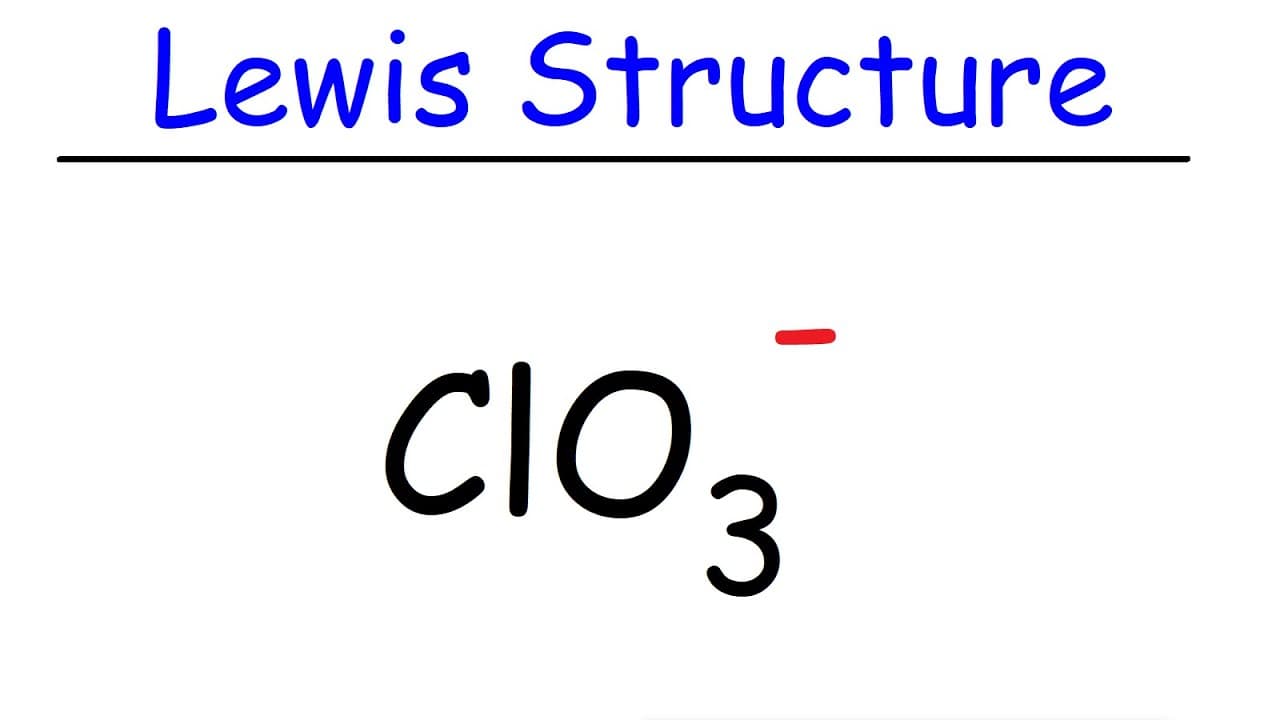
How to Draw the Lewis Structure of the Chlorate Ion
TL;DR
To draw the Lewis structure of the chlorate ion (ClO3-), start with 26 valence electrons: 7 from chlorine and 6 from each of the three oxygen atoms. Place chlorine at the center with one lone pair and connect it to three oxygen atoms, minimizing the formal charge on chlorine to achieve the most stable structure. The result shows that while oxygen follows the octet rule, chlorine can have an expanded octet.
Transcript
in this video we're going to talk about how to draw the lewis structure of the chlorate ion cl o3 minus so let's begin by adding the number of valence electrons in this polyatomic ion chlorine has seven valence electrons oxygen has six and we need to multiply by three because we have three oxygen atoms in its polyatomic ion and then that charge is ... Read More
Key Insights
- 😑 The chlorate ion has 26 valence electrons contributed by chlorine and oxygen.
- 😑 The central chlorine atom in the chlorate ion possesses 1 lone pair of electrons.
- 🤨 Chlorine, being in the third row or below, can have an expanded octet and doesn't adhere strictly to the octet rule.
- 👔 The most stable lewis structure minimizes the formal charge on the central element, ideally making it zero.
- 🌀 Oxygen atoms in the structure follow the octet rule, having 2 lone pairs with 2 bonds or 3 lone pairs with 1 bond.
- 🈂️ The overall -1 charge in the chlorate ion is due to the negative formal charge on one oxygen atom.
- ✋ Alternative resonance structures may obey the octet rule but have higher formal charges, making them less stable.
Install to Summarize YouTube Videos and Get Transcripts
Explore YouTube Video Summarizer or Get YouTube Transcript Extractor
Questions & Answers
Q: How many valence electrons are there in the chlorate ion?
The chlorate ion has a total of 26 valence electrons: 7 from chlorine and 6 from each of the 3 oxygen atoms.
Q: What determines the number of lone pairs on the central chlorine atom?
The number of lone pairs on the central chlorine atom is determined by finding the highest multiple of 8 below the total valence electrons (26 in this case), which is 24. Subtracting 24 from 26 gives 2, indicating 2 electrons or 1 lone pair.
Q: Is chlorine required to follow the octet rule?
No, chlorine is an element in the third row of the periodic table, allowing it to have more than 8 electrons in its outer shell. It does not have to obey the octet rule.
Q: How can we determine the most stable Lewis structure for the chlorate ion?
To determine the most stable Lewis structure, minimize the formal charge on the central chlorine atom by distributing the electrons and bonds around it. The formal charge should ideally be zero or close to it.
Summary & Key Takeaways
-
The chlorate ion (ClO3-) has 26 valence electrons, with chlorine contributing 7 and oxygen contributing 6 each (multiplied by 3).
-
The central chlorine atom in the chlorate ion has 1 lone pair of electrons.
-
Chlorine, being in the third row of the periodic table, can have an expanded octet and does not have to follow the octet rule.
-
To determine the most stable Lewis structure, the formal charge on the central element should be minimized.
Read in Other Languages (beta)
Share This Summary 📚
Summarize YouTube Videos and Get Video Transcripts with 1-Click
Try YouTube Summary with ChatGPT & Claude or YouTube Transcript Generator
Explore More Summaries from The Organic Chemistry Tutor 📚



Summarize YouTube Videos and Get Video Transcripts with 1-Click
Try YouTube Summary with ChatGPT & Claude or YouTube Transcript Generator