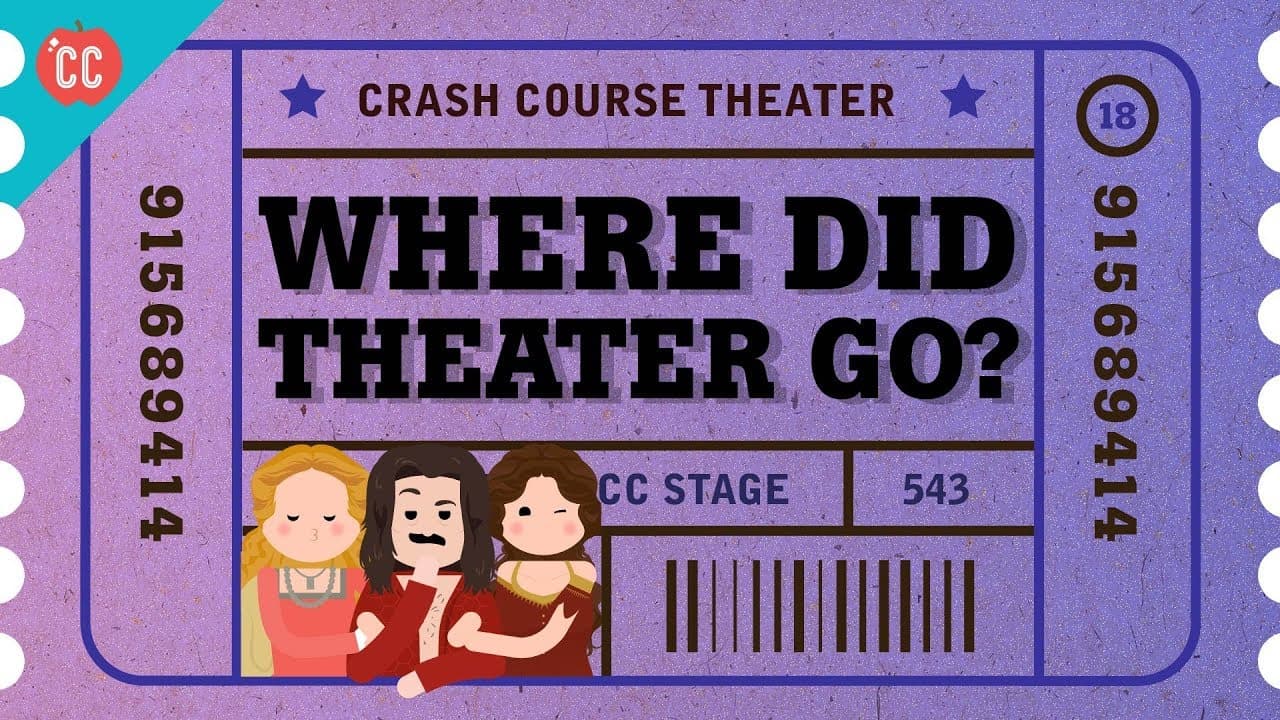
Why Did Theaters Shut Down in Renaissance England?
TL;DR
Theaters in Renaissance England were shut down primarily due to Puritan opposition, which viewed them as morally corrupting, leading to a complete ban in 1642 amid the English Civil War. However, performances continued clandestinely, and with the Restoration in 1660, theaters reopened, featuring women on stage and new comedic styles that challenged traditional morals.
Transcript
Hey there, I'm Mike Rugnetta. This is Crash Course Theater, and remember how we said it was gonna take a bunch of buzzkill Puritans to end this huge flowering of art and culture and awesomeness? Well, here they are. Today we're gonna be talking about objections to theatre in Renaissance England and how the theaters eventually closed. But good news,... Read More
Key Insights
- Puritans in Renaissance England were vehemently opposed to theater, viewing it as corrupting and sinful, leading to its closure.
- Anti-theatricalism has historical roots, with figures like Plato criticizing theater for its false representation of reality.
- Theaters were closed in 1642 by a Puritanical Parliament, citing religious and moral objections amidst the English Civil War.
- Despite the closures, clandestine performances persisted, with William Davenant pioneering English opera as a loophole.
- The Restoration in 1660 saw the revival of theater, with women finally taking the stage and new comedic styles emerging.
- Restoration comedies, known for their smutty and witty nature, challenged conventional morality and embraced themes of lust and envy.
- Notable anti-theatricalists like William Prynne and Jeremy Collier published extensive critiques, influencing some playwrights to reform.
- The Restoration period marked a significant cultural shift, with plays reflecting the social and political changes of the time.
Install to Summarize YouTube Videos and Get Transcripts
Explore YouTube Video Summarizer or Get YouTube Transcript Extractor
Questions & Answers
Q: What is the historical context of anti-theatricalism?
Anti-theatricalism has a long history, with figures like Plato expressing disdain for theater due to its false representation of reality. This sentiment was echoed by early Christians and later by Puritans in Renaissance England, who viewed theater as morally corrupting, leading to significant opposition and eventual closure of theaters.
Q: How did the English Civil War impact theater?
The English Civil War provided a pretext for the Puritanical Parliament to close theaters in 1642, citing religious and moral objections. The conflict and subsequent political changes created an environment where public performances were banned, although clandestine performances continued in secret until the monarchy was restored.
Q: What role did William Davenant play in theater during this period?
William Davenant played a crucial role during the theater closures by pioneering English opera, which was not specifically banned. This adaptation allowed public performances to continue in a different form. After the Restoration, Davenant led one of the two main theater companies in London, contributing to the revival of English theater.
Q: What changes occurred in theater after the Restoration?
After the Restoration in 1660, theater experienced significant changes, including the introduction of women on stage and the revival of old plays with happier endings. Restoration comedies emerged, known for their smutty and witty nature, challenging conventional morality and reflecting the social and political changes of the time.
Q: How did Restoration comedies differ from earlier theatrical works?
Restoration comedies differed from earlier works by embracing themes of lust, envy, and cynicism towards conventional morality. These plays were smutty and witty, focusing on upper-class characters seeking love, often adulterous, and challenging the notion of marriage as a happy ending, reflecting the social changes post-Restoration.
Q: Who were some notable anti-theatricalists during this period?
Notable anti-theatricalists included William Prynne, who published a thousand-page critique of theater, and Jeremy Collier, whose pamphlet influenced some playwrights to reform. Their works condemned theater for its perceived immorality and played a role in shaping public opinion against theatrical performances during the period.
Q: What was the significance of women on stage during the Restoration?
The introduction of women on stage during the Restoration marked a significant cultural shift in English theater. It challenged previous norms where male actors played female roles and allowed for new dynamics in performances. Women not only took on female roles but also male roles, adding a new dimension to theatrical productions.
Q: How did political changes influence theater during this period?
Political changes, such as the English Civil War and the Restoration of the monarchy, had a profound impact on theater. The Puritanical Parliament used the war as an excuse to close theaters, while the Restoration led to their revival. These shifts influenced the themes and styles of plays, reflecting the social and political climate of the time.
Summary & Key Takeaways
-
Theater in Renaissance England faced significant opposition from Puritans who viewed it as morally corrupting, leading to its closure in 1642. Despite this, clandestine performances continued, with figures like William Davenant adapting to the restrictions by creating English opera. The Restoration in 1660 revived theater with women on stage and new comedic styles.
-
Anti-theatricalism has deep historical roots, with critics like Plato and later, Puritans, condemning theater for its perceived immorality. The English Civil War provided an opportunity for Puritanical Parliament to shut down theaters, citing religious objections. However, public performances persisted in secret until the monarchy's restoration.
-
The Restoration period saw a cultural shift in English theater, with women finally performing on stage and the emergence of restoration comedies. These comedies were known for their smutty and witty nature, challenging conventional morality and embracing themes like lust and envy, reflecting the social changes of the time.
Read in Other Languages (beta)
Share This Summary 📚
Summarize YouTube Videos and Get Video Transcripts with 1-Click
Try YouTube Summary with ChatGPT & Claude or YouTube Transcript Generator
Explore More Summaries from CrashCourse 📚




Summarize YouTube Videos and Get Video Transcripts with 1-Click
Try YouTube Summary with ChatGPT & Claude or YouTube Transcript Generator