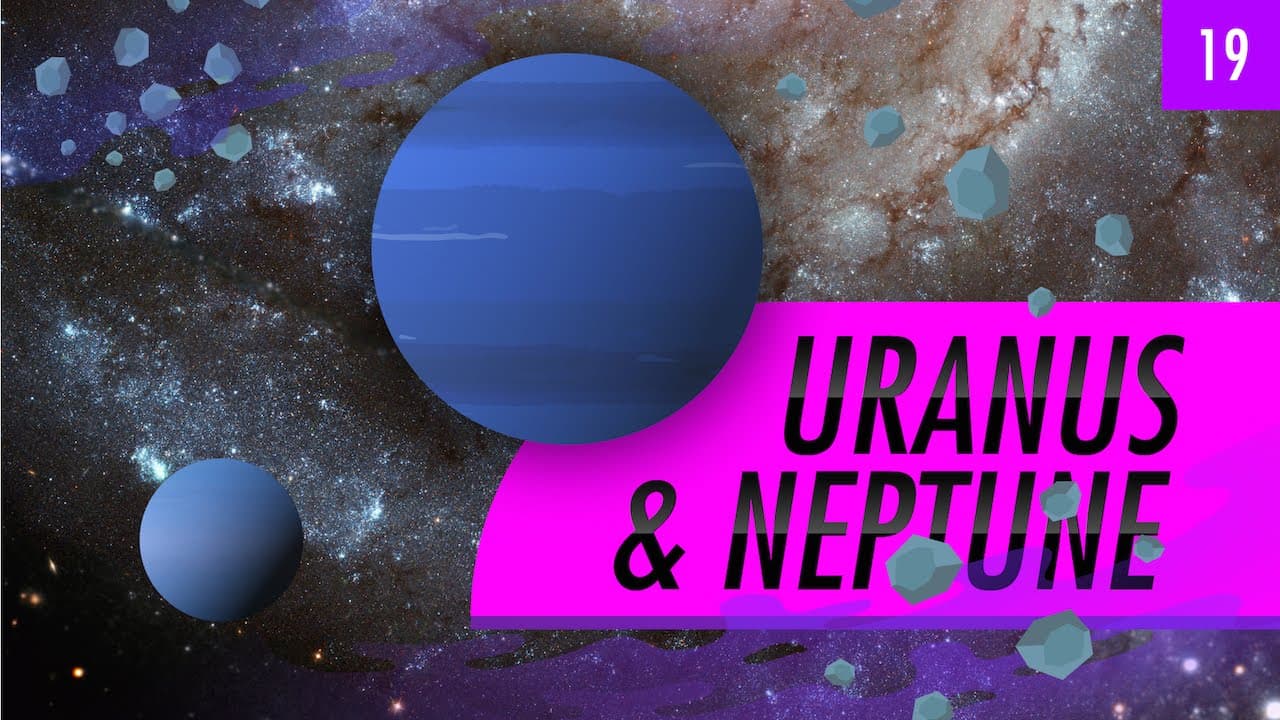
Uranus & Neptune: Crash Course Astronomy #19
TL;DR
Uranus and Neptune are ice giants with small rocky cores and thick mantles of water, ammonia, and methane, but Uranus rotates sideways while Neptune has a far more active atmosphere. Uranus is tilted about 98°, and Neptune’s winds exceed 2,000 kph. Both have rings and unusual moons, while Voyager 2 supplied much of what is known about them. Read on to compare their discoveries, weather, interiors, and mysteries.
Transcript
This episode of Crash Course is brought to you by Squarespace. You run us. YOU run us. You RAN us. You ran us. Ooo- Ooo ran ose. There are five planets in our solar system you can see without a telescope; well, six if you include the one you’re sitting on. But there are two more big ones out there, orbiting the Sun out in the cold depths of the out... Read More
Key Insights
- Uranus and Neptune are classified as ice giants due to their composition, with small rocky cores and thick mantles of ammonia, water, and methane.
- Uranus has a peculiar sideways rotation, tilted at about 98°, which leads to extreme seasonal variations compared to other planets.
- Neptune is known for its active atmosphere, featuring clouds and storms with wind speeds exceeding 2000 kph, faster than the speed of sound on Earth.
- Both planets have rings, although Uranus's rings are faint and narrow, while Neptune's are clumpy and incomplete, possibly constrained by nearby moonlets.
- Uranus's magnetic field is off-center and tilted, possibly due to interference from its icy mantle or core, a mystery yet to be fully understood.
- Neptune's largest moon, Triton, is geologically active with nitrogen geysers and a surface covered in nitrogen ice, suggesting recent resurfacing.
- Uranus was the first planet discovered with a telescope, while Neptune's existence was predicted mathematically before being observed.
- Voyager 2 provided most of the detailed information we have about these planets, with flybys in 1986 for Uranus and 1989 for Neptune.
Install to Summarize YouTube Videos and Get Transcripts
Explore YouTube Video Summarizer or Get YouTube Transcript Extractor
Questions & Answers
Q: What are the main similarities and differences between Uranus and Neptune?
Both are ice giants with small rocky cores, thick mantles containing water, ammonia, and methane, rings, and numerous moons. Uranus rotates nearly sideways and appears relatively calm, while Neptune has a more active atmosphere with clouds, storms, and winds exceeding 2,000 kph.
Q: Why are Uranus and Neptune called ice giants?
Their interiors are modeled as small rocky cores surrounded by thick mantles of water, ammonia, and methane. Outer-solar-system scientists classify those mantle materials as “ice,” distinguishing Uranus and Neptune from the gas giants Jupiter and Saturn.
Q: Why does Uranus rotate on its side?
Uranus is tilted by about 98°, so its axis points almost directly toward the Sun during part of its orbit and produces extreme seasons. One possible explanation is a grazing collision with a very large object long ago, but the transcript says no one knows the cause.
Q: How was Uranus discovered?
William Herschel spotted Uranus through a telescope in 1781 while mapping the sky. He first noted the greenish disk and moved on, but later observations showed that it had changed position, establishing that it was a planet beyond Saturn.
Q: How was Neptune discovered?
Neptune became the first planet located through mathematical prediction rather than initial direct discovery. Irregularities in Uranus’s orbit led astronomers to infer another planet, and Urbain Le Verrier predicted its position before Johann Galle observed it in 1846.
Q: Why do Uranus and Neptune have different colors and weather?
Uranus’s atmosphere contains hydrogen and helium plus about 2% methane, which absorbs red light and leaves the planet looking cyan or aquamarine. Neptune is a deeper blue for reasons that remain uncertain, and its atmosphere is much more active, producing clouds, storms, and winds above 2,000 kph.
Q: What makes Neptune’s moon Triton unusual?
Triton, Neptune’s largest moon, travels in a retrograde orbit, suggesting that Neptune captured it. Its nitrogen-ice surface has active nitrogen geysers and relatively few craters, indicating geological activity and recent resurfacing.
Q: What did Voyager 2 reveal about Uranus and Neptune?
Voyager 2 made the only spacecraft visit to Uranus in 1986 and flew past Neptune in 1989. Its observations supplied much of the detailed information about Uranus’s rings and moons, Neptune’s storms, and Triton’s nitrogen geysers.
Summary & Key Takeaways
-
Uranus and Neptune are ice giants with small rocky cores, thick mantles of ammonia, water, and methane, and atmospheres that give them greenish and blue hues. Uranus has a unique sideways rotation and relatively calm weather, while Neptune is more active with clouds and storms.
-
Both planets have rings and numerous moons. Uranus's rings are faint and narrow, and its moons include Miranda, known for its patchwork terrain. Neptune's rings are clumpy and incomplete, and its moon Triton is geologically active with nitrogen geysers.
-
Uranus was discovered by telescope, while Neptune was found through mathematical prediction. Voyager 2's flybys provided much of the current knowledge about these planets, revealing their unique characteristics and mysteries.
Read in Other Languages (beta)
Share This Summary 📚
Summarize YouTube Videos and Get Video Transcripts with 1-Click
Try YouTube Summary with ChatGPT & Claude or YouTube Transcript Generator
Explore More Summaries from CrashCourse 📚






Summarize YouTube Videos and Get Video Transcripts with 1-Click
Try YouTube Summary with ChatGPT & Claude or YouTube Transcript Generator