How Does Hamming Code Correct Errors in Data?
TL;DR
Hamming codes use additional parity bits to detect and correct errors in data transmission. By implementing even parity and ensuring bits are spaced appropriately, the method allows for the correction of single-bit errors while avoiding the need for retransmission. This approach is critical in maintaining data integrity over communication channels.
Transcript
we've uh I think done about five or maybe even six videos Counting the extra bits in this area of information Theory and a little bit of coding Theory and we got to a reasonably good um state with this but the story needs finishing off so I'd like to finish off the story and go back to our old example of San Francisco weather States I'll try and ma... Read More
Key Insights
- 🤑 Splitting codes into good and bad ones highlights the impact of disturbances on the line and the need for error detection and correction methods.
- 🫦 Parity check bits are added to ensure even parity and detect errors in coding.
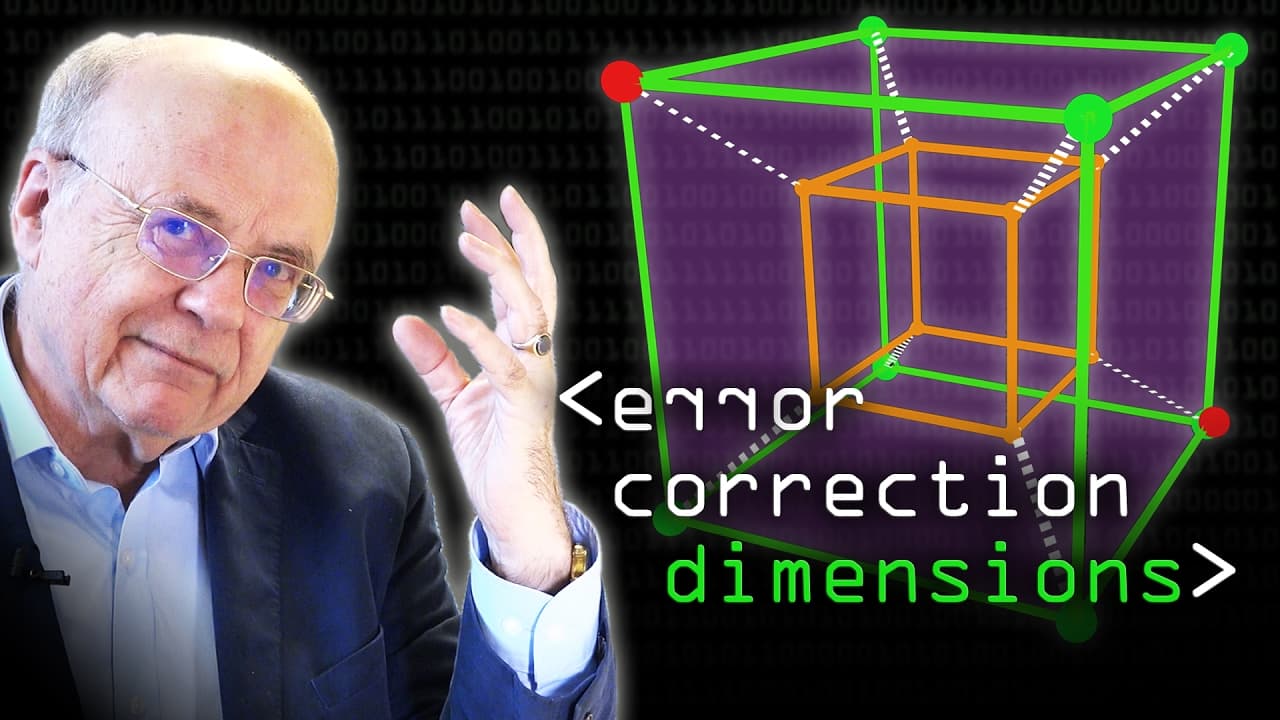
- 👨💻 The cube diagram demonstrates the relationship between distance and error correction capability in coding.
Install to Summarize YouTube Videos and Get Transcripts
Explore YouTube Video Summarizer or Get YouTube Transcript Extractor
Questions & Answers
Q: What is the purpose of splitting the codes into good and bad ones?
By splitting the codes into good and bad ones, the video showcases how disturbances on the line can lead to errors and the need for error detection and correction methods.
Q: Can the introduced A and Knack protocol correct bit errors?
The A and Knack protocol can detect bit errors but cannot correct them. It allows for acknowledgment or acknowledgement of received codes and notifies if any errors occurred.
Q: What is the significance of the cube diagram in error correction?
The cube diagram demonstrates that in three bits, only two valid code words can be correctable. It shows the relationship between distance and error correction capability.
Q: How does the Hamming code differ from previous coding methods?
The Hamming code introduces the use of parity check bits at the positions of exact powers of two. Instead of one parity check bit, it utilizes three parity check bits for error detection and correction.
Summary & Key Takeaways
-
The content explores the concept of information theory and coding, specifically focusing on San Francisco weather states and using two-bit codes to represent different states accurately.
-
The video discusses the impact of disturbances on the line, resulting in bit errors and the need for error detection and correction methods.
-
The concept of "parity" is introduced, where additional bits are added to ensure even parity and detect errors. However, these methods can only detect errors and not correct them.
Read in Other Languages (beta)
Share This Summary 📚
Summarize YouTube Videos and Get Video Transcripts with 1-Click
Try YouTube Summary with ChatGPT & Claude or YouTube Transcript Generator
Explore More Summaries from Computerphile 📚



Summarize YouTube Videos and Get Video Transcripts with 1-Click
Try YouTube Summary with ChatGPT & Claude or YouTube Transcript Generator