How Do Taxes and Subsidies Address Market Failures? | Crash Course Economics #21
TL;DR
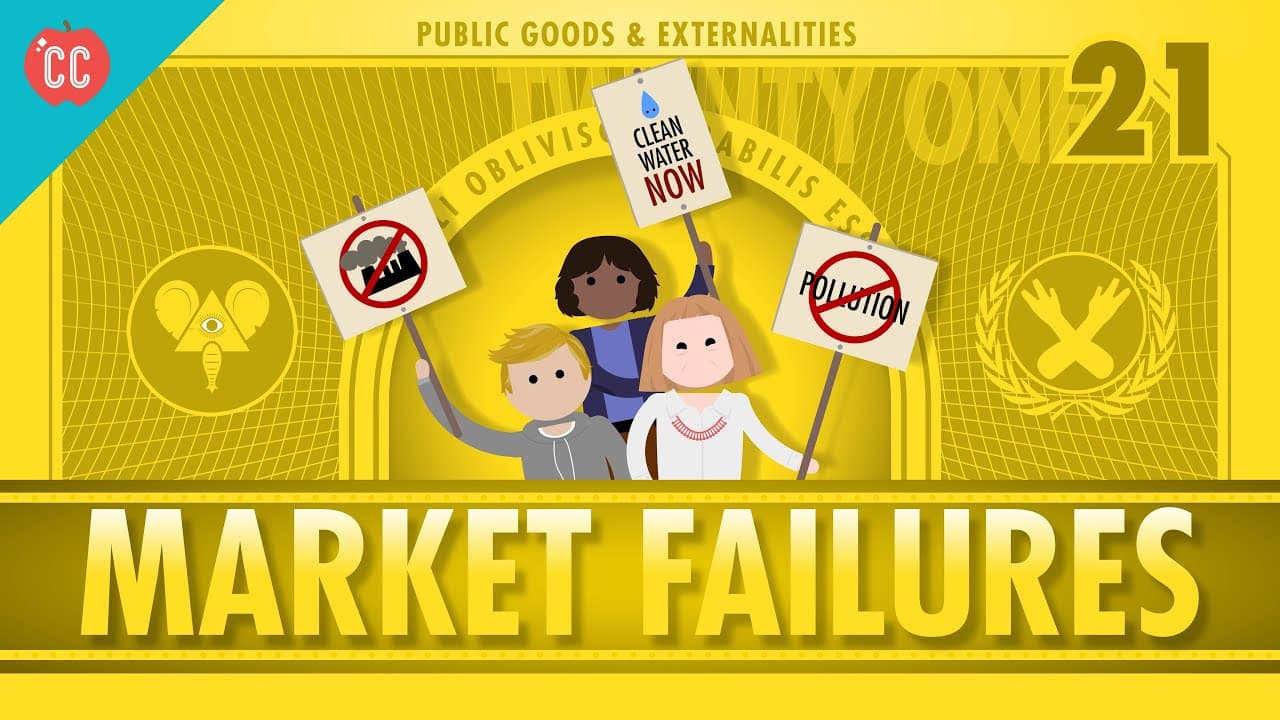
Taxes and subsidies address market failures by changing incentives when market prices do not reflect society’s full costs or benefits. Taxes can fund public goods and discourage negative externalities, while subsidies can encourage goods with positive externalities. Crash Course Economics #21 also explains the free rider problem, the tragedy of the commons, regulation, and emissions trading. Read on to see why markets and governments often need to work together.
Transcript
Jacob: I’m Jacob Clifford Adriene: and I’m Adriene Hill and welcome to Crash Course Economics. Jacob: In the last few videos we’ve said a lot of nice things about how competitive markets allocate resources. You know, they do a pretty good job. Adriene: But nobody’s perfect. Sometimes markets get it wrong. Sometimes they fail. Sometimes the byproduc... Read More
Key Insights
- Market failures occur when free markets do not allocate resources efficiently.
- Public goods are characterized by non-exclusion and non-rivalry, making them challenging for private markets to provide.
- The free rider problem arises when individuals benefit from resources without paying for them, leading to underfunding of essential services.
- Externalities are costs or benefits not reflected in market prices, leading to overproduction or underproduction.
- Governments use taxes and subsidies to correct market failures by adjusting incentives.
- Regulatory policies set rules to control negative externalities, such as pollution.
- Market-based policies, like emissions trading, create economic incentives to reduce negative impacts.
- Global challenges like climate change require international cooperation to address effectively.
Install to Summarize YouTube Videos and Get Transcripts
Explore YouTube Video Summarizer or Get YouTube Transcript Extractor
Questions & Answers
Q: How do taxes and subsidies address market failures?
Taxes and subsidies adjust incentives when markets do not reflect the full costs or benefits of an activity. Taxes can fund essential public goods or discourage activities with negative externalities, while subsidies can encourage goods and services that create positive externalities.
Q: What is a market failure?
A market failure occurs when markets alone do not allocate resources efficiently or provide enough of something society needs. The episode identifies public goods, the free rider problem, the tragedy of the commons, and externalities as important sources of market failure.
Q: What is the free rider problem?
The free rider problem occurs when people benefit from a good or service without paying for it. The episode illustrates this with fire protection: if too many households choose to contribute only $20 instead of $100, the city may not have enough money for a fire department.
Q: Why does the government use taxes to provide public goods?
Taxes prevent people from opting out of paying for essential shared services while continuing to receive their benefits. Governments often use tax revenue to fund fire protection, schools, and national defense when markets alone would not provide enough of them.
Q: What makes something a public good?
A public good has two characteristics: non-exclusion and non-rivalry. Non-exclusion means people who do not pay cannot easily be denied the benefit, while non-rivalry means one person’s use does not prevent another person from using it.
Q: What is the tragedy of the commons?
The tragedy of the commons occurs when resources available to everyone are misused or overexploited because individuals have incentives to take as much as possible. The episode connects it to air pollution, deforestation, endangered-species hunting, overfishing, and depleted fish stocks.
Q: What are positive and negative externalities?
Externalities are costs or benefits that affect other people or society as a whole. A negative externality makes others worse off, while a positive externality makes others better off; because these effects are not fully reflected in market prices, production can be too high or too low.
Q: How can governments address negative externalities such as pollution?
Governments can use taxes, regulations, and market-based policies such as emissions trading to reduce negative externalities. Emissions trading sets a cap and allows permits to be bought and sold, creating an economic incentive for companies to reduce pollution.
Summary & Key Takeaways
-
Market failures happen when free markets fail to allocate resources efficiently, often due to the free rider problem and externalities. Public goods, characterized by non-exclusion and non-rivalry, are typically underprovided by private markets. Governments intervene with taxes, subsidies, and regulations to correct these failures and ensure essential services are provided.
-
Externalities, both positive and negative, are costs or benefits that affect third parties and are not reflected in market prices. Governments address these through regulatory and market-based policies. Taxes and subsidies adjust incentives, while emissions trading creates economic motivations to reduce pollution. These interventions aim to align individual actions with societal needs.
-
Global issues like climate change highlight the limitations of unregulated markets, where individual incentives may conflict with collective well-being. International cooperation is crucial to effectively tackle such challenges. Governments and markets must work together to balance efficiency with equity, ensuring resources are used sustainably and equitably.
Read in Other Languages (beta)
Share This Summary 📚
Summarize YouTube Videos and Get Video Transcripts with 1-Click
Try YouTube Summary with ChatGPT & Claude or YouTube Transcript Generator
Explore More Summaries from CrashCourse 📚



Summarize YouTube Videos and Get Video Transcripts with 1-Click
Try YouTube Summary with ChatGPT & Claude or YouTube Transcript Generator