What Are the Core AI Fundamentals in 2023?
TL;DR
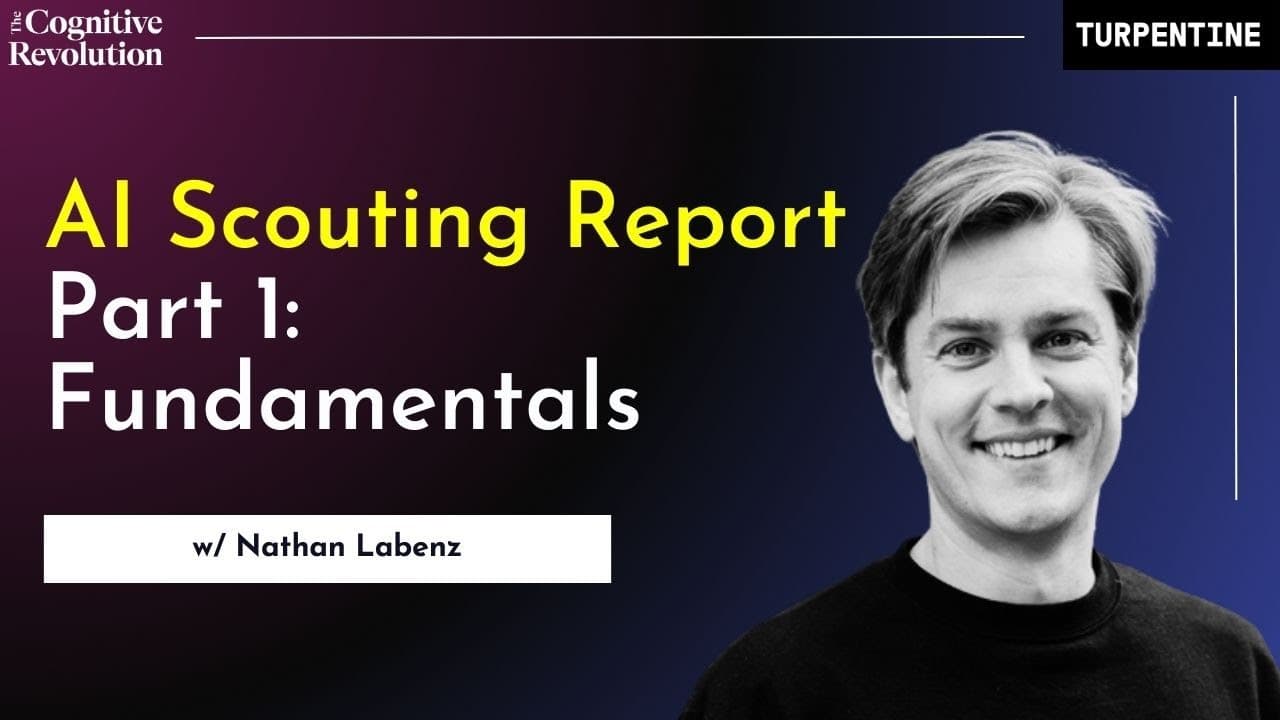
AI has reached a human-level threshold, though it operates differently from humans. The key components are data, compute, and algorithms, with the Transformer model playing a crucial role. This video aims to provide a comprehensive understanding of AI fundamentals, akin to a high school AP course, highlighting current capabilities and future trends.
Transcript
hello and welcome to the cognitive Revolution today we're changing up the format and I'm presenting part one of my AI scouting report for June 2023 the AI Scouting Report is my attempt to zoom out from all the day-to-day AI news and hype and help you focus on what really matters I'm synthesizing the most important Concepts and trends that I've obse... Read More
Key Insights
- AI now performs at a human-level on many tasks, although it doesn't mimic human cognition.
- The Transformer model, introduced in 2017, is pivotal in modern AI development.
- AI's strengths include breadth of knowledge, speed, and cost-effectiveness, while humans excel in depth and insight.
- Emergent capabilities in AI, such as sentiment analysis, arise from large-scale data and compute.
- Training involves forward passes and backpropagation to optimize model parameters.
- AI has shown the ability to grok, or deeply understand, certain tasks after extensive training.
- The Transformer model's architecture allows for scalable computation using GPUs.
- Mechanistic interpretability seeks to understand what AI models learn, revealing alien-like intelligence.
Install to Summarize YouTube Videos and Get Transcripts
Explore YouTube Video Summarizer or Get YouTube Transcript Extractor
Questions & Answers
Q: How does AI achieve human-level performance?
AI achieves human-level performance through a combination of large-scale data, compute, and advanced algorithms like the Transformer model. These elements allow AI to process vast amounts of information and learn from it, resulting in capabilities that match or exceed average human performance on a variety of tasks. However, AI's approach and strengths differ from human cognition.
Q: What role does the Transformer model play in AI?
The Transformer model, introduced in 2017, is crucial in AI's development due to its ability to process information in parallel, which allows for scalable computation. This architecture enables AI to handle large datasets efficiently, leading to significant advancements in language processing and other AI applications. Its design has become a foundation for many state-of-the-art AI systems.
Q: What are AI's strengths compared to humans?
AI's strengths compared to humans include its breadth of knowledge, speed, and cost-effectiveness. AI systems can access and process vast amounts of information quickly and at a lower cost than human labor. However, humans still excel in depth of understanding and the ability to generate novel insights, areas where AI currently lags behind.
Q: What is meant by AI's emergent capabilities?
Emergent capabilities in AI refer to abilities that arise unexpectedly as a result of training on large-scale data and compute. These capabilities, such as sentiment analysis, are not explicitly programmed but develop as the model learns to optimize its performance on tasks. This phenomenon highlights the complexity and potential of AI systems to discover new ways of solving problems.
Q: How is AI trained to optimize performance?
AI is trained to optimize performance through a process involving forward passes and backpropagation. In a forward pass, the model processes input data to generate an output. Backpropagation then adjusts the model's parameters by evaluating the output against a loss function, which measures the difference between the predicted and actual results. This iterative process gradually improves the model's accuracy.
Q: What is grokking in the context of AI?
Grokking in AI refers to the phenomenon where a model deeply understands a task after extensive training, leading to a sudden improvement in performance. This occurs when the model, through iterative training, internalizes the underlying principles of a task, allowing it to generalize beyond the examples it was trained on. Grokking highlights AI's potential to achieve profound understanding in specific areas.
Q: What challenges exist in understanding AI model behavior?
Understanding AI model behavior is challenging due to the complexity and scale of modern systems. Mechanistic interpretability aims to uncover the internal processes of models, revealing what they learn and how they make decisions. However, this task is difficult as models often develop alien-like intelligence that differs from human reasoning, making it hard to ascribe clear meanings to their internal states.
Q: How does AI differ from human cognition?
AI differs from human cognition in several ways. While AI excels in processing large volumes of data quickly and cost-effectively, it lacks the depth of understanding and novel insight generation that humans possess. AI operates through mathematical transformations and optimizations, resulting in emergent capabilities that are often alien-like compared to human thought processes. This distinction underscores the unique strengths and limitations of AI.
Summary & Key Takeaways
-
AI has reached a point where it can perform at a human-level on various tasks, though it operates differently from humans. The development of AI relies on three pillars: data, compute, and algorithms, with the Transformer model being a key innovation. This video provides an overview of AI fundamentals, aiming to equip viewers with a comprehensive understanding of current capabilities and future trends.
-
The Transformer model, introduced in 2017, has been instrumental in AI's progress due to its ability to process information in parallel. AI's strengths include breadth of knowledge, speed, and cost-effectiveness, while humans excel in depth and insight. Emergent capabilities, such as sentiment analysis, arise from large-scale data and compute.
-
Training AI models involves forward passes and backpropagation to optimize parameters. AI has demonstrated the ability to grok, or deeply understand, certain tasks after extensive training. Mechanistic interpretability aims to uncover what AI models learn, revealing an alien-like intelligence that differs from human cognition.
Read in Other Languages (beta)
Share This Summary 📚
Summarize YouTube Videos and Get Video Transcripts with 1-Click
Try YouTube Summary with ChatGPT & Claude or YouTube Transcript Generator
Explore More Summaries from Cognitive Revolution "How AI Changes Everything" 📚





Summarize YouTube Videos and Get Video Transcripts with 1-Click
Try YouTube Summary with ChatGPT & Claude or YouTube Transcript Generator