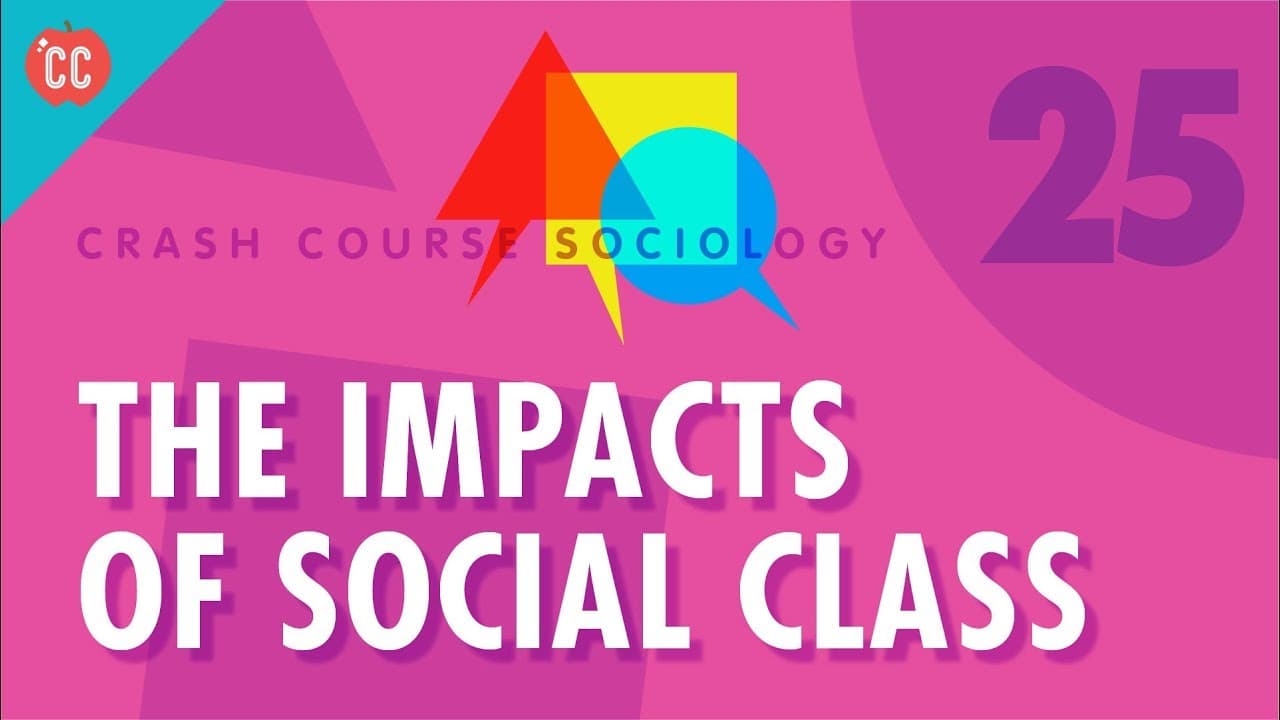
How Does Social Class Impact Education and Health?
TL;DR
Social class significantly influences education, health, and values. It affects parenting styles, with upper-middle-class parents often more involved in their children's education, leading to better outcomes. Additionally, lower socioeconomic status correlates with poorer health and shorter lifespans due to factors like access to healthcare and occupational risks, perpetuating inequalities across generations.
Transcript
Class matters. You probably already know that. And not only because you’re a student of sociology, but because you’re a person who lives in a society. But do you know how much it really matters? Social class is huge determinant of many of the most fundamental aspects of modern life – from your education, to your beliefs, as well as your values, you... Read More
Key Insights
- Social class significantly influences various aspects of life, including education, beliefs, values, income, and health, impacting both living conditions and life expectancy.
- Class socialization begins early, with parents imparting values based on their class, influencing children's future social and economic roles.
- Parenting styles differ by class; upper-middle-class parents are more involved in structuring children's activities, while working-class parents emphasize discipline and autonomy.
- Political and religious beliefs often correlate with class, with upper-class individuals leaning towards fiscal conservatism and social progressivism, while lower-class individuals tend to hold opposite views.
- Education access and quality are heavily influenced by social class, with affluent neighborhoods offering better schools, perpetuating inequality across generations.
- Higher education, especially at elite institutions, is less accessible to lower-income families, reinforcing class divides and limiting social mobility.
- Health disparities are evident across classes, with upper-class individuals enjoying better health outcomes and longer lifespans due to access to healthcare and healthier living conditions.
- Occupational hazards and stress levels vary by class, with lower-class jobs posing more risks, contributing to poorer health outcomes.
Install to Summarize YouTube Videos and Get Transcripts
Explore YouTube Video Summarizer or Get YouTube Transcript Extractor
Questions & Answers
Q: How does social class affect parenting styles?
Social class influences parenting styles significantly. Upper-middle-class parents often engage more in their children's academic and social activities, employing structured schedules and encouraging autonomy. In contrast, working-class parents may focus more on discipline and obedience due to limited resources, impacting children's socialization and future opportunities.
Q: What role does education play in perpetuating social class differences?
Education is a key factor in perpetuating social class differences. Access to quality education is often determined by social class, with affluent families having better access to good schools and resources. This leads to better educational outcomes for their children, reinforcing class divisions and limiting upward mobility for lower-income families.
Q: In what ways do political and religious beliefs differ by social class?
Political and religious beliefs often vary by social class. Upper-class individuals tend to be fiscally conservative and socially progressive, while lower-class individuals are more likely to hold opposite views. Additionally, religious affiliations differ, with upper-income individuals more likely to belong to liberal Protestant groups, Judaism, or Atheism, whereas lower-income individuals often identify as Evangelical Protestants or Catholics.
Q: How does social class impact health outcomes?
Social class significantly impacts health outcomes, with upper-class individuals generally experiencing better health and longer lifespans. This is due to better access to healthcare, healthier living environments, and less hazardous occupations. In contrast, lower-class individuals face more health risks due to poor living conditions, limited healthcare access, and high-stress jobs.
Q: What is the relationship between income segregation and education?
Income segregation leads to educational disparities, as families with similar income levels tend to live in the same neighborhoods. Affluent neighborhoods typically have better-funded schools, providing superior educational resources and opportunities. This results in unequal educational outcomes, perpetuating social class differences and limiting social mobility for lower-income families.
Q: How do occupational hazards vary by social class?
Occupational hazards vary significantly by social class. Lower-class individuals are more likely to hold jobs with higher risks of accidents and exposure to dangerous materials, contributing to poorer health outcomes. In contrast, upper and middle-class individuals often work in safer, white-collar jobs with more flexible schedules and better health benefits.
Q: Why is education not always the 'Great Equalizer'?
Education is not always the 'Great Equalizer' because access to quality education is often determined by social class. Affluent families can afford better schooling and resources, leading to superior educational outcomes for their children. This perpetuates social class differences and limits opportunities for upward mobility among lower-income individuals.
Q: What are food deserts, and how do they relate to social class?
Food deserts are areas with limited access to fresh, healthy foods, often found in low-income neighborhoods. Residents in these areas tend to rely on cheaper, unhealthy food options due to limited availability and resources, contributing to poorer health outcomes. This highlights the link between social class and access to healthy living conditions.
Summary & Key Takeaways
-
Social class plays a crucial role in determining various life outcomes, including education, beliefs, values, and health. These class-based differences begin with early socialization and continue to influence individuals throughout their lives, affecting their opportunities and quality of life.
-
Parenting styles and educational opportunities differ significantly across social classes, with upper-middle-class families having more resources to invest in their children's development. This often results in better educational outcomes and perpetuates social inequality across generations.
-
Health outcomes are also stratified by class, with upper-class individuals enjoying better health and longer lifespans. This is due to a combination of access to healthcare, healthier living conditions, and less hazardous occupations, highlighting the pervasive impact of class on life quality.
Read in Other Languages (beta)
Share This Summary 📚
Summarize YouTube Videos and Get Video Transcripts with 1-Click
Try YouTube Summary with ChatGPT & Claude or YouTube Transcript Generator
Explore More Summaries from CrashCourse 📚




Summarize YouTube Videos and Get Video Transcripts with 1-Click
Try YouTube Summary with ChatGPT & Claude or YouTube Transcript Generator