What Impact Did the Harlem Renaissance Have on Politics?
TL;DR
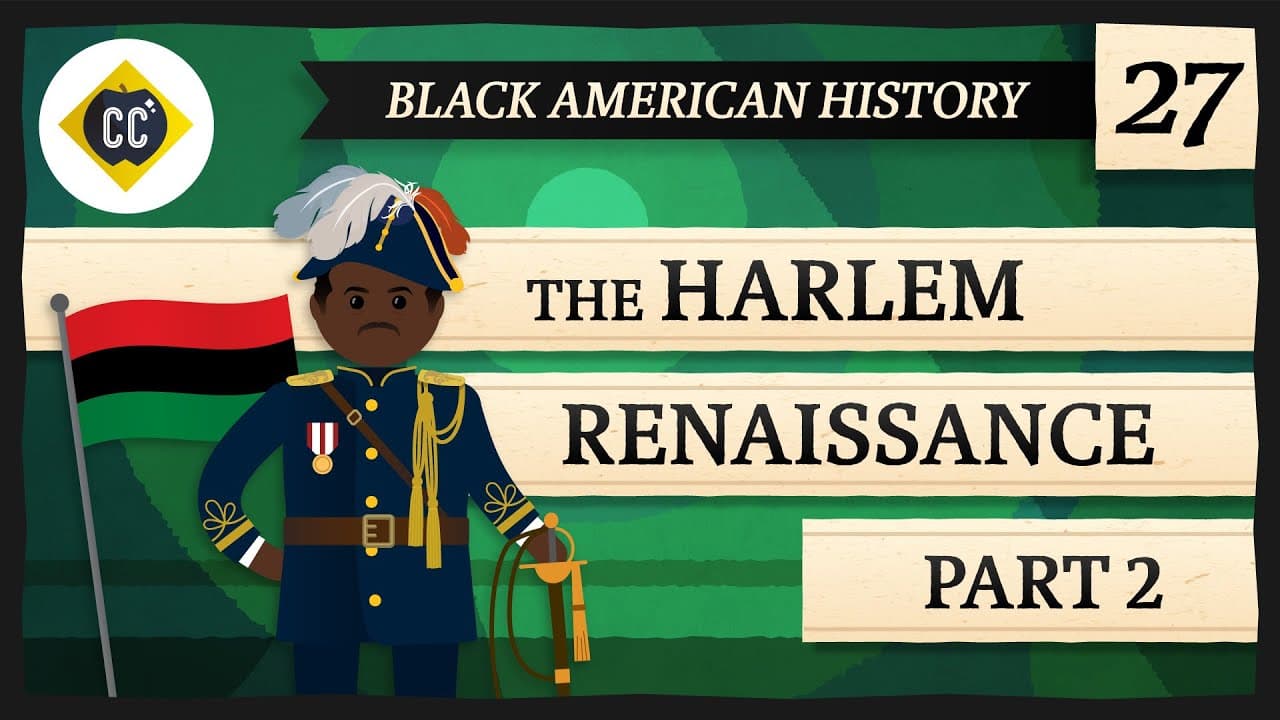
The Harlem Renaissance was as political as it was artistic, driving debates over how Black communities should win equality and economic mobility. Labor activist A. Philip Randolph and economist Chandler Owen defined the uncompromising "New Negro" in The Messenger, founded in 1917, while the NAACP (founded 1909) and National Urban League (founded 1911) organized against discrimination. Read on to see how figures from Marcus Garvey to Carter G. Woodson shaped Black political thought.
Transcript
hi I'm Clint Smith and this is Crash Course black American history and today we're continuing our exploration of the Harlem Renaissance in our last episode we talked about the proliferation of black Artistry across the Harlem Renaissance over a million black people migrated to the north and changed the cultural landscape of New York and other North... Read More
Key Insights
- 🧑🚒 The Harlem Renaissance was not solely about artistic production but also encompassed political activism and the fight against racial injustice.
- 😀 Black artists during this time faced numerous challenges, including racism and inequality in employment opportunities.
- 🖤 Black theorists and political thinkers emerged during the Harlem Renaissance, debating strategies for achieving political equality and economic mobility.
- 🧑🚒 Organizations like the NAACP and the National Urban League were actively involved in grassroots activism and fought against discrimination and segregation.
- 🖤 Marcus Garvey and the UNIA advocated for black nationalism and self-reliance, but his controversial views and alignment with the Ku Klux Klan made him divisive among other Black leaders.
- 🖐️ The NAACP achieved significant legal victories and played a crucial role in investigating lynchings in the South.
- 🏈 The creation of Negro History Week, later expanded to Black History Month, aimed to highlight and honor African-American contributions.
Install to Summarize YouTube Videos and Get Transcripts
Explore YouTube Video Summarizer or Get YouTube Transcript Extractor
Questions & Answers
Q: What political impact did the Harlem Renaissance have?
Beyond art, the Harlem Renaissance advanced organized political activism against racial injustice and pushed for political equality, universal suffrage, and economic mobility. A. Philip Randolph and Chandler Owen defined the "New Negro" as uncompromising on these goals in their magazine The Messenger, founded in 1917. They argued Black workers deserved the same protection through labor unions that white workers had.
Q: What role did the NAACP play during the Harlem Renaissance?
Founded in 1909 and headquartered in New York City, the NAACP was heavily involved in grassroots activism against discrimination and segregation. In 1917 in Buchanan v. Warley it convinced the Supreme Court to overturn city ordinances mandating where Black people could live, and in 1926 it defended Ossian Sweet, a Black physician from Detroit, against murder charges after an attack on his home. It also investigated lynchings, though its effort to pass a national anti-lynching bill was unsuccessful.
Q: Who were the key political figures and organizations of the Harlem Renaissance?
A. Philip Randolph, a Northern labor activist, and economist Chandler Owen defined the goals of the "New Negro" through their magazine The Messenger. The NAACP and the National Urban League, both based in New York, led grassroots activism, while Marcus Garvey's UNIA and historian Carter G. Woodson also shaped the era's political and intellectual life.
Q: What role did Marcus Garvey play during the Harlem Renaissance?
Marcus Garvey and his first wife Amy Ashwood Garvey founded the Universal Negro Improvement Association (UNIA) in Jamaica in 1914, though it failed to gain traction there. After Garvey immigrated to the US, he began public speaking in New York City, and the UNIA became the largest and most militant of the organizations pursuing equal rights for Black people.
Q: How did A. Philip Randolph and Chandler Owen define the "New Negro"?
In The Messenger, the independent magazine they founded in 1917, Randolph and Owen described the New Negro as uncompromising on political equality and universal suffrage. Because economic mobility was difficult for Black Americans, they also called for the same protection through labor unions that white workers had, so Black people would not be exploited by those price gouging them for necessities.
Q: How did the Harlem Renaissance differ from Booker T. Washington's approach?
Booker T. Washington championed accommodation to segregation and the slow aggregation of Black economic freedom through vocational labor, glorifying common labor while remaining separate from white Americans even if it meant fewer rights. The Northern "New Negroes" rejected accommodation, segregation, and any notion of having to wait for their freedom. The video notes Washington's views are more understandable given he was born into slavery and still lived in the South.
Q: How did Black artists fare economically during the Harlem Renaissance?
Despite creating beautiful work, many artists struggled and very few could pursue their art full-time. They often worked in unstable and dangerous roles at industrial plants or on seaports, frequently for lower wages than their white counterparts. Even in the North, both systemic and interpersonal racism were everywhere.
Q: What was Negro History Week and who created it?
Negro History Week, created in 1926, was the predecessor to Black History Month and the brainchild of Carter G. Woodson, who earned his Ph.D. in history from Harvard in 1912 as only the second Black person to do so, after W.E.B. DuBois. He and other activists urged schools to use a week in February to highlight and honor African American contributions. In the early 1970s it extended into a month-long celebration, and in 1976 it became federally recognized.
Summary & Key Takeaways
-
The Harlem Renaissance was a period of Black Artistry in the early 20th century that also involved political messages and activism against racial injustice.
-
Black artists during this time often faced challenges and had to work in unstable and lower-paid roles in industrial plants or seaports.
-
Black theorists and political thinkers emerged during the Harlem Renaissance, debating strategies for achieving equality and labor rights for Black communities.
Read in Other Languages (beta)
Share This Summary 📚
Summarize YouTube Videos and Get Video Transcripts with 1-Click
Try YouTube Summary with ChatGPT & Claude or YouTube Transcript Generator
Explore More Summaries from CrashCourse 📚



Summarize YouTube Videos and Get Video Transcripts with 1-Click
Try YouTube Summary with ChatGPT & Claude or YouTube Transcript Generator