Dividing quadratics by linear expressions with remainders | Algebra 2 | Khan Academy
TL;DR
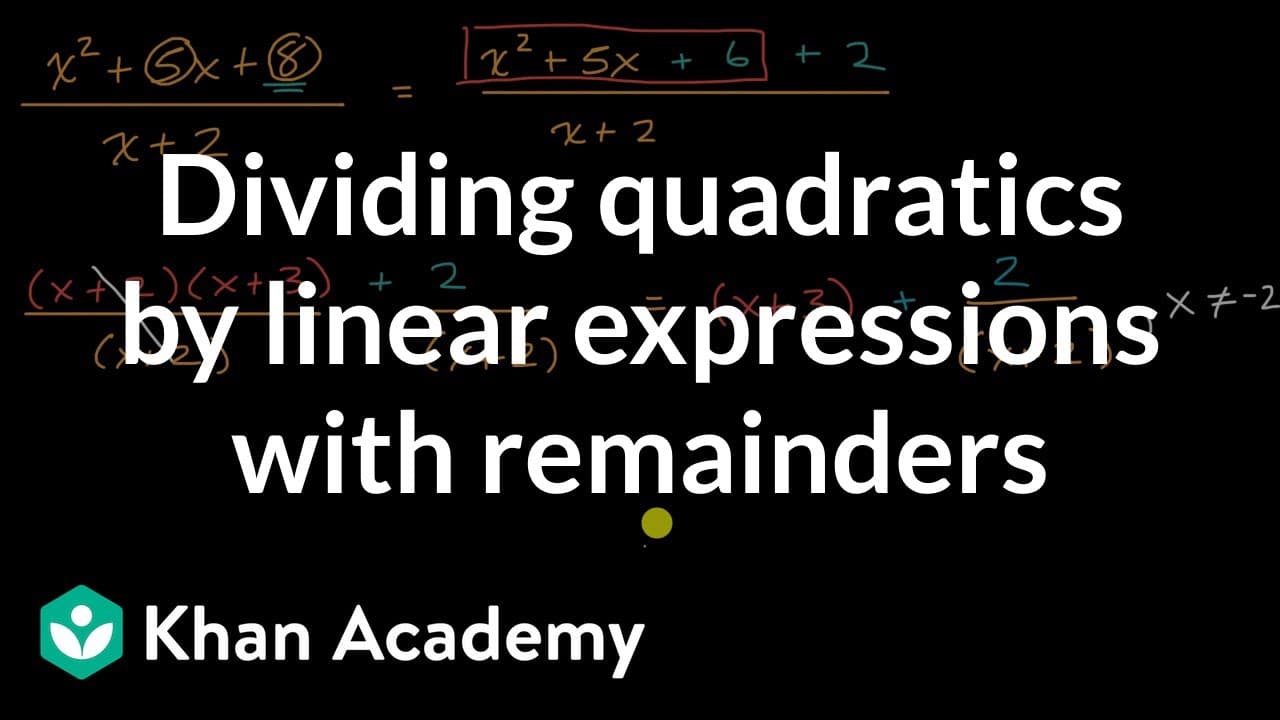
Dividing x² + 5x + 8 by x + 2 gives x + 3 with a remainder of 2, or x + 3 + 2/(x + 2), where x ≠ -2. The result can be found by rewriting part of the numerator or by algebraic long division, which divides the highest-degree terms and subtracts each product. Read on to see both methods and why the domain restriction matters.
Transcript
- [Instructor] So if you've been watching these videos, you know that we have a lot of scenarios where people seem to be walking up to us on the street and asking us to do math problems. And I guess this will be no different. So let's say someone walks up to you on the street and says, "Quick, you, "x squared plus five x plus eight over x plus two,... Read More
Key Insights
- ➗ Simplifying polynomial division can be done by factoring the numerator or using algebraic long division.
- 🧑🏭 Factoring the numerator helps identify common factors with the denominator.
- 🍉 Algebraic long division involves dividing the numerator term-by-term and subtracting the product from the original numerator.
Install to Summarize YouTube Videos and Get Transcripts
Explore YouTube Video Summarizer or Get YouTube Transcript Extractor
Questions & Answers
Q: What is x² + 5x + 8 divided by x + 2?
The quotient is x + 3 with a remainder of 2. Written as an equivalent expression, the result is x + 3 + 2/(x + 2), with the restriction x ≠ -2.
Q: How can x² + 5x + 8 be rewritten to divide by x + 2?
Rewrite the numerator as x² + 5x + 6 + 2. The first three terms factor as (x + 2)(x + 3), leaving the extra 2 as the remainder.
Q: Why can’t x² + 5x + 8 be factored directly with x + 2 as a factor?
Using 2 and 3 would produce a middle-term coefficient of 5, but their product is 6 rather than 8. Therefore, x + 2 is not a factor of the entire numerator.
Q: How does algebraic long division begin for this expression?
Compare the highest-degree terms x² and x. Since x goes into x² exactly x times, place x in the quotient and multiply x(x + 2) to get x² + 2x.
Q: What happens after subtracting x² + 2x from x² + 5x + 8?
Subtracting cancels the x² terms and leaves 3x. Bring down the 8, producing 3x + 8 for the next division step.
Q: How is the constant term of the quotient found?
The highest-degree term x goes into 3x three times, so place +3 in the quotient. Multiplying 3(x + 2) gives 3x + 6, and subtracting this from 3x + 8 leaves 2.
Q: How is a remainder written after polynomial division?
Write the quotient first, then add the remainder divided by the original divisor. Here, x + 3 with remainder 2 becomes x + 3 + 2/(x + 2).
Q: Why must the simplified expression include x ≠ -2?
At x = -2, the original denominator x + 2 equals zero. Canceling x + 2 without retaining that restriction would change the domain of the original expression.
Summary & Key Takeaways
-
This video teaches two methods for simplifying polynomial division: factoring the numerator and using algebraic long division.
-
The first method involves factoring the numerator to check for common factors with the denominator.
-
The second method, algebraic long division, involves dividing the numerator by the denominator step-by-step to simplify the expression.
Read in Other Languages (beta)
Share This Summary 📚
Summarize YouTube Videos and Get Video Transcripts with 1-Click
Try YouTube Summary with ChatGPT & Claude or YouTube Transcript Generator
Explore More Summaries from Khan Academy 📚


Summarize YouTube Videos and Get Video Transcripts with 1-Click
Try YouTube Summary with ChatGPT & Claude or YouTube Transcript Generator