Constant-volume calorimetry | Thermodynamics | AP Chemistry | Khan Academy
TL;DR
Constant-volume calorimetry measures heat from a reaction at fixed volume, where rigid walls prevent work and make qv equal to the change in internal energy, ΔE. A bomb calorimeter transfers combustion heat to water and tracks its temperature rise. The worked caffeine example produces a heat of combustion of −4.23 × 10³ kilojoules per mole; read on for the calibration and calculation steps.
Transcript
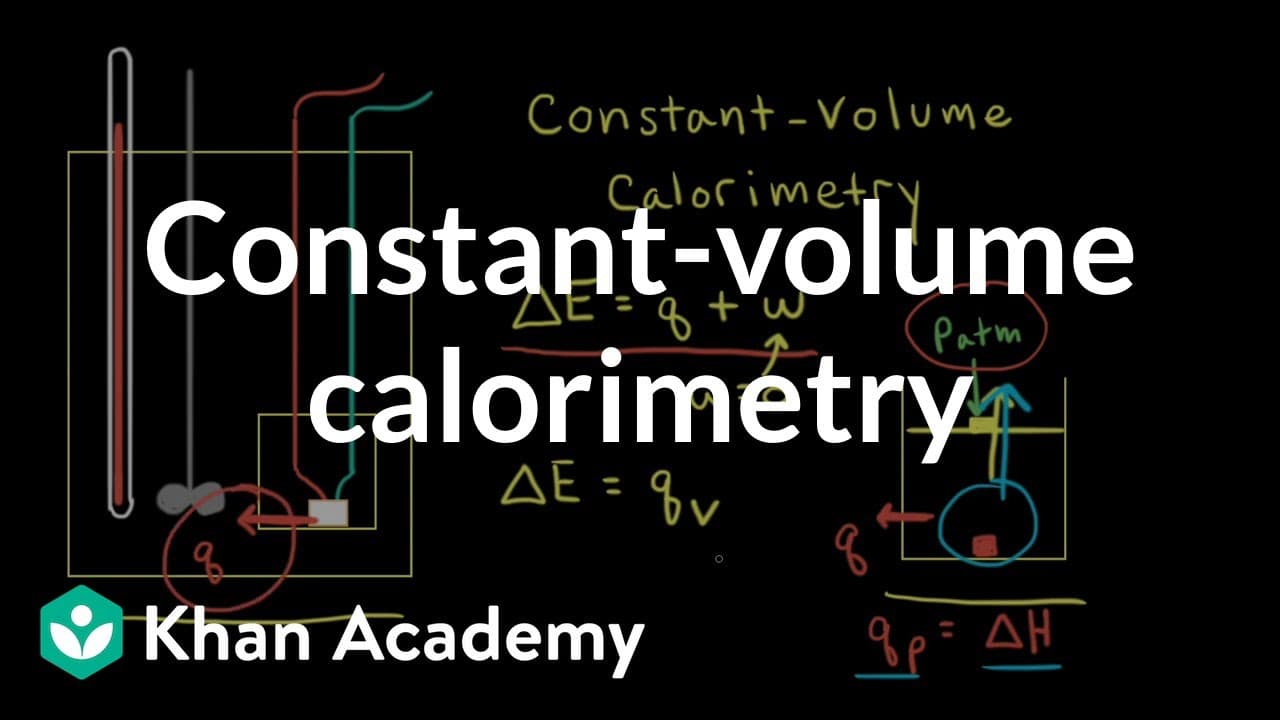
- [Instructor] Calorimetry refers to the measurement of heat flow. And there are many different types of calorimeters. In this case, we're looking at a constant volume calorimeter which is also called a bomb calorimeter. Let's look at how a bomb calorimeter works. First, the sample to be combusted is placed in a container that has some oxygen. And ... Read More
Key Insights
- 🥵 Calorimetry is used to measure heat flow in chemical reactions.
- 💦 Constant volume calorimeters, also known as bomb calorimeters, are used when no work is done.
- 🥵 The heat transferred in a constant volume calorimeter is equal to the change in internal energy.
- 🤗 Constant pressure calorimeters, on the other hand, involve work done by the system.
- 🥵 The heat capacity of a calorimeter can be determined by combusting a substance with a known heat of combustion.
- 🥵 The heat capacity is used to calculate the heat of combustion for another substance.
- 💱 The change in internal energy is often approximately equal to the change in enthalpy.
Install to Summarize YouTube Videos and Get Transcripts
Explore YouTube Video Summarizer or Get YouTube Transcript Extractor
Questions & Answers
Q: How does a constant-volume calorimeter work?
A sample is placed with oxygen in a rigid container and ignited using ignition wires. Heat from the combustion transfers to stirred water, and a thermometer measures the resulting temperature increase.
Q: What is calorimetry?
Calorimetry is the measurement of heat flow. Different types of calorimeters measure heat transferred during processes such as combustion reactions.
Q: Why is a constant-volume calorimeter called a bomb calorimeter?
The transcript identifies a constant-volume calorimeter as a bomb calorimeter. It uses a rigid container whose solid walls cannot move while the enclosed sample combusts in oxygen.
Q: Why does qv equal the change in internal energy in a bomb calorimeter?
The first law states that the change in internal energy is equal to q plus w. Because the calorimeter has rigid walls, no work is done, so w is zero and the constant-volume heat qv equals ΔE.
Q: What is the difference between constant-volume and constant-pressure calorimetry?
At constant volume, rigid walls prevent work, so the transferred heat qv equals the change in internal energy, ΔE. At constant pressure, expanding gases can move a piston and perform work, while the transferred heat qp equals the change in enthalpy, ΔH.
Q: How is the heat capacity of a bomb calorimeter determined?
Combust a measured amount of a substance whose released energy is known, then divide that energy by the observed temperature change. In the example, 0.2350 grams of benzoic acid releases 6.199 kilojoules and raises the temperature by 1.642 degrees Celsius, giving 3.3775 kilojoules per degree Celsius.
Q: How is the heat of combustion calculated with a calibrated calorimeter?
Use q = −Ccal × ΔT, where Ccal is the calorimeter heat capacity and ΔT is the water’s temperature change. The negative sign indicates that the reacting substance gives off the heat absorbed by the calorimeter.
Q: What heat of combustion is calculated for caffeine in the example?
Combusting 0.265 grams of caffeine raises the water temperature by 1.525 degrees Celsius, and the calculation shown gives qv = −5.757 kilojoules. Dividing by 1.36 × 10⁻³ moles of caffeine gives −4.23 × 10³ kilojoules per mole, with the negative sign meaning heat is released.
Summary & Key Takeaways
-
Calorimetry is the measurement of heat flow and can be done using different types of calorimeters.
-
In a constant volume calorimeter, a sample to be combusted is placed in a container with oxygen, and the heat from the combustion reaction is transferred to the water in the container.
-
The heat transferred in a constant volume calorimeter is equal to the change in internal energy, while in a constant pressure calorimeter, it is equal to the change in enthalpy.
Read in Other Languages (beta)
Share This Summary 📚
Summarize YouTube Videos and Get Video Transcripts with 1-Click
Try YouTube Summary with ChatGPT & Claude or YouTube Transcript Generator
Explore More Summaries from Khan Academy 📚



Summarize YouTube Videos and Get Video Transcripts with 1-Click
Try YouTube Summary with ChatGPT & Claude or YouTube Transcript Generator