10 Best Vibe Coding Videos on YouTube

Jul 27, 2026
11 min read
77 views
Last updated: July 2026
Vibe coding means describing the software you want in plain language and letting AI build it. This list is for founders who want to go from their first prompted app to shipping and selling real products, without a traditional engineering background.
The ten videos run roughly ten hours total and move as a deliberate sequence, not a ranking by views. Together they cover the full arc: understanding the shift, building and shipping with tools like Base44 and Claude Code, respecting fundamentals, and finding customers.
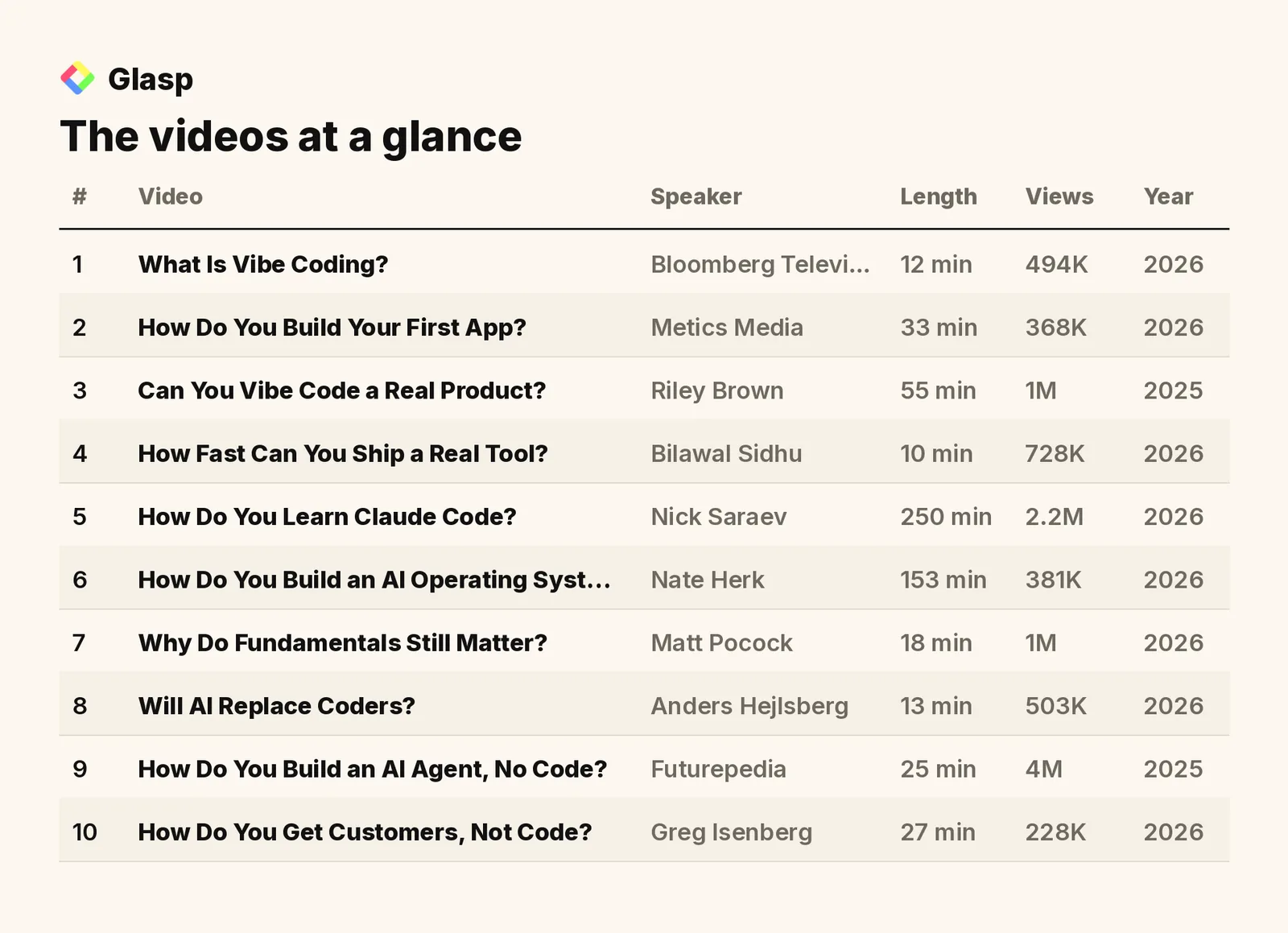
The videos on this list, in the order to watch them, are:
What Is Vibe Coding? (Bloomberg Television)
How Do You Build Your First App? (Metics Media)
Can You Vibe Code a Real Product? (Riley Brown)
How Fast Can You Ship a Real Tool? (Bilawal Sidhu)
How Do You Learn Claude Code? (Nick Saraev)
How Do You Build an AI Operating System? (Nate Herk)
Why Do Fundamentals Still Matter? (Matt Pocock)
Will AI Replace Coders? (Anders Hejlsberg)
How Do You Build an AI Agent, No Code? (Futurepedia)
How Do You Get Customers, Not Code? (Greg Isenberg)
Total: 10 videos, 596 minutes of watch time (about 10 hours), and 10.9M combined views.
1. What Is Vibe Coding?

Bloomberg Television · 12 min · 494K views · 2026
In short: Vibe coding lets non-experts build software by describing what they want to an AI in plain conversational language.
This overview frames the shift before you touch a tool. It explains how conversational programming opens software creation to founders and small business owners, and why professional engineers still matter for quality.
Key takeaways
Vibe coding allows non-experts to create software by interacting with AI in plain language, moving development away from writing syntax by hand.
AI enhances productivity by shifting engineers away from writing code toward project management and quality assurance of the output.
Generative tools like Codex and Gemini automate coding tasks, which has significantly increased activity on platforms like GitHub.
Professional engineers remain crucial for maintaining software quality and robustness, and their role now includes managing AI agents.
Watch on YouTube · Read the summary and Q&A
2. How Do You Build Your First App?

Metics Media · 33 min · 368K views · 2026
In short: You describe your desired features in plain language on a platform like Base44, then test and refine the app through iterations.
This is the hands-on starting point for a complete beginner. It walks through planning, prompting, and refining a working app with logins, payments, and a custom domain, with no coding experience required.
Key takeaways
Vibe coding follows a loop of describing requirements, testing the result, and refining until the app meets expectations.
Base44 offers a free plan with limited credits and a paid plan that adds user authentication and Stripe payments.
The three main categories of vibe coding tools are all-in-one app builders, AI-powered code editors, and AI coding agents.
Vibe coding suits MVPs and internal tools well but faces limitations with complex apps and security concerns.
Watch on YouTube · Read the summary and Q&A
3. Can You Vibe Code a Real Product?

Riley Brown · 55 min · 1M views · 2025
In short: Yes, using only AI tools and five prompts you can clone a real app's core features like recording, transcription, and summaries.
A vibe coder and a senior iOS developer race to clone the notetaker app Granola using only five prompts each. It shows what AI tools can and cannot do under tight constraints, including render errors and API issues.
Key takeaways
Riley Brown and a senior iOS developer each build a clone of the Granola notetaker using AI exclusively and five prompts.
The build targets key features including voice recording, transcription, calendar integration, and AI-generated summaries, all produced through prompting.
Riley uses a tool built for vibe coding mobile apps, while the developer uses Claude Code and Xcode to compete.
Both apps hit problems: folder functionality and API integration break on one side, and render errors appear on the other.
Watch on YouTube · Read the summary and Q&A
4. How Fast Can You Ship a Real Tool?

Bilawal Sidhu · 10 min · 728K views · 2026
In short: In three days, using AI agents and open-source data, one person built a geospatial dashboard combining satellite, CCTV, and flight data.
This case study shows the ceiling of AI-assisted building. WorldView combines live satellite tracking, real-time CCTV, and flight data into an interactive 3D model, built over a weekend with open-source data.
Key takeaways
WorldView combines real-time data sources including satellite tracking, CCTV, and flight data into a single interactive 3D browser model.
The project was built in three days using AI agents and open-source data, showing how quickly complex tools can come together.
Live tracking covers every satellite in orbit and over 6,700 planes, with military flights pulled from ADS-B Exchange.
The build used AI coding tools including Gemini 3.1 and Claude 4.6 to integrate multiple live data feeds into one view.
Watch on YouTube · Read the summary and Q&A
5. How Do You Learn Claude Code?

Nick Saraev · 250 min · 2.2M views · 2026
In short: Set up Claude Code in an IDE, then use a CLAUDE.md project file, sub-agents, and context management to build and ship.
For founders ready to move past app builders, this long course teaches Claude Code from setup through deployment. It covers IDE configuration, sub-agents, and context management for real project work.
Key takeaways
Claude Code automates business tasks and builds applications, run inside an IDE such as Visual Studio Code or Antigravity.
The CLAUDE.md file acts as the project brain, centralizing important configurations and settings for a project.
Sub-agents allow parallel processing, which speeds up tasks like email classification by distributing the workload across agents.
Context management optimizes token usage to prevent context rot and keep prompt handling efficient over long sessions.
Watch on YouTube · Read the summary and Q&A
6. How Do You Build an AI Operating System?
Nate Herk · 153 min · 381K views · 2026
In short: Combine Claude Code with the Three Ms and Four Cs frameworks and connect your tools to automate tasks in one system.
This course systematizes Claude Code into a personal AI operating system. It uses two frameworks to structure setup and connects tools like Google Workspace so tasks run through one coordinated workflow.
Key takeaways
An AI operating system integrates intelligence on top of traditional OS functions to automate tasks and increase productivity.
The Three Ms framework covers mindset, method, and machine, while the Four Cs cover context, connections, capabilities, and cadence.
Skills in Claude Code automate repetitive tasks, and the GWS CLI provides extensive access to Google Workspace for integrations.
Continuous improvement through audits and custom skill development keeps the system effective and adapted to specific workflows.
Watch on YouTube · Read the summary and Q&A
7. Why Do Fundamentals Still Matter?

Matt Pocock · 18 min · 1M views · 2026
In short: AI often fails without strong software design, so good structure, shared design concepts, and TDD make its output more maintainable.
This talk is the counterweight to prompt-and-pray building. It argues software fundamentals matter more in the AI era, because AI works better on codebases that are simple to change and understand.
Key takeaways
Software fundamentals stay crucial in the AI era because they keep code quality high and maintainable as AI generates more of it.
Generating code straight from specifications often results in poor quality, since complexity makes systems hard to modify and understand.
A shared design concept and a ubiquitous language between humans and AI improve collaboration and code clarity.
Test-driven development forces AI to take small steps, which improves code quality and tightens the feedback loop.
Watch on YouTube · Read the summary and Q&A
8. Will AI Replace Coders?
Anders Hejlsberg · 13 min · 503K views · 2026
In short: No, AI handles repetitive tasks but cannot innovate, so humans remain essential for creative problem-solving and designing core systems.
The creator of C# and TypeScript gives a grounded view of where humans fit. He argues AI assists with repetitive coding but cannot replace the creativity needed to design CPUs, operating systems, and frameworks.
Key takeaways
AI is not capable of innovation and requires human input for creativity and new ideas, according to Anders Hejlsberg.
Software engineers remain essential for designing CPUs and operating systems, tasks that AI cannot perform on its own.
Understanding fundamental programming concepts is crucial for coding proficiency, and that knowledge transcends any single language.
Open-source contributions on platforms like GitHub now serve as a modern resume for aspiring tech professionals.
Watch on YouTube · Read the summary and Q&A
9. How Do You Build an AI Agent, No Code?

Futurepedia · 25 min · 4M views · 2025
In short: Set up a brain, memory, and tools on a no-code platform like n8n, then add guardrails to prevent errors.
This shows how vibe coding extends past apps into automation. Using n8n, you assemble a working AI agent with no code that can check calendars or send emails, with guardrails to keep it safe.
Key takeaways
AI agents reason, plan, and take actions autonomously based on given information, unlike automations that only follow predefined steps.
An AI agent consists of three components: the brain, which is a large language model, memory, and tools for external interaction.
Platforms like n8n let users build AI agents without code through a visual interface that connects tools and services.
Guardrails are essential to prevent errors such as incorrect actions or an agent getting stuck in loops.
Watch on YouTube · Read the summary and Q&A
10. How Do You Get Customers, Not Code?
Greg Isenberg · 27 min · 228K views · 2026
In short: Prioritize distribution over product by building MCP servers, using programmatic SEO, and creating viral artifacts to grow an audience first.
Once you can build anything, distribution becomes the hard part. This talk argues founders should grow an audience before finishing the product, and lays out concrete channels AI cannot replicate for you.
Key takeaways
Distribution is the new moat because AI can build the product but cannot build your audience or brand for you.
MCP servers let AI assistants discover your product at zero customer acquisition cost, opening a new distribution channel.
Programmatic SEO can generate large volumes of monthly visitors through many quality pages built for search intent.
Answer engine optimization matters for AI citation and visibility, and viral artifacts encourage users to share your product.
Watch on YouTube · Read the summary and Q&A
Frequently asked questions
What is vibe coding?
Vibe coding is building software by describing the features you want to an AI in plain language, then testing and refining until it works, with little or no manual coding.
Do you need to know how to code to vibe code?
No. Platforms like Base44 and n8n let non-experts build working apps and agents through plain language, though understanding software fundamentals improves the quality of the result.
What tools are used for vibe coding?
Common tools include all-in-one app builders like Base44, AI-powered code editors, AI coding agents, and Claude Code, along with automation platforms like n8n.
Will AI replace software engineers?
According to the creator of C# and TypeScript, no. AI handles repetitive tasks, but engineers remain essential for innovation, design, and maintaining software quality.
Is vibe coding good enough for real products?
Vibe coding suits MVPs, internal tools, and prototypes well, but it faces limitations with complex apps and security, so it often needs engineering oversight for production.
Where should I start with vibe coding?
The best starting point is building one small app end to end rather than studying the tools first, since a first working project teaches the prompt, run, fix loop faster than any tutorial. From there you can move on to bigger builds like a full product or an AI agent.
How long does it take to build something with vibe coding?
A useful tool can be shipped in a single focused session, because the AI handles most of the typing and the person steers the direction. Larger products still take longer, since real users bring edge cases, polish, and maintenance that a first version skips.
What is the difference between vibe coding and no-code tools?
No-code tools assemble features inside a fixed builder, while vibe coding produces actual code you can change, extend, and host wherever you want. Both can get an AI agent or a small product live, but vibe coding leaves you with fewer limits once the idea grows.
What should I do after I build my app with AI?
Getting customers matters more than adding features, because a working app with no users is just a demo. Once building is cheap, the harder and more valuable work is finding people who need the thing and getting it in front of them.
How to use this list
Watch these in order to move from understanding vibe coding to building, shipping, and selling with it. If you are short on time, start with What Is Vibe Coding for the concept, then jump to the beginner's guide to build your first app the same day. Save the longer Claude Code courses for when you are ready to graduate past app builders, and end with the distribution talk once you have something worth shipping.
Related lists
💡 Want summaries and transcripts for any YouTube video? Try YouTube Summary with ChatGPT & Claude.