How to Build an AI Agent Without Coding
TL;DR
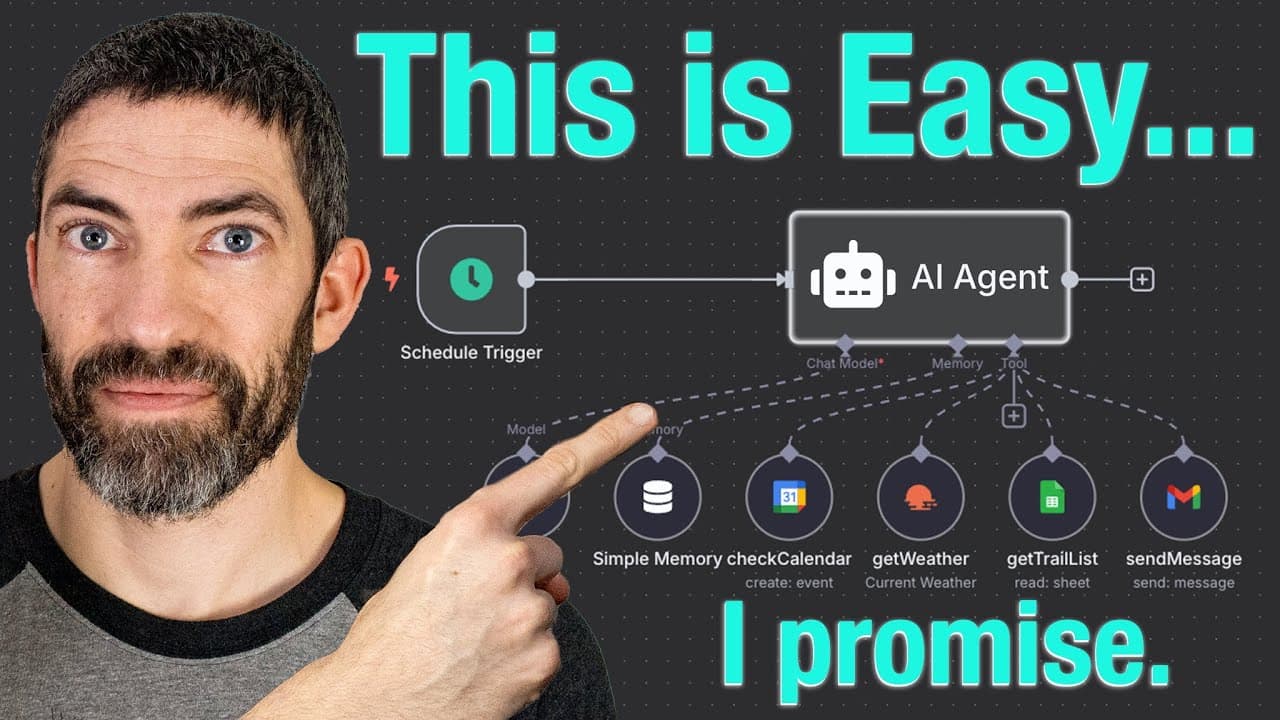
AI agents can autonomously reason, plan, and take actions based on given information, unlike static automations. Building an AI agent involves setting up a brain (language model), memory, and tools for interaction. Using platforms like n8n, you can create a functioning AI agent without coding, capable of performing tasks like checking calendars or sending emails, while setting guardrails to prevent errors.
Transcript
ai agents are one of the most exciting and fast-moving areas of AI they're becoming incredibly powerful and if you've been watching from the sidelines it might feel like you're getting left behind and then you look at some examples or tutorials and they seem way too technical but here's the truth agents are a lot easier to understand than they firs... Read More
Key Insights
- AI agents are systems capable of reasoning, planning, and taking actions autonomously based on provided information.
- Unlike automations, which follow predefined steps, AI agents dynamically adapt and make decisions on the fly.
- AI agents consist of three key components: the brain (large language model), memory, and tools for external interaction.
- Platforms like n8n allow users to build AI agents without coding by using a visual interface to connect different tools and services.
- Guardrails are essential for AI agents to prevent errors, such as incorrect actions or getting stuck in loops.
- APIs and HTTP requests enable AI agents to interact with external systems, fetching or sending data as needed.
- Building a simple AI agent involves connecting a language model, setting up memory, and integrating necessary tools like calendars or email services.
- AI agents can be used for various tasks, from personal assistance to business operations, providing efficiency and automation.
Install to Summarize YouTube Videos and Get Transcripts
Explore YouTube Video Summarizer or Get YouTube Transcript Extractor
Questions & Answers
Q: How do AI agents differ from traditional automations?
AI agents differ from traditional automations in that they can autonomously reason, plan, and take actions based on the information they receive, allowing them to adapt dynamically to changing circumstances. Traditional automations, on the other hand, follow predefined, static steps without the capability for reasoning or adaptation. This makes AI agents more flexible and capable of handling complex tasks that require decision-making.
Q: What are the core components of an AI agent?
The core components of an AI agent include the brain, memory, and tools. The brain is typically a large language model that handles reasoning, planning, and language generation. Memory allows the agent to remember past interactions and use that context for decision-making. Tools enable the agent to interact with the outside world, such as retrieving data, taking actions, or orchestrating workflows.
Q: How can you build an AI agent without coding?
You can build an AI agent without coding by using platforms like n8n, which offer a visual interface for constructing agent workflows. By dragging and dropping nodes, you can connect different tools and services, such as language models, memory systems, and APIs, to create a fully functional AI agent. This approach allows users to focus on the logic and functionality of the agent without needing programming skills.
Q: Why are guardrails important for AI agents?
Guardrails are important for AI agents to prevent errors, such as incorrect actions, getting stuck in loops, or making decisions that could cause harm or unintended consequences. They help ensure that the agent operates within safe and predefined boundaries, especially when interacting with external systems or handling sensitive data. Guardrails are crucial for maintaining the reliability and trustworthiness of AI agents, particularly in business applications.
Q: What role do APIs play in AI agents?
APIs play a crucial role in AI agents by enabling them to interact with external systems and services. Through APIs, agents can retrieve data, send information, and perform actions such as updating databases or sending emails. This interaction allows agents to extend their capabilities beyond their internal logic, making them more versatile and useful for a wide range of tasks.
Q: How do you test and debug an AI agent built on n8n?
To test and debug an AI agent built on n8n, you can use the platform's built-in testing features to run the workflow and observe the output. If errors occur, n8n provides error messages that can be used to diagnose issues. Additionally, tools like ChatGPT can be used to troubleshoot and provide step-by-step guidance on resolving errors, ensuring the agent functions correctly.
Q: What are some practical applications of AI agents?
AI agents have a wide range of practical applications, including personal assistance, customer support, sales automation, research, and data analysis. They can automate routine tasks, provide timely information, and assist in decision-making processes. In business settings, AI agents can improve efficiency, reduce costs, and enhance customer experiences by handling inquiries and performing tasks that would otherwise require human intervention.
Q: How can AI agents be customized for specific tasks?
AI agents can be customized for specific tasks by configuring their components, such as the language model, memory, and tools, to align with the desired functionality. Users can define specific prompts, connect relevant APIs, and set up workflows that cater to particular needs or industries. Customization allows AI agents to be tailored to perform specialized tasks, making them highly adaptable to various use cases.
Summary & Key Takeaways
-
AI agents are digital systems that can autonomously reason, plan, and act based on given information, differing from static automations. They require a brain, memory, and tools to function. Using platforms like n8n, individuals can create AI agents without coding, utilizing APIs for interaction.
-
Building an AI agent involves setting up a language model for reasoning, memory for context retention, and tools for external actions. Guardrails are necessary to prevent errors or unintended actions, making the system reliable for personal or business use.
-
With no coding required, platforms like n8n enable users to visually construct AI agents by connecting various tools and services. These agents can perform tasks like checking calendars or sending emails, offering practical, real-world applications for automation and efficiency.
Read in Other Languages (beta)
Share This Summary 📚
Summarize YouTube Videos and Get Video Transcripts with 1-Click
Try YouTube Summary with ChatGPT & Claude or YouTube Transcript Generator
Explore More Summaries from Futurepedia 📚




Summarize YouTube Videos and Get Video Transcripts with 1-Click
Try YouTube Summary with ChatGPT & Claude or YouTube Transcript Generator