Lattice parameter from molar mass and density - HCP structure
TL;DR
This video explains how to calculate lattice parameters and atomic radii from molar mass and density.
Transcript
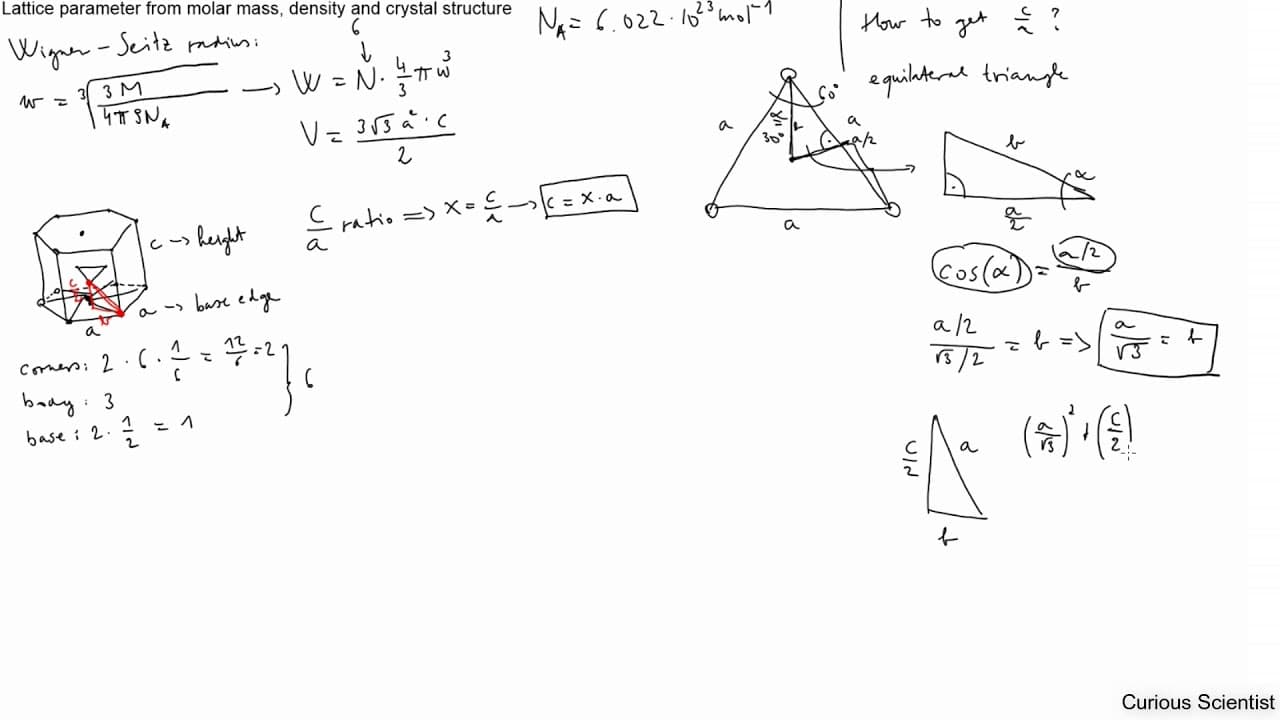
welcome in this video I'm going to show you how to calculate the lattice parameter and atomic radius for exact on or close-packed structure material from the molar mass the density and the crystal structure so we can start with the same old equation which I showed you how to get already in a different video I will put the link in the description so... Read More
Key Insights
- 🦻 Calculating the Wigner Seitz radius helps estimate the average volume per atom in crystal structures, aiding in various material analyses.
- 😚 Understanding the geometric relationships and proportions in hexagonal close-packed structures is essential for accurate calculations of physical properties.
- 🌍 The lattice parameter directly influences several material properties, including density and bonding characteristics, impacting their applications in real-world scenarios.
- 🎮 The video emphasizes the importance of mathematical derivation and geometric visualization in grasping complex material properties.
- 🪡 The example calculation of titanium underscores how theory can differ from practice, stressing the need for contextual awareness in applications.
- 🫀 Knowledge of atomic structure is fundamental in fields like material science, chemistry, and physics, influencing the design of materials with desired properties.
- 💦 The concepts presented are crucial for students and professionals working with solid-state materials and their computational methods in research and applications.
Install to Summarize YouTube Videos and Get Transcripts
Explore YouTube Video Summarizer or Get YouTube Transcript Extractor
Questions & Answers
Q: What is the Wigner Seitz radius, and why is it important?
The Wigner Seitz radius is defined as the radius of a sphere whose volume is equivalent to the average volume occupied by an atom in a crystal structure. It provides insight into the spatial distribution of atoms, allowing for a better understanding of material properties and behaviors in solid-state physics.
Q: How does the C/a ratio factor into calculating lattice parameters?
The C/a ratio is crucial for hexagonal close-packed structures, as it represents the relationship between the height and the base edge of the prism that describes the atomic arrangement. Understanding this ratio allows for accurate calculations of the unit cell dimensions and can significantly influence the derived properties of the material.
Q: What steps are involved in deriving the lattice parameter from the molar mass and density?
The process begins with calculating the Wigner Seitz radius using the molar mass and density. Next, one formulates the lattice volume using equations based on the crystal structure. Finally, applying the C/a ratio helps in expressing the lattice parameter, allowing for the computation of the atomic radius.
Q: Can you explain the significance of using real versus theoretical C/a ratios in calculations?
Theoretical C/a ratios are approximations often used in academic settings for simplicity. However, real ratios can differ due to imperfections in crystal structures. Using actual measured ratios provides more accurate results, which can be particularly important in engineering and materials science applications where precision is critical.
Summary & Key Takeaways
-
The video demonstrates calculations for the Wigner Seitz radius and lattice parameter using molar mass, density, and crystal structure, particularly for hexagonal close-packed materials.
-
Key equations and concepts such as the C/a ratio are explored, showing how to derive these values through geometric considerations and mathematical rearrangements.
-
An example calculation for titanium is provided, illustrating how to obtain the Wigner Seitz radius, lattice parameter, and atomic radius step-by-step.
Read in Other Languages (beta)
Share This Summary 📚
Summarize YouTube Videos and Get Video Transcripts with 1-Click
Try YouTube Summary with ChatGPT & Claude or YouTube Transcript Generator
Explore More Summaries from Curious Scientist 📚




![Building a coil winder [Part 6] - A few improvements thumbnail](/_next/image?url=https%3A%2F%2Fi.ytimg.com%2Fvi%2F3eyxG_g2iUA%2Fhqdefault.jpg&w=750&q=75)

Summarize YouTube Videos and Get Video Transcripts with 1-Click
Try YouTube Summary with ChatGPT & Claude or YouTube Transcript Generator