How to Prioritize Problems and Grow a Business

TL;DR
Fix the most consequential problem already affecting your business before pursuing imagined opportunities. Sustainable growth comes from prioritizing the weakest link, hiring people who raise the team’s average, building valuable skills that limit downside, and repeatedly delivering strong customer experiences rather than chasing urgency, novelty, or virality.
Transcript
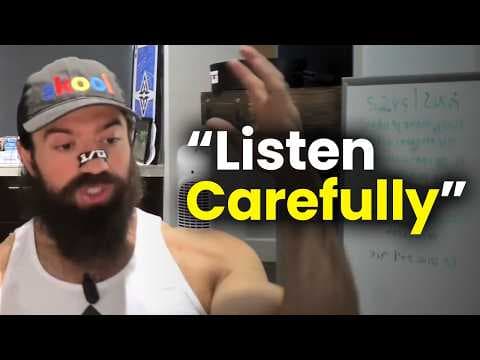
Here's 14 years of business advice in 60 seconds. Sell to the rich until you have the money to sell to all the poor people. The middle is where you get killed. You lack priorities, not information. Most times it's not that you lack insight, it's that you're solving the wrong thing. Business as a whole will only be as strong as its weakest link. You... Read More
Key Insights
- Existing business problems are often the best opportunities for growth because fixing them strengthens what already works. Pursuing a new opportunity while ignoring a current weakness divides attention, adds unfamiliar problems, and reduces the bandwidth available to make either initiative succeed.
- Prioritization is the discipline of addressing the most consequential issue before less important fires. A business will never be free of problems, so leaders must accept that some issues will continue burning while limited time, money, and attention are directed toward the weakest link.
- Effective strategy is the curation and prioritization of all available opportunities, not merely choosing among options already visible. Deconstrained thinking first considers what outcome is genuinely desirable, then compares broader possibilities and selects the one that matters most.
- Business risk becomes more manageable when valuable skills create a strong fallback. Sales and marketing capabilities can improve the worst-case outcome, allowing an entrepreneur to pursue larger opportunities without assuming that reckless commitment or high motivation can compensate for inadequate preparation.
- Strong employees bring the best workable solution they can devise instead of finding a new problem with every proposal. Constructive teammates show their reasoning, accept imperfect choices, and place their own ideas in front of the group for evaluation and criticism.
- A durable brand is an association between something an audience already understands and something unfamiliar. What a company says matters, and what other people say also matters, but customers’ direct experiences create the strongest association and should support truthful, achievable promises.
- Virality is not required to build a valuable brand because repeated demonstrations of expertise can earn trust from a specific audience. Educational content should show that a business can solve a defined problem and guide attention toward relevant products or services.
- Exceptional results come from many strong improvements rather than one miraculous tactic. Concentrated work on a single high-quality asset can create more value than spreading effort across many mediocre outputs, because audiences seek value per second rather than simply more seconds of material.
- More videos from this channel:
- More from this channel: MoreMozi
Install to Summarize YouTube Videos and Get Transcripts
Explore YouTube Video Summarizer or Get YouTube Transcript Extractor
Questions & Answers
Q: How should entrepreneurs prioritize problems when everything feels urgent?
Entrepreneurs should rank issues by consequence rather than treating every request as equally urgent. The transcript compares this process to triage: an engine on fire matters more than a flickering cabin light, just as a heart attack takes precedence over a broken ankle. Limited resources must go toward the problem that most threatens or constrains the business, while less important fires are temporarily allowed to burn.
Q: Why should a business fix existing problems before chasing new opportunities?
Existing problems are opportunities to strengthen a business that already has customers, systems, and momentum. A new opportunity may look attractive, but it also brings problems that are not yet visible. Pursuing it while an existing weakness remains unresolved creates more problems and leaves less attention for each one. A useful test is whether an issue is a real problem requiring action or merely a missed opportunity that currently exists only as an idea.
Q: What separates exceptional entrepreneurs from other business owners?
Exceptional entrepreneurs consider a wider range of possible outcomes and then prioritize the most important one. The transcript contrasts this with opening a refrigerator and choosing only from what happens to be inside. Better strategy begins by deciding what result is actually wanted, surveying the broader set of potential options, and deliberately selecting among them. This combination of curation, prioritization, and deconstrained thinking can produce major differences in performance.
Q: How can entrepreneurs take large risks without being reckless?
Large risks become more reasonable when an entrepreneur develops skills that create an acceptable fallback. The transcript describes sales and marketing abilities as backstops that can generate income or support another attempt if a venture fails. Knowing the worst-case result is survivable can encourage bigger swings. By contrast, quitting a stable job without savings or business skills may create serious damage, because motivation alone does not guarantee the ability to execute.
Q: What employee behavior is a red flag in business?
A major red flag is repeatedly producing problems for every proposed solution without offering a stronger alternative. Every practical choice is imperfect, so teams need people willing to propose the best workable option, explain their reasoning, and expose their own ideas to criticism. Someone who only critiques from the sidelines makes decisions harder. Someone who consistently contributes solutions helps the organization move forward despite uncertainty and tradeoffs.
Q: Do businesses need viral content to build a strong brand?
Businesses do not need viral content to build a strong brand. Repeatedly demonstrating expertise over time can show a specific audience that the business understands and can solve its problem. A highly viewed clip may produce little lasting value if attention does not become trust, followers, customers, or sales. For many companies, educational content is more relevant than entertainment because it naturally connects useful expertise with products and services.
Q: How does customer experience affect a company’s brand?
Customer experience is the strongest of the three brand signals identified in the transcript: what the company says, what other people say, and what customers experience directly. Businesses should therefore state facts, tell the truth, and avoid promises they cannot keep. When delivery supports the message, the brand can improve advertising returns, support prices above the broader market, and encourage customers to buy repeatedly.
Q: Should content creators focus on quality or quantity?
The transcript proposes combining quality and volume, described internally as “qualume,” while favoring capture over manufacturing. The broader principle is to organize real business activity so useful expertise can be captured deliberately, rather than posting everything indiscriminately or manufacturing endless disconnected material. Quality still matters because audiences want value per second. Concentrated effort on one exceptional piece can outperform producing many mediocre pieces that offer little useful information.
Summary & Key Takeaways
-
Business growth depends on identifying the weakest link and solving the most consequential real problem first. New opportunities often introduce additional problems while diverting attention from existing weaknesses. Effective prioritization requires accepting that some issues will remain unresolved temporarily because limited resources must be concentrated where they produce the greatest leverage.
-
Strong teams are built by hiring ahead of current needs and choosing people who raise the organization’s average capability. Excessive rules can indicate weak standards or poor hiring. Productive teammates contribute workable solutions, accept that every available option has drawbacks, and put their own recommendations forward instead of merely criticizing other people’s ideas.
-
A durable brand grows through demonstrated expertise, honest claims, and customer experiences that confirm what the company promises. Virality is unnecessary for most businesses, especially those using educational content to sell products or services. Consistent quality, useful information, and satisfied customers can turn attention into trust, repeat purchases, and stronger pricing power.
Read in Other Languages (beta)
Share This Summary 📚
Summarize YouTube Videos and Get Video Transcripts with 1-Click
Try YouTube Summary with ChatGPT & Claude or YouTube Transcript Generator
Explore More Summaries from MoreMozi 📚




Summarize YouTube Videos and Get Video Transcripts with 1-Click
Try YouTube Summary with ChatGPT & Claude or YouTube Transcript Generator