Why Does China Claim the South China Sea?
TL;DR
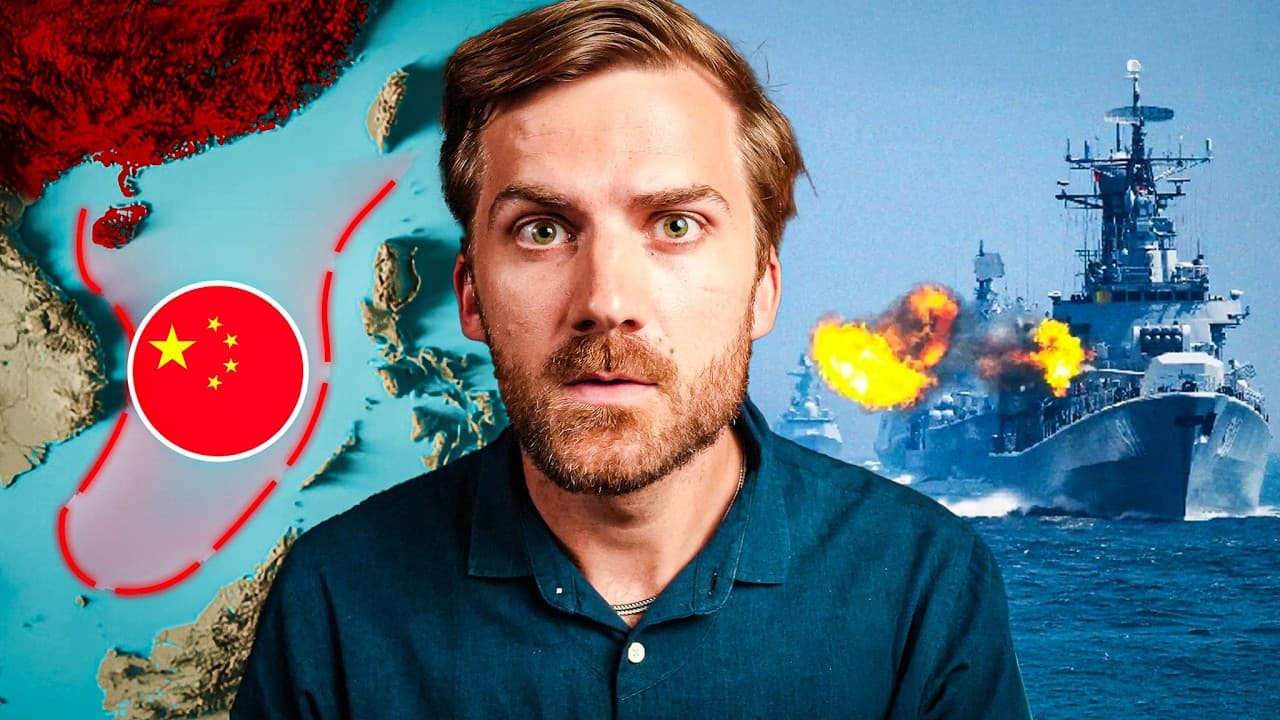
China claims most of the South China Sea by combining evidence of centuries-old Chinese navigation with postwar acts of possession, strategic concerns, and expected resources. The Republic of China strengthened this narrative in 1946 by sending naval ships to major islands and placing a Chinese flag on a Spratly Island. Read on to see how trade routes, colonial expansion, World War II, and competing claims shaped this position.
Transcript
(bright music) - Look at this map of the most disputed water in the world. It's a sea that is claimed in part by seven countries. - [Reporter 1] Tensions are rising in one of the most hotly contested regions on the planet, the South China Sea. - Including one that no one likes to talk about. This sea is peppered with tiny islands, most of which loo... Read More
Key Insights
- Seven countries dispute the sea: The South China Sea is claimed in part by seven countries and is described as one of the world’s most contested regions. The dispute concerns not only open water but also tiny islands, rocks, and sunken reefs. Governments build bases on these features and even create islands where none previously existed.
- China claims nearly everything: China’s position covers basically the entire South China Sea, not merely several isolated islands. The explanation presented combines four elements: historical contact, postwar state action, strategic territory, and hoped-for resources. China also promotes a story connecting these elements for both its domestic population and the wider world.
- The merchant map has limits: The early 1600s map establishes detailed Chinese knowledge of maritime routes and important island groups. It supports the conclusion that Chinese merchants participated in extensive regional trade. It does not, however, demonstrate that the Chinese state owned the islands, administered them, or maintained a resident population there.
- Artifacts establish visits, not rule: Chinese pottery, bowls, and coins found on the islands provide physical evidence that Chinese travelers reached and used them. Merchants sheltered there when weather deteriorated and fished in nearby waters. Because nobody lived on the islands and the empire showed no interest in claiming them, the objects alone do not establish sovereignty.
- Initial neglect reflected low value: Before imperial competition transformed the region, the islands appeared to be little more than rocks in the ocean. The Chinese empire did not see enough value to claim them formally. This earlier indifference matters because it separates historical awareness and practical use from the later political assertion that the territory belonged to China.
- French expansion altered the dispute: France’s colonial project in Indochina created a new confrontation with China and changed how governments evaluated nearby islands. When France asserted ownership during the 1930s, China and Japan reacted angrily. The claims helped turn previously neglected features into symbols of control and potential instruments of regional influence.
- Strategists watched small islands: Officials and strategic thinkers in Britain, Paris, and the United States considered who would control the South China Sea’s small islands. Their attention reflected a broader shift in perception. Features once dismissed as unimportant could affect access and military reach when incorporated into the plans of expanding states.
- Japan explored military applications: Japanese surveys considered whether particular islands could function as seaplane harbors or submarine docks. These possible uses made the islands more than markers on a map. They could become operational positions supporting movement and control across a large sea, even though many were only small rocks or reefs.
- World War II changed calculations: Japan’s wartime expansion brought almost the entire South China Sea coastline under one power for the first time described in the transcript. That concentration of control exposed the region’s strategic value. Afterward, governments understood that leaving an island unclaimed could allow a competitor to occupy and use it.
- Vietnam combined two arguments: Southern Vietnam based its position on the proximity of many disputed islands to Vietnam and on France’s earlier formal claims. This reasoning emerged while Vietnam was divided and experiencing an independence movement. Its case therefore joined geography with an asserted inheritance from the former colonial power.
- Freedomland complicated Philippine claims: A Filipino businessman declared the Free Territory of Freedomland after claiming to have discovered a cluster of 53 islands. He occupied them for about 90 days, while the claim technically remained for roughly two decades. The Philippine government later ended his claim and tried to use it as support for its own ownership.
- The 1946 mission asserted possession: During China’s civil war, the nationalist Republic of China dispatched its navy to several major islands. The naval ships had been supplied by the United States to support the nationalists. By placing a Chinese flag on a Spratly Island in 1946, the government converted a historical narrative into a visible act of state possession.
Install to Summarize YouTube Videos and Get Transcripts
Explore YouTube Video Summarizer or Get YouTube Transcript Extractor
Questions & Answers
Q: Why does China claim most of the South China Sea?
China supports its claim with a combination of historical navigation, archaeological objects, postwar acts of possession, strategic interests, and hoped-for resources. An early 1600s merchant map shows Chinese trade routes and important island groups, while pottery, bowls, and coins show that Chinese travelers visited the islands. World War II then demonstrated that these rocks and reefs could provide valuable strategic positions, encouraging governments to claim them before competitors did. In 1946, the Republic of China reinforced its position by sending naval ships to major islands and planting a Chinese flag on a Spratly Island.
Q: Does early Chinese navigation prove ownership of the islands?
No, the evidence presented shows Chinese activity but does not prove ownership or occupation. Merchants and explorers knew the islands, sheltered near them during bad weather, and fished in the surrounding waters. Archaeologists also found Chinese pottery, bowls, and coins, but nobody lived on the islands permanently. The distinction matters because knowledge, trade, and temporary use are different from state administration or continuous possession.
Q: What does the early Chinese merchant map establish?
The map was commissioned by a wealthy Chinese merchant around the early 1600s, or possibly earlier. It depicts the South China Sea in surprisingly accurate detail and traces trade routes from China’s eastern coast through Southeast Asia and Indonesia toward the Indian Ocean. Its inclusion of important island groups demonstrates that Chinese merchants knew the region and incorporated it into extensive maritime networks. It establishes trading patterns, but it does not establish that China owned or occupied the islands.
Q: Why did the islands become strategically important?
The islands gained strategic importance when imperial competition intensified in the 1930s and during World War II. France claimed islands after colonizing Indochina, while Japan surveyed locations that might serve as seaplane harbors or submarine docks. Japan later controlled almost the entire coastline of the South China Sea, showing how scattered positions could contribute to regional dominance. Governments consequently feared that islands left unclaimed would be occupied and used by rival powers.
Q: How did World War II reshape the South China Sea claims?
World War II transformed the islands from largely neglected rocks into recognized strategic positions at a major crossroads. Japan took many of them and made the South China Sea effectively a Japanese-controlled area by dominating almost all of its coastline. After the United States defeated Japan, Japan had to give up the territories it had conquered during the war. The resulting vacuum produced a scramble because regional governments believed that failing to claim an island would leave it available to someone else.
Q: How did southern Vietnam justify its claims?
Southern Vietnam argued that many of the disputed islands were close to Vietnam. It also pointed to the fact that France, Vietnam’s former colonial ruler, had formally claimed islands in the region. This position developed while Vietnam was divided and undergoing an independence movement. The claim therefore combined geographic proximity with an attempt to inherit earlier French assertions of ownership.
Q: What was the Free Territory of Freedomland?
The Free Territory of Freedomland was a self-declared country created by a Filipino businessman. He claimed to have discovered a cluster of 53 islands and occupied them for about 90 days. Although the physical occupation was brief, his claim technically continued for roughly two decades. The Philippine government eventually forced him to relinquish it and attempted to use the earlier private claim to support Philippine ownership.
Q: What did the Republic of China do after World War II?
During China’s civil war, the nationalist Republic of China sent naval forces to several of the largest islands. The ships used for the mission had been supplied by the United States to support the nationalists. In 1946, the expedition placed a Chinese flag on a Spratly Island to assert that the territory belonged to China. This act mattered because it added a concrete postwar assertion of possession to the older evidence of maps, navigation, fishing, and artifacts.
Summary & Key Takeaways
-
Early maritime activity: A Chinese merchant map commissioned around the early 1600s, or possibly earlier, depicts the South China Sea and trading routes extending from China’s eastern coast through Southeast Asia and Indonesia toward the Indian Ocean. It also shows important island groups in surprisingly accurate detail. Chinese merchants and explorers stopped near these islands during bad weather, fished around them, and left pottery, bowls, and coins. However, nobody lived there permanently, and this activity did not establish ownership or occupation.
-
Colonial competition changes priorities: France’s colonization of Indochina, now Vietnam, brought it into direct conflict with China. During the 1930s, France claimed ownership of islands in the South China Sea, angering both China and Japan. The islands and surrounding water consequently gained strategic importance for expanding empires. Thinkers in Britain, Paris, and the United States began considering who might control these small positions and what that control could mean for power across the wider region.
-
Japan demonstrates strategic value: By the late 1930s, Japan was rapidly taking territory across the region, including many South China Sea islands. Japanese planners surveyed possible uses for the islands, including seaplane harbors and submarine docks. During World War II, Japan controlled almost the entire coastline surrounding the sea, making it effectively a Japanese-controlled area. This wartime experience demonstrated that scattered rocks and reefs could become valuable positions at an important international crossroads when supported by a powerful military.
-
Postwar claims begin multiplying: The United States eventually defeated Japan and forced it to relinquish territories conquered during the war, including South China Sea islands. Governments then scrambled to claim positions that World War II had shown to be strategically important. China invoked old maps and Chinese artifacts, while southern Vietnam relied on geographic proximity and claims inherited from France. The Philippines initially made no claim while establishing its independence, but a Filipino businessman soon declared a separate state across a cluster of 53 islands.
-
Modern possession takes shape: The businessman called his claimed state the Free Territory of Freedomland and occupied its islands for about 90 days, although the claim technically continued for roughly two decades. The Philippine government later forced him to relinquish it and attempted to use that private claim to support Philippine ownership. Meanwhile, during China’s civil war, the nationalist Republic of China sent United States-supplied naval ships to major islands. In 1946, its forces planted a Chinese flag on a Spratly Island.
Read in Other Languages (beta)
Share This Summary 📚
Summarize YouTube Videos and Get Video Transcripts with 1-Click
Try YouTube Summary with ChatGPT & Claude or YouTube Transcript Generator
Explore More Summaries from Johnny Harris 📚





Summarize YouTube Videos and Get Video Transcripts with 1-Click
Try YouTube Summary with ChatGPT & Claude or YouTube Transcript Generator