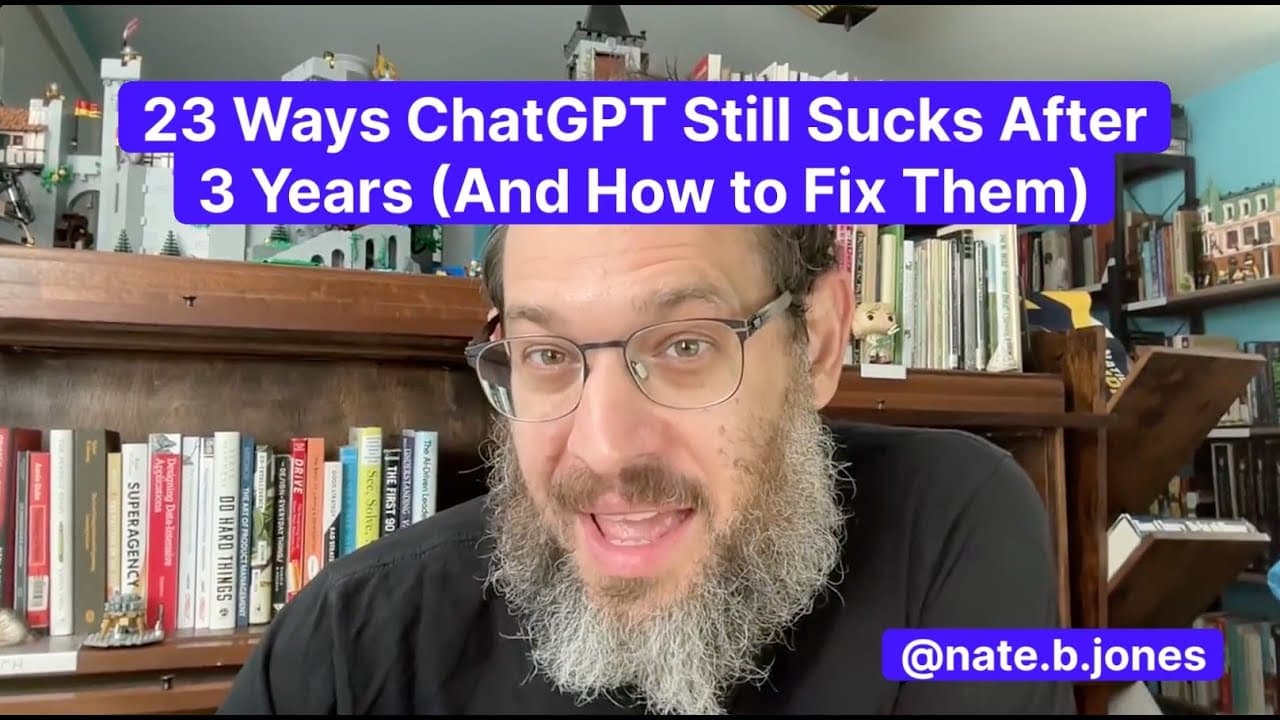
What Are 23 Ways ChatGPT Still Sucks After 3 Years, and How Can They Be Fixed?
TL;DR
ChatGPT’s biggest workflow problems can be fixed by turning chat into a collaborative workbench that converts ideas into work people can ship. The 23 proposed improvements include granular sharing, branching, dynamic intent controls, reliable exports, visible tasks, automatic updates, source validation, editable memory, privacy controls, and better retrieval. Read on to see how these changes could replace copy-paste ping-pong with a more usable workflow.
Transcript
I have spent a ton of time talking about chat bots, chat GPT, Claude, Gemini. I've also spent a lot of time giving advice to builders who are trying to work on embedding AI in their products. But there's one thing I haven't done yet, and that's what we're going to do today. I have not talked about how I would improve the chatbot experience. If you ... Read More
Key Insights
- Current chatbot collaboration is largely confined to one user and the AI, which forces teams into copy-paste exchanges. Message selection, granular links, permissions, comments, live co-editing, and threaded branches would make conversations function more like shared workspaces.
- Branching is essential for experimentation because trying a new direction can overwrite or disrupt the original work. Users should be able to create alternatives, compare them side by side, preserve prior versions, and merge successful changes into the main thread.
- Effective intent capture should begin with an approximate request rather than demanding perfect prompting. A chatbot could convert the gist into a clean specification and generate checkboxes or other controls that help users confirm important variables before execution.
- Agenticness should be adjustable according to the task. Users may want coaching, quick conversational loops, direct action, or extended autonomous work, but current personality controls focus more on temperament than on the model's level of initiative and productivity.
- Chatbot answers become harder to ship when exports damage headings, code blocks, and other formatting. A dependable export layer for tools such as Docs and Notion would reduce the time users spend repairing content after the model has produced it.
- Action items should be treated as structured work rather than ordinary chat messages. Deadlines and reminders could be highlighted and placed into a calendar view, while a separate read-only publishing page could present selected results without exposing the entire working conversation.
- Automated maintenance should respond when sources or subject areas change. Scheduled agents need more control, proactive notifications, and dynamic updates, while refreshed chats, artifacts, and code should show differences instead of forcing users to reread complete outputs.
- Trust depends on visible sources, controllable memory, and safer handling of sensitive material. Users should be able to inspect citation lists, validate URLs, see which memories influenced a conversation, remove irrelevant memories, add useful ones, and understand privacy and cost implications.
Install to Summarize YouTube Videos and Get Transcripts
Explore YouTube Video Summarizer or Get YouTube Transcript Extractor
Questions & Answers
Q: How can ChatGPT’s biggest workflow problems be fixed?
ChatGPT should function more like a collaborative workbench that helps people turn ideas into work they can ship. The proposed fixes include granular sharing, conversation branches, intent controls, reliable exports, structured tasks, automatic updates, source validation, editable memory, privacy controls, and better retrieval.
Q: How can chatbot collaboration be improved?
Users should be able to select specific messages, link directly to relevant sections, and grant view, comment, or edit access. Shared threads should support live co-editing, comments, typing indicators, suggestion modes, and branches that can reconnect to the main conversation.
Q: Why do ChatGPT conversations need branching?
Branching would let users try a new angle without wrecking the original conversation or artifact. Alternative versions should remain connected to their starting point, appear side by side for comparison, and allow useful changes to be merged back into the main thread.
Q: How could chatbots understand user intent more effectively?
A chatbot could accept an approximate request and turn it into a clean specification before doing the work. Dynamically generated checkboxes could guide users through relevant variables, reducing the need to write pages of precise prompting.
Q: What is an agenticness control for a chatbot?
An agenticness control would let users decide how independently the chatbot operates for a particular task. It could shift between coaching, short collaborative loops, direct action, and extended autonomous work instead of adjusting only temperament or conversational style.
Q: How can chatbot outputs become easier to ship?
Exports should preserve headings, code blocks, and other formatting when content moves into destinations such as Docs and Notion. Chatbots should also extract action items, highlight deadlines and reminders, provide a calendar view, and publish selected results on a clean read-only page.
Q: How should AI agents keep work updated automatically?
Agents should monitor relevant sources, recognize changes, refresh affected work, and notify the user proactively. Users need control over scheduled activity, while updated chats, artifacts, and code should display differences from prior versions instead of requiring a complete reread.
Q: How can users verify chatbot sources and control memory?
The chatbot should expose its citation list, support copying citations in markdown, and validate whether cited URLs are real. It should also show which memories influenced a conversation and let users remove, edit, or add memories while providing clearer privacy and cost information.
Summary & Key Takeaways
-
Current chatbot conversations isolate the user and AI, making teamwork depend on copying and pasting. The proposed alternative includes message-level links, permissions, comments, live co-editing, threaded discussions, branching, side-by-side comparisons, and merging, so collaborators can explore alternatives without destroying the original conversation or sharing an entire messy thread.
-
Chatbots also make users work too hard to communicate intent and refine outputs. Dynamic interfaces could translate an approximate request into a clean specification, expose relevant checkboxes, offer one-tap revisions, and let users control whether the model coaches, collaborates in short loops, or works autonomously for an extended period.
-
Turning answers into durable work requires reliable exports, visible action items, stakeholder-ready publishing, automatic refreshes, and clear differences between versions. Trust and reuse also depend on inspectable citations, editable memories, privacy controls, cost visibility, smart organization, pinning, deep search, version history, and consistent control over tone.
Read in Other Languages (beta)
Share This Summary 📚
Summarize YouTube Videos and Get Video Transcripts with 1-Click
Try YouTube Summary with ChatGPT & Claude or YouTube Transcript Generator
Explore More Summaries from AI News & Strategy Daily | Nate B Jones 📚






Summarize YouTube Videos and Get Video Transcripts with 1-Click
Try YouTube Summary with ChatGPT & Claude or YouTube Transcript Generator