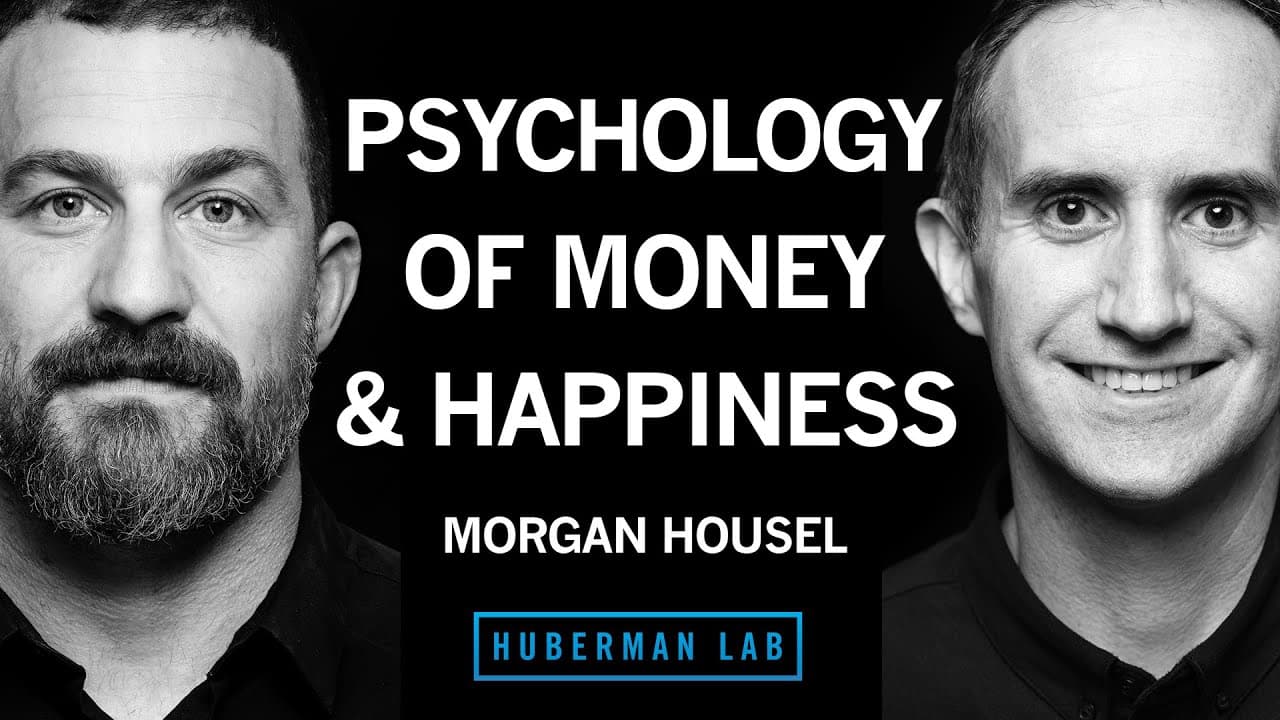
How to Apply The Psychology of Money for Greater Happiness | Morgan Housel
TL;DR
Money supports greater happiness by buffering stress and creating the freedom to live according to your personal goals. Morgan Housel explains that people often save too much or spend too much, while the deeper value of wealth is independence rather than endless accumulation. Aligning your pursuit of money and career with what you genuinely want can produce a healthier relationship with both. Read on for practical questions that can clarify that alignment.
Transcript
welcome to the huberman Lab podcast where we discuss science and science-based tools for everyday life I'm Andrew huberman and I'm a professor of neurobiology and Opthalmology at Stanford School of Medicine my guest today is Morgan howel Morgan howel is a partner at the collaborative fund and an expert in private wealth generation a... Read More
Key Insights
- Money affects our psychology by altering our perception of freedom and happiness.
- People often lie at extremes of saving too much or spending too much.
- Money cannot directly buy happiness, but it can buffer stress and provide freedom.
- True financial freedom involves aligning money management with personal values.
- Social media and wealth signaling can distort our internal reward circuits.
- Using money as a measure of self-worth or career progress is psychologically dangerous.
- Healthy financial habits involve balancing spending, saving, and personal goals.
- Understanding one's future regrets can guide better financial decisions.
Install to Summarize YouTube Videos and Get Transcripts
Explore YouTube Video Summarizer or Get YouTube Transcript Extractor
Questions & Answers
Q: How does money affect happiness and freedom?
Money cannot buy happiness directly, but it can buffer stress and provide freedom. Morgan Housel describes that freedom as independence, while warning that someone constantly pursuing wealth is not truly free or independent.
Q: What is the main lesson of Morgan Housel's The Psychology of Money?
The discussion presents money as a tool whose real value lies in reducing stress and supporting freedom, independence, and personal goals. It also argues that people often frame and pursue money incorrectly, especially when their financial behavior does not match what they genuinely want.
Q: Can money buy happiness?
Money cannot buy happiness, according to the discussion. It can nevertheless buffer stress and create the independence needed to organize life around meaningful personal goals.
Q: What common mistakes do people make when saving or spending money?
Many people fall at one of two extremes: saving too much or spending too much. A healthier approach is to examine whether financial choices and the pursuit of wealth actually match personal goals.
Q: Why can constantly pursuing wealth undermine financial freedom?
The discussion defines freedom primarily as independence. If a person is constantly pursuing more wealth, that pursuit itself can prevent the person from feeling genuinely free or independent.
Q: How can people improve their relationship with money?
Morgan Housel recommends asking probing questions about money, career, wealth, and happiness. Answering them can help make a person's relationship with money and pursuit of it more clearly match their particular goals.
Q: How should money and career fit into a person's life?
Money and career should be organized around a person's goals rather than treated as ends in themselves. The discussion connects a healthier approach to feeling happy, independent, and freer from stress.
Q: What psychological stance supports healthier wealth management?
Money is best viewed as a means of supporting freedom and personal goals, not as something to pursue endlessly. Avoiding the extremes of oversaving and overspending can help keep financial behavior aligned with the life a person actually wants.
Summary & Key Takeaways
-
Morgan Housel discusses how money impacts our psychology, emphasizing its role in providing freedom and reducing stress rather than directly buying happiness. He explains that many people mismanage money by either oversaving or overspending, failing to align their financial habits with personal values and goals.
-
The conversation explores the dangers of using money as a measure of self-worth or career success, noting that social media and wealth signaling can distort our internal reward systems. Housel suggests that true financial freedom comes from using money to support one's life purpose and psychological well-being.
-
Practical tools for smarter financial decisions are provided, including understanding future regrets and avoiding extreme financial behaviors. The discussion highlights the importance of aligning money management with personal values to enhance happiness and life satisfaction.
Read in Other Languages (beta)
Share This Summary 📚
Summarize YouTube Videos and Get Video Transcripts with 1-Click
Try YouTube Summary with ChatGPT & Claude or YouTube Transcript Generator
Explore More Summaries from Andrew Huberman 📚






Summarize YouTube Videos and Get Video Transcripts with 1-Click
Try YouTube Summary with ChatGPT & Claude or YouTube Transcript Generator