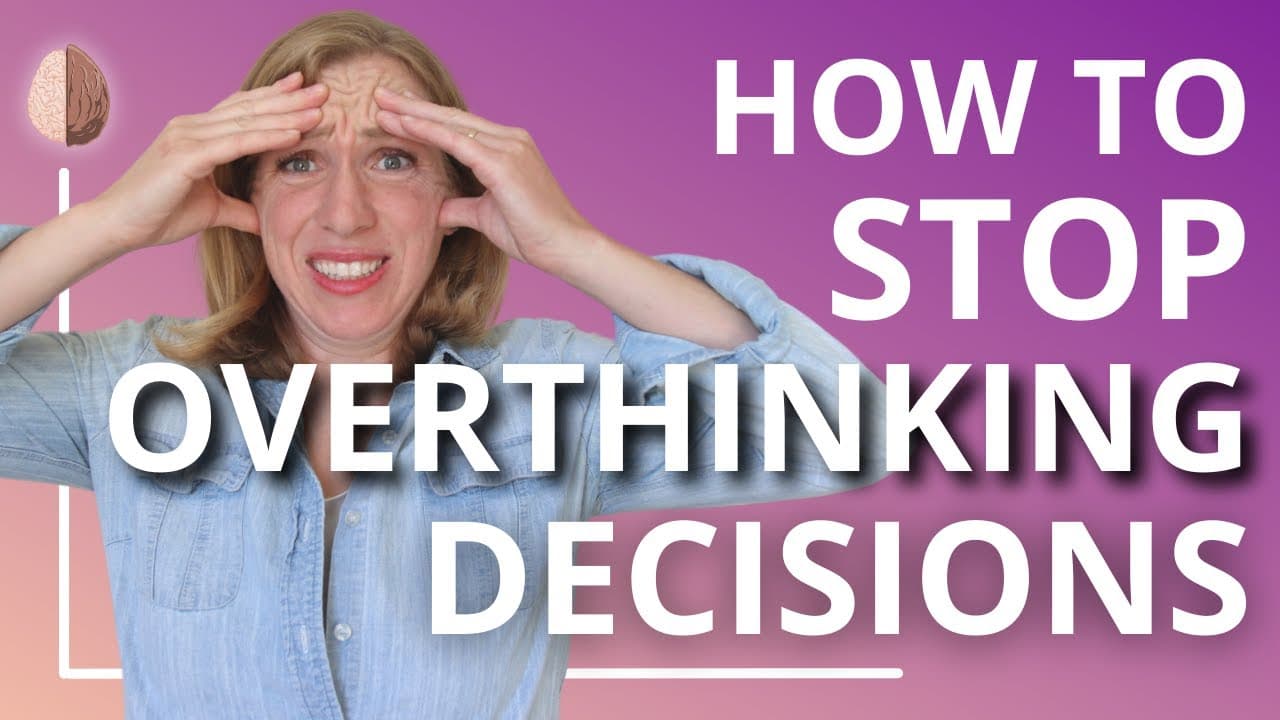
How to Overcome Decision Paralysis and Stop Overthinking
TL;DR
To overcome decision paralysis, start by regulating your emotions and facing fears associated with decision-making. Accept that no decision is perfect and practice tolerating imperfection. Building resilience and appreciating the good outcomes of your choices can help reduce overthinking and enhance confidence in making decisions.
Transcript
When you get overwhelmed by making a choice, when you can't decide between A and B, you often settle for C or you end up paralyzed, procrastinating, or making no decision at all. In this video you'll learn the three underlying causes of decision paralysis and two keys to overcoming it. And I'll give you a hint: it has to do with emotion r... Read More
Key Insights
- 😨 Decision paralysis is often caused by an abundance of choices, fear of disappointment, and struggles with executive functioning.
- 🥺 Having too many options can paradoxically lead to dissatisfaction and an increased fear of making the wrong decision.
- 😨 Regulating emotions, such as facing fears and accepting imperfection, is crucial in overcoming decision paralysis.
- 🖐️ Executive functioning plays a significant role in decision-making, and challenges in this area can further contribute to decision paralysis.
- 👋 Tolerating imperfect decisions and celebrating good decisions can boost confidence and reduce overthinking.
- 💁 Avoiding decisions or procrastinating is a form of risk avoidance, which can perpetuate decision paralysis.
- 🤩 Building resilience and accepting uncertainty are key in making decisions and moving forward.
Install to Summarize YouTube Videos and Get Transcripts
Explore YouTube Video Summarizer or Get YouTube Transcript Extractor
Questions & Answers
Q: How does having too many options lead to decision paralysis?
Having a plethora of options can lead to dissatisfaction and constant second-guessing, as individuals feel the pressure to make the perfect choice among countless alternatives.
Q: How can regulating emotions help overcome decision paralysis?
By identifying fears and visualizing how one could manage the worst-case scenarios, individuals can reduce the emotional barriers that prevent them from making decisions and accept that no decision is perfect.
Q: What are the key aspects of executive functioning that contribute to decision paralysis?
Executive functioning, which includes working memory, organization, planning, prioritization, and self-control, can be impaired in individuals with depression, anxiety, or ADHD, making it difficult to process and evaluate complex tasks.
Q: How can individuals become more comfortable with making imperfect decisions?
By understanding that avoiding decisions ultimately leads to a lack of control and disappointment, individuals can learn to embrace the discomfort and tolerate imperfect outcomes, building resilience in decision-making.
Summary & Key Takeaways
-
Many individuals struggle with decision paralysis, where they are unable to make choices due to fear of making the wrong decision or being overwhelmed by options.
-
Three underlying causes of decision paralysis include the abundance of choices in the modern world, difficulties in emotion regulation, and challenges with executive functioning.
-
To overcome decision paralysis, it is important to appreciate the paradox of having too many options, regulate emotions by facing fears and tolerating imperfection, and develop resilience in making decisions.
Read in Other Languages (beta)
Share This Summary 📚
Summarize YouTube Videos and Get Video Transcripts with 1-Click
Try YouTube Summary with ChatGPT & Claude or YouTube Transcript Generator
Explore More Summaries from Therapy in a Nutshell 📚




Summarize YouTube Videos and Get Video Transcripts with 1-Click
Try YouTube Summary with ChatGPT & Claude or YouTube Transcript Generator