Why Is Stack Overflow Dying From AI Mistakes?
TL;DR
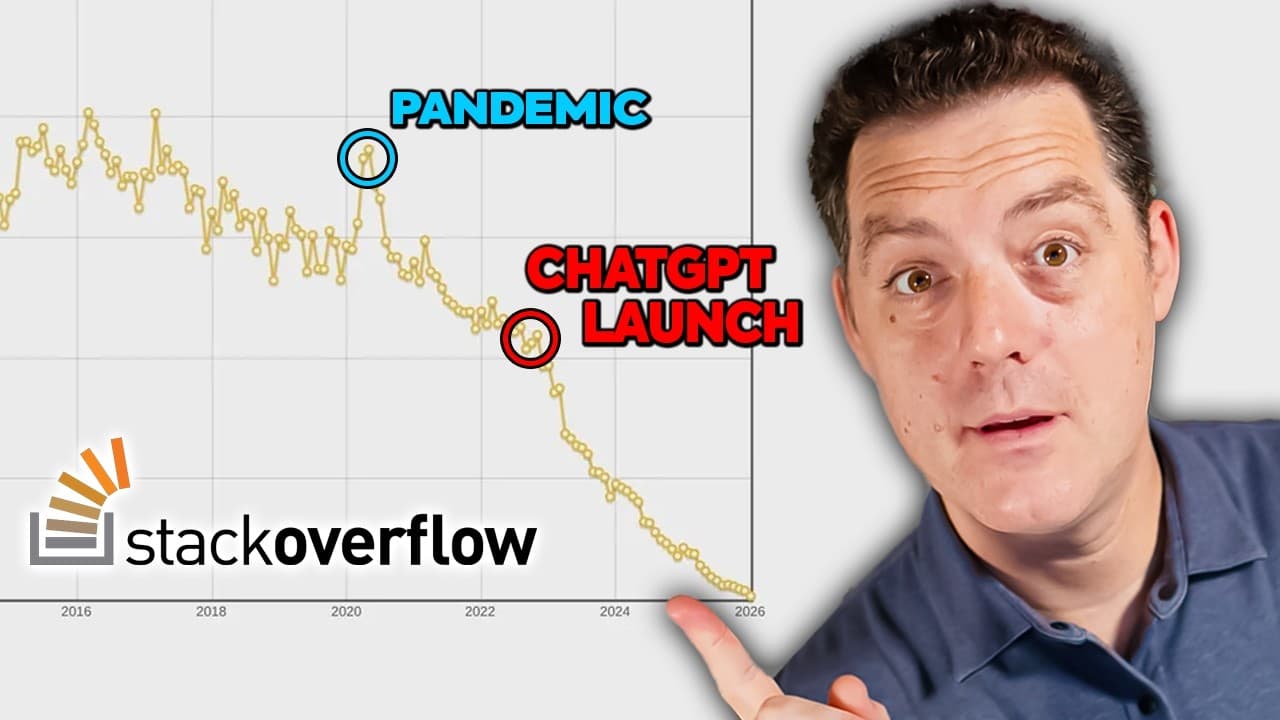
Stack Overflow is losing relevance as AI tools train on its data, reducing the need for its Q&A hub. The video argues that AI like ChatGPT has decimated usage, and even founders benefited before decline; a self-undermining loop may be forming as models reuse public data.
Transcript
Pour one out for Stack Overflow. Stack Overflow is basically dead at this point. And honestly, that's kind of sad. It's been the go-to place for developers when they have questions or bugs and they can't figure something out. Stack Overflow has been the community. You go there, you post your question, you post your bug, and other developers try to ... Read More
Key Insights
- Stack Overflow is described as effectively dead due to AI disruption and changing developer workflows.
- AI training data from Stack Overflow is a core factor in how models learn coding solutions, amplifying the disruption.
- ChatGPT and similar AI tools launched in late 2022 and rapidly reduced Stack Overflow usage.
- The data from Stack Overflow was public and indexed, facilitating AI models to train on it without explicit permission.
- Founders sold Stack Overflow in 2021 for a large sum, then the platform declined as AI took over.
- AI agents reduce the need for nitty-gritty coding questions by automating much of the work.
- The video compares the decline of Stack Overflow to Blockbuster, illustrating rapid disruption by streaming and AI.
- Dell sponsorship and the ebook of 50 AI use cases are cited as part of the AI ecosystem context.
Install to Summarize YouTube Videos and Get Transcripts
Explore YouTube Video Summarizer or Get YouTube Transcript Extractor
Questions & Answers
Q: A real search query question about the video (e.g. 'How to...', 'What is...', 'Why does...', 'When should...'). Question 1
Why does the video claim Stack Overflow is dying due to AI disruption, and how does it relate to the way developers now work with AI tools and code generation? The answer is that AI training on Stack Overflow data reduces the hub’s usefulness as models learn from public answers and then automate or bypass the need to post questions, leading to fewer new questions and slower growth for the site. This cycle is described as self-undermining because the data source that powered the models becomes less valuable as the models get better at solving problems without human interaction.
Q: Question 2
How did ChatGPT affect Stack Overflow usage according to the video, and what does this imply about developer behavior? The video states that ChatGPT launched at the end of 2022 and devastated Stack Overflow usage, implying developers shifted to AI assistants for coding help rather than posting on the site. This suggests a behavioral shift where immediate AI-generated guidance replaces traditional Q&A engagement, reducing crowd-sourced answers and the rate of new questions.
Q: Question 3
What is the Blockbuster analogy used in the video to describe Stack Overflow’s decline, and what does it illustrate? The analogy compares Stack Overflow’s decline to Blockbuster’s fall with the rise of Netflix. It illustrates how new technology and business models can abruptly replace a dominant platform, even one that was a cultural cornerstone, emphasizing how quickly disruption can occur in tech ecosystems.
Q: Question 4
What about the data rights and training data concerns mentioned in the video? The video notes that Stack Overflow’s data was public and indexed by Google, which allowed AI companies to train models on it. This feeds a cycle where the same data fuels improvements in AI, which then reduces human usage of Stack Overflow, potentially undermining future data growth for the site.
Q: Question 5
What is the significance of the founders selling Stack Overflow in 2021 according to the video? The video highlights that the founders sold Stack Overflow for about 1.8 billion dollars before the AI surge, illustrating how a major tech asset can change hands just before disruptive technologies reshape the market, underscoring a broader narrative of rapid technology-driven disruption.
Q: Question 6
How do AI agents influence how developers write and debug code, based on the video? AI agents can write and fix code, reducing the need to Post nitty-gritty bugs on Stack Overflow. This leads to fewer detailed questions on the platform and shifts developer learning toward AI-assisted workflows, changing the traditional path of seeking human advice for debugging.
Q: Question 7
What other AI-related content does the video promote, and why is it relevant? The video promotes a free ebook with 50 real-world AI use cases and sponsorships for AI hardware like Dell Pro Max workstations, which situates Stack Overflow’s decline within a broader AI adoption landscape and highlights resources helping professionals leverage AI in their work.
Q: Question 8
What is the overall message about the future of traditional search and Q&A sites in the video? The message is that traditional Q&A hubs like Stack Overflow are likely to be eaten by AI-enabled search and assistance, as AI changes how people obtain coding help, learn, and train, suggesting a broader shift in how information is sourced online and how communities around coding evolve.
Summary & Key Takeaways
-
Stack Overflow's role as a go-to Q&A hub for developers is fading as AI models ingest its data. The video frames this as a systemic shift where AI tools reduce reliance on traditional coding help sites and could accelerate their own obsolescence. The narrative uses a Blockbuster analogy to illustrate sudden disruption.
-
The video notes that Stack Overflow data became public and was used to train models, which in turn diminishes the need for the site as developers turn to AI for fixes and guidance. It also highlights how the founders sold the company just before the AI surge, signaling a broader tech disruption.
-
A broader point is that AI agents handle coding tasks, reducing the depth of Bugs discussed on Stack Overflow and changing how developers learn and solve problems, while a real-world ebook and hardware sponsorships illustrate the growing AI ecosystem driving this shift.
Read in Other Languages (beta)
Share This Summary 📚
Summarize YouTube Videos and Get Video Transcripts with 1-Click
Try YouTube Summary with ChatGPT & Claude or YouTube Transcript Generator
Explore More Summaries from Matthew Berman 📚






Summarize YouTube Videos and Get Video Transcripts with 1-Click
Try YouTube Summary with ChatGPT & Claude or YouTube Transcript Generator