AS5600 magnetic position encoder - best encoder for stepper motors
TL;DR
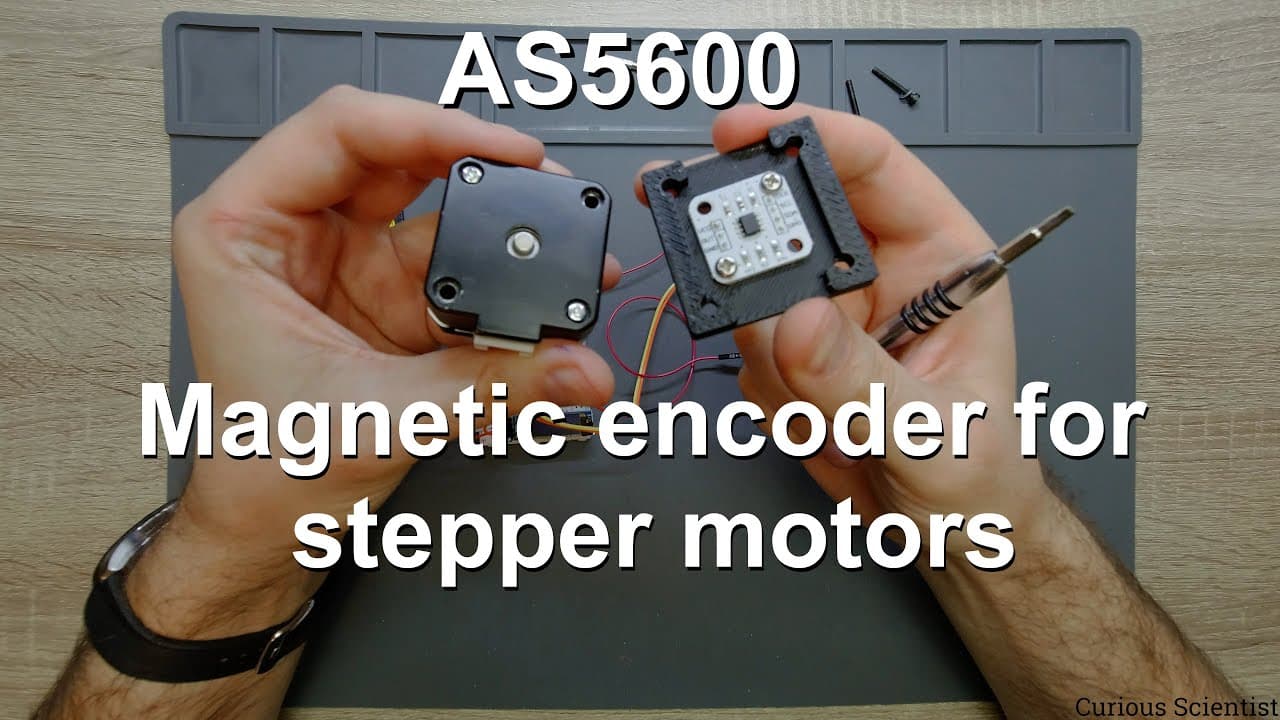
This video explains the AS5600 magnetic rotary position sensor and its applications.
Transcript
welcome everyone in this video i'm going to show you another type of encoder and this time it is the as5600 magnetic rotary position sensor so it is this tiny chip here i covered this pcb with a small piece of captain tape but it's just a small white pcb two by two centimeters and it has seven pins as you can see for us now it is only four pins whi... Read More
Key Insights
- 🧘 The AS5600 sensor utilizes Hall effect technology to achieve precise angular position detection, making it ideal for applications requiring rotational measurement.
- ✋ Featuring a 12-bit conversion, the sensor offers high resolution in feedback, enabling fine control in mechanical systems when paired with stepper motors or servo mechanisms.
- 😒 Effective use of the AS5600 involves understanding the characteristics of the magnet required, including its diametric magnetization for optimal sensor performance.
- 🎨 The I²C interface simplifies the integration of multiple sensors with microcontrollers, facilitating a more modular design approach in electronic projects.
- 📡 Practical implementation may require troubleshooting to address common issues such as sensor misalignment and noise interference in data signals.
- 👨💻 Accurate coding techniques are essential for converting raw sensor data into meaningful positional values, incorporating exploration of quadrants and turns in angular measurements.
- ♓ The AS5600's potential for versatility is enhanced by the ability to interface with various microcontrollers beyond the Arduino platform, including STM32 and Raspberry Pi.
Install to Summarize YouTube Videos and Get Transcripts
Explore YouTube Video Summarizer or Get YouTube Transcript Extractor
Questions & Answers
Q: What is the primary function of the AS5600 magnetic rotary position sensor?
The AS5600 sensor's main function is to accurately measure angular position using magnetic fields. With its integrated Hall effect sensors, it detects the magnetic fields produced by a specially designed magnet, translating this into precise digital values, facilitating various applications in robotics, automation, and more.
Q: How does the I²C interface work with the AS5600 sensor?
The I²C (Inter-Integrated Circuit) interface allows the AS5600 to communicate with microcontrollers using just two wires: SDA (data line) and SCL (clock line). This makes it easier to connect multiple devices and manage them since all communicate over the same data and clock lines without needing separate connections for each device.
Q: What are the implications of using a magnet with diametric magnetization in this sensor?
Using a diametrically magnetized magnet is crucial for the AS5600's operation. The magnet is oriented such that its north and south poles are on the cylindrical sides, which allows the sensor to detect the exact angle of rotation based on the varying proximity and alignment of these poles during rotation.
Q: How is angular position converted into digital values with the AS5600?
The AS5600 contains a 12-bit ADC (Analog-to-Digital Converter) that converts the magnetic field readings into digital values. This results in 4096 distinct positions, with each step representing an angular resolution of approximately 0.08789 degrees, translating the magnetic changes into precise positional data.
Q: What practical applications can this sensor be used for?
The AS5600 sensor can be used in various applications, including robotics for precise motor positioning, CNC machines for accurate milling or cutting, and other automated systems requiring angle detection such as joystick controllers and steering wheels.
Q: What challenges arise when integrating the AS5600 with microcontrollers like Arduino?
Challenges include ensuring proper alignment of the magnet with the sensor, managing I²C communication effectively, dealing with potential signal noise causing inaccurate readings, and writing efficient software to interpret the data and provide real-time feedback on angular position.
Q: How did the presenter demonstrate the sensor's capabilities in the video?
The presenter showcased the AS5600 sensor by assembling it with an Arduino Nano and an OLED display, displaying angular position changes in real-time as the shaft connected to a stepper motor was rotated, effectively illustrating the sensor's functionality and precision.
Q: What coding considerations are important for using the AS5600 with Arduino?
Important coding considerations include implementing effective I²C communication for reading positional data, managing interrupts to ensure timely updates without overload, and incorporating logic to handle negative angle corrections when transitioning between quadrants in angular measurements.
Summary & Key Takeaways
-
The AS5600 magnetic rotary position sensor operates using I²C communication, powered by a 5V source and capable of precise angular measurements.
-
Utilizing a specialized magnet with diametrically magnetized poles, it achieves high resolution of 0.08789 degrees across 4096 digital positions.
-
Practical implementation involves connecting the sensor to microcontrollers like the Arduino Nano while managing code for reading and displaying positional data efficiently.
Read in Other Languages (beta)
Share This Summary 📚
Summarize YouTube Videos and Get Video Transcripts with 1-Click
Try YouTube Summary with ChatGPT & Claude or YouTube Transcript Generator
Explore More Summaries from Curious Scientist 📚

![Building a coil winder [Part 6] - A few improvements thumbnail](/_next/image?url=https%3A%2F%2Fi.ytimg.com%2Fvi%2F3eyxG_g2iUA%2Fhqdefault.jpg&w=750&q=75)
Summarize YouTube Videos and Get Video Transcripts with 1-Click
Try YouTube Summary with ChatGPT & Claude or YouTube Transcript Generator