What Are the Three Types of Life Problems?
TL;DR
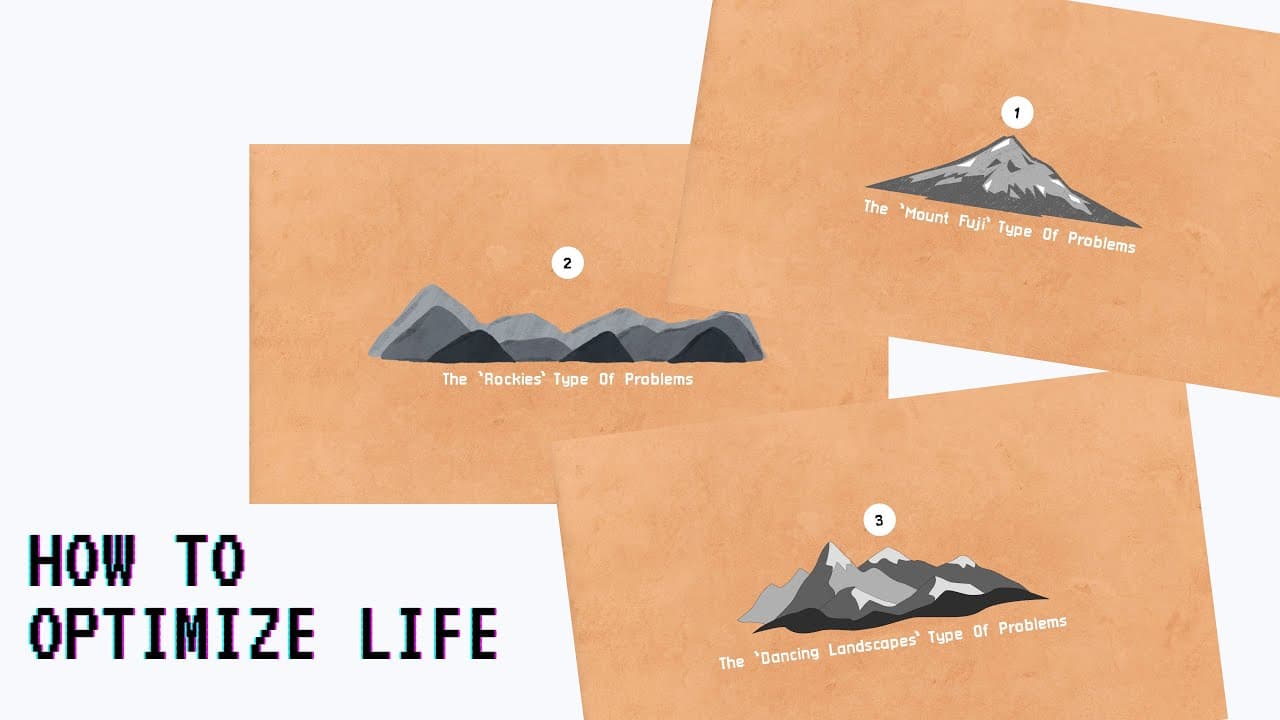
There are three types of life problems: Mount Fuji, Rockies, and Dancing Landscapes. Mount Fuji problems have a clear path to optimization, Rockies involve multiple paths with uncertainties, and Dancing Landscapes are dynamic and influenced by interdependencies with others. Understanding which type you're facing aids in effectively navigating and simplifying complex decisions.
Transcript
there are three types of problems in life according to complexity scientist Scott E page and they are the mount fujis the Rockies and the dancing Landscapes if paralysis by analysis is what's holding you back like it is for me then knowing these types of three problems and which one you're facing helps you not only know one whether you can't optimi... Read More
Key Insights
- 🛟 Differentiate life problems into Mount Fuji, Rockies, and Dancing Landscapes.
- ⚾ Optimization varies based on the type of problem: clear path, multiple uncertainties, or dynamic interactions.
- ❓ Interdependencies with others influence decision-making in Dancing Landscapes.
- 🅰️ Simplifying complexities through reframing and understanding the problem type is crucial.
- 😀 Decision-making in life requires adaptability and recognizing the nature of the problem faced.
- 🤔 Scott E Page's framework helps in strategic thinking and navigating complexities effectively.
- ❓ Reframing problems can simplify even complex Dancing Landscapes into manageable Mount Fuji-like challenges.
Install to Summarize YouTube Videos and Get Transcripts
Explore YouTube Video Summarizer or Get YouTube Transcript Extractor
Questions & Answers
Q: What are the three types of life problems according to Scott E Page?
Scott E Page categorizes life problems as Mount Fuji, Rockies, and Dancing Landscapes, each with distinct characteristics impacting optimization strategies and complexity.
Q: How does understanding the type of problem one is facing help in decision-making?
Knowing whether you're dealing with a straightforward Mount Fuji problem, a complex Rockies problem, or a dynamic Dancing Landscape problem allows for tailored optimization strategies and navigating uncertainties effectively.
Q: How do interdependencies play a role in the Dancing Landscapes type of problem?
In Dancing Landscapes, interdependencies with others' actions create dynamic challenges where peaks can become valleys and vice versa, necessitating constant adaptation and making decisions more complex.
Q: What is the key takeaway from Scott E Page's classification of life problems?
The key takeaway is to identify which type of problem you're dealing with, simplify complexities based on that understanding, and optimize decision-making strategies accordingly.
Summary & Key Takeaways
-
Scott E Page classifies life problems into three types: Mount Fuji (clear path to optimization), Rockies (multiple paths with uncertainties), and Dancing Landscapes (dynamic, interdependent problems).
-
Each problem type requires different optimization strategies and understanding of interdependencies.
-
Knowing which type of problem you're facing helps in simplifying complexities and making informed decisions.
Read in Other Languages (beta)
Share This Summary 📚
Summarize YouTube Videos and Get Video Transcripts with 1-Click
Try YouTube Summary with ChatGPT & Claude or YouTube Transcript Generator
Explore More Summaries from Vicky Zhao [BEEAMP] 📚



Summarize YouTube Videos and Get Video Transcripts with 1-Click
Try YouTube Summary with ChatGPT & Claude or YouTube Transcript Generator