How to Build an AI Second Brain in Obsidian
TL;DR
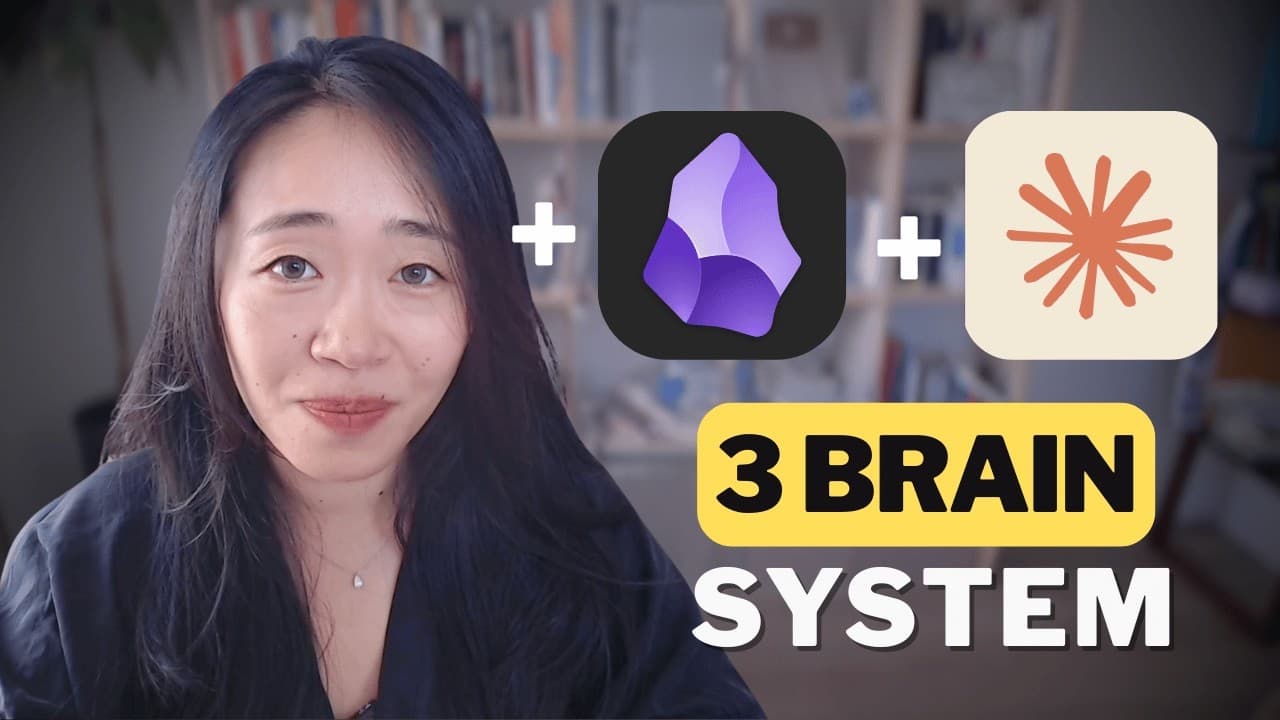
Build an AI second brain in Obsidian by separating human thinking from AI-assisted doing while using shared, curated context to support both. The framework assigns three distinct roles: the human brain handles difficult thinking and judgment, the AI brain executes structured workflows, and the shared second brain preserves useful knowledge. Read on to see how this division improves clarity, trust, and productivity.
Transcript
There are now three brains that we have access to. We have the human brain. We have, let's draw our human here. We have the AI brain, so to speak. Let's do a little robot. We'll make it friendly. And then we have the shared second brain. And to me, this is really obsidian. Hopefully, that kind of looks like obsidian. All right. So, I want to talk a... Read More
Key Insights
- The human brain is responsible for difficult thinking that depends on experience, curiosity, taste, and judgment. Preserving some cognitive friction helps people strengthen critical thinking, improve memory, develop mental models, and generate distinct interpretations instead of outsourcing their most valuable reasoning.
- The AI brain is best used for doing structured work, including following workflows, coding, and completing repetitive knowledge tasks. Its value comes from translating human thinking into practical output, while its hallucinations and weaker judgment make it unsuitable as a replacement for core human reasoning.
- A shared second brain is the context layer that supports both human thinking and AI execution. It stores information that may be difficult for human memory to retrieve and supplies curated knowledge that helps an AI agent work beyond the general information contained in its language model.
- A useful second brain is a tool for thought that improves cognitive ability rather than merely storing information. By returning to active ideas, connecting notes, and examining concepts over time, a person can deepen understanding and create insights that would be harder to maintain in limited memory.
- Curated personal context improves AI output because it can contain reliable, relevant, or privately developed information that is absent from the internet. The AI agent performs better when its work is grounded in selected notes and frameworks instead of relying only on its broad underlying model.
- Human-created notes and AI-generated output should remain separate because they have different levels of authorship and trust. Separation makes it clear which ideas were personally developed or reviewed and which materials were produced automatically in the background but have not yet been checked.
- Thinking and doing should occupy distinct spaces because project management and task lists can distract from demanding intellectual work. A dedicated thinking area supports research, analysis, connection-making, and insight generation, while a separate doing area supports workflows, projects, and finished work output.
- A simple Obsidian setup can begin with two folders: one for human thinking and another for AI-assisted doing. In an established vault, the same distinction can be maintained by keeping normal thinking notes separate from a dedicated AI context folder containing project-specific materials.
Install to Summarize YouTube Videos and Get Transcripts
Explore YouTube Video Summarizer or Get YouTube Transcript Extractor
Questions & Answers
Q: How do you build an AI second brain in Obsidian?
Create separate spaces for human thinking and AI-assisted doing, with Obsidian serving as the shared context layer. A new vault can start with two folders: one for personal thinking and one for AI context, workflows, projects, and output. This boundary keeps unreviewed AI material from being confused with trusted human ideas.
Q: What are the three brains in this system?
The framework consists of the human brain, the AI brain, and a shared second brain. The human brain handles difficult thinking, the AI brain performs structured work, and the shared second brain stores the context required by both. In this setup, Obsidian serves as that shared second brain.
Q: What responsibilities should remain with the human brain?
The human brain should retain deep thinking, curiosity, taste, judgment, interpretation, and the creation of mental models. Working through intellectual friction can improve critical thinking, memory, and understanding. The framework therefore advises against outsourcing the thinking that is central to human cognitive development.
Q: What work should the AI brain handle?
The AI brain is best suited to doing structured work, including coding, following workflows, and completing repetitive knowledge tasks step by step. It can translate human thinking into practical output and increase productivity. Because it can hallucinate or miss the real point, it should not replace human judgment.
Q: Why does AI need a shared second brain?
A shared second brain supplies curated context that may not exist in an LLM or on the internet. That context can include personal ideas, selected knowledge, and project-specific materials. Giving AI this relevant information helps it produce more useful work than relying only on its general model.
Q: Why should human notes and AI-generated output remain separate?
Human notes and AI output have different authorship, credibility, and review status. Personal notes may have been read and considered, while an AI agent can generate material in the background that nobody has checked. Separating them prevents provisional AI output from appearing trustworthy or personally endorsed.
Q: Why should thinking and doing occupy different spaces in Obsidian?
Thinking requires sustained attention for research, analysis, connecting notes, and developing insights. Doing involves tasks, workflows, project management, and finished output, which can interrupt that intellectual work. Separate spaces give each mode a clear purpose and protect focused thinking from operational distractions.
Q: How does a shared second brain improve human thinking?
A shared second brain stores active ideas that are difficult to hold in limited short-term memory or retrieve later from long-term memory. Returning to those notes helps a person examine concepts, build connections, and think more critically over time. Its value comes from improving cognitive ability, not merely storing information.
Summary & Key Takeaways
-
The three-brain framework assigns distinct responsibilities to human thought, AI execution, and shared context. Human thinking draws on experience, curiosity, taste, and judgment. AI handles structured workflows and repetitive knowledge work. A shared second brain supports both by preserving relevant information that memory or a general language model may not reliably retrieve.
-
A second brain should function as a tool for thought that improves and protects cognitive ability. Recording active ideas makes it possible to revisit work, form connections, and think more critically. Curated personal context also helps AI agents produce more relevant work than they can generate from the language model's general information alone.
-
The proposed Obsidian structure separates thinking from doing and human work from AI output. Human notes belong in a dedicated thinking space, while AI context and project materials belong in a doing space. This protects focused analysis, prevents unreviewed AI content from appearing authoritative, and gives each digital space a clear purpose.
Read in Other Languages (beta)
Share This Summary 📚
Summarize YouTube Videos and Get Video Transcripts with 1-Click
Try YouTube Summary with ChatGPT & Claude or YouTube Transcript Generator
Explore More Summaries from Vicky Zhao 📚



Summarize YouTube Videos and Get Video Transcripts with 1-Click
Try YouTube Summary with ChatGPT & Claude or YouTube Transcript Generator