How to Explain Complex Ideas With Clear Frameworks
TL;DR
Start by stating the bottom line, clarifying what you will not cover, and connecting abstract ideas to familiar examples. Keep attention through surprise, complication, and resolution, then highlight unfamiliar concepts, explain them through multiple modes, spell out why they matter, and scaffold each new idea on knowledge the audience already has.
Transcript
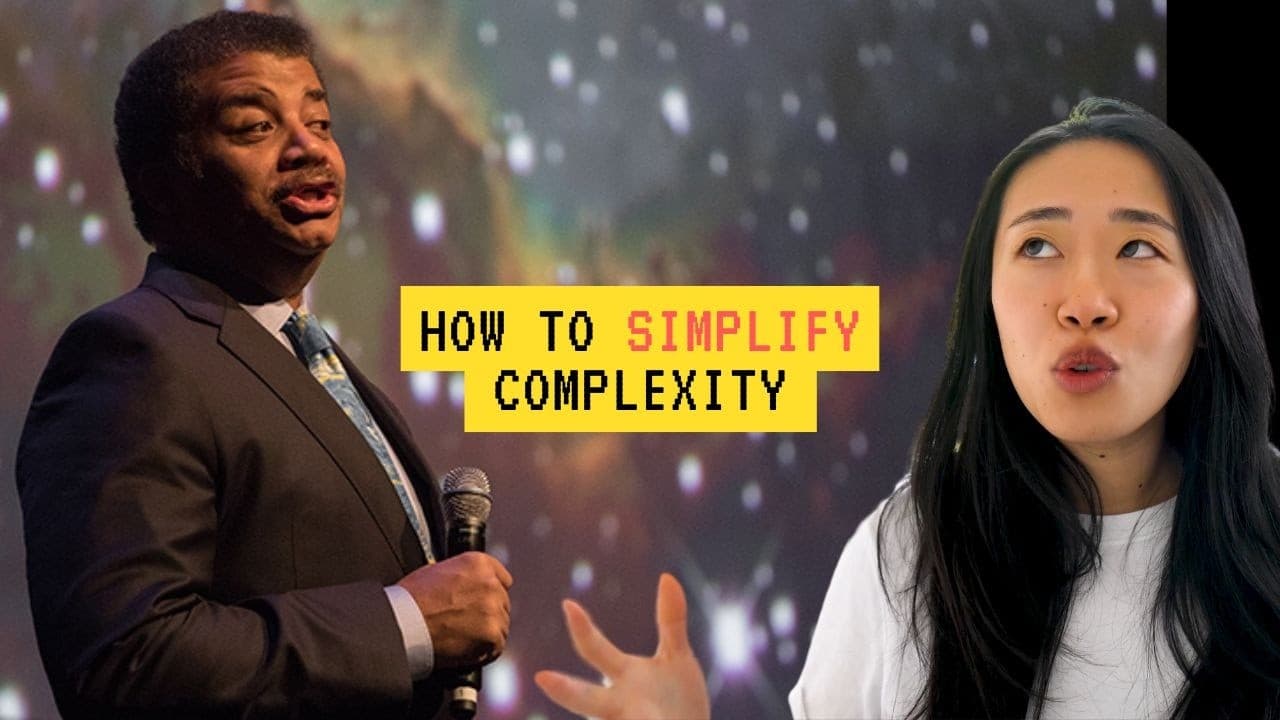
I have been binging on Neil deGrasse Tyson's Star Talk YouTube channel since I got sick two weeks ago. For those of you who don't know, he's an astrophysicist known for taking big, complex, and often boring topics and making them really easy to understand and engaging. Of course, as I was binging on these videos, I couldn't help but notic... Read More
Key Insights
- Bottom Line Up Front is a framework for immediately telling the audience what the explanation will cover. It gives listeners direction before details arrive, helping them understand the purpose of the discussion and providing a clear frame for interpreting everything that follows.
- Via negativa clarifies an explanation by stating what will not be discussed. Neil deGrasse Tyson separates the astrophysical three-body problem from its depiction in a streaming show, defining the scope quickly and assuring viewers that the explanation will not spoil the show.
- Concrete examples make abstract subjects easier to approach. Instead of beginning with classical mechanics, hypothetical concepts, or models of particles, the explanation starts with the familiar Moon and Earth, giving the audience recognizable objects and motions on which to build new understanding.
- Starting from the middle places listeners directly inside a relevant problem. A presentation does not always need the complete historical path, the preliminary research, or every discovery in sequence. Beginning where the interesting conflict appears helps the audience maintain direction and recognize what deserves attention.
- Surprise, complication, and resolution form a three-part attention framework. The communicator first challenges a familiar belief, then introduces the more demanding explanation, and finally supplies a satisfying conclusion. This sequence captures attention before asking the audience to spend mental energy on unfamiliar material.
- Key concepts require visible emphasis rather than equal treatment. The center of mass receives special attention because many viewers may not understand it. Highlighting the unfamiliar term tells listeners where to concentrate instead of presenting several ideas with no indication of their relative importance.
- Multiple modes of explanation increase the chance of understanding. The center of mass is described verbally, represented with moving graphics, labeled with text, and demonstrated through physical movements of the globe and Moon. Each mode reinforces the same relationship from a different direction.
- The so-what framework states the consequence of newly presented information. After explaining that Earth and the Moon orbit a shared center of mass, the explanation adds that the moving center causes Earth to jiggle. This prevents learners from having to infer significance while still processing the concept.
- More videos from this channel:
- More from this channel: Vicky Zhao
Install to Summarize YouTube Videos and Get Transcripts
Explore YouTube Video Summarizer or Get YouTube Transcript Extractor
Questions & Answers
Q: How can I explain a complex idea more clearly?
Begin with the bottom line so listeners know what you intend to explain, then define anything you are deliberately leaving outside the discussion. Replace abstract terminology with familiar objects or situations, highlight the concepts the audience is unlikely to know, and state why each new fact matters. Build toward the difficult idea in manageable stages instead of presenting every technical detail at once.
Q: What is the Bottom Line Up Front framework?
Bottom Line Up Front is a communication framework that states the main purpose or conclusion before supporting details. In the analyzed example, Neil deGrasse Tyson immediately says he will provide an astrophysical explanation of the three-body problem. That opening gives the audience a destination, establishes the subject, and makes the details that follow easier to organize and interpret.
Q: How does via negativa improve a presentation?
Via negativa improves clarity by identifying what the presentation will not do. The example excludes discussion of how the three-body problem appears in a streaming show and therefore defines the scope of the explanation. This technique can remove uncertainty, distinguish the intended topic from a related one, and help the audience focus on the specific perspective being presented.
Q: Why should a presentation start with a concrete example?
A concrete example reduces the mental effort created by abstract language. Terms involving mechanics, models, particles, or hypothetical concepts can make listeners feel distant from a subject. Starting with the Moon and Earth provides recognizable objects, movements, and relationships. The communicator can then introduce a less familiar idea, such as their shared center of mass, using that familiar foundation.
Q: What does it mean to start a presentation from the middle?
Starting from the middle means entering the explanation at a relevant and interesting problem instead of recounting every event that preceded it. Neil deGrasse Tyson does not begin with the discovery of gravity or a story about Newton. He starts with how the Moon and Earth move, giving the audience an immediate question and a clear reason to follow the explanation.
Q: How does the surprise, complication, and resolution framework work?
The framework begins by challenging something the audience believes, such as the statement that the Moon simply orbits Earth. It then introduces the complication that both bodies orbit a common center of mass. Finally, it resolves the loop by naming this as a two-body problem that can be solved with equations of gravity and mechanics, giving the audience a completed understanding.
Q: How can multiple explanation modes improve understanding?
A new concept can be reinforced through visuals, spoken explanation, written text, and physical movement. For the center of mass, the explanation gives its location verbally, shows the Earth and Moon moving in graphics, labels their relationship with text, and uses hand-held objects to demonstrate the motion. These complementary modes give more people a chance to grasp the same idea.
Q: Why is spelling out the so-what important?
Spelling out the so-what tells listeners why a fact matters before expecting them to infer its consequence. After establishing that the Moon and Earth orbit a shared center of mass, the explanation notes that the center-of-mass line shifts and Earth therefore jiggles. This added step turns a technical relationship into an understandable effect while the audience is still processing new information.
Summary & Key Takeaways
-
Clear explanations begin with orientation. State the bottom line first, clarify what is outside the discussion, and replace abstract terminology with recognizable examples. Starting from the middle of a relevant problem also prevents listeners from getting lost in background information before they understand what matters and why they should care.
-
Audience attention can be structured through surprise, complication, and resolution. Challenge a familiar assumption, introduce the demanding new idea after attention has been secured, and then close the loop with a clear conclusion. New loops can subsequently renew curiosity while allowing the explanation to advance in manageable stages.
-
Understanding improves when unfamiliar concepts receive deliberate emphasis and multiple forms of explanation. Words, graphics, text, and physical gestures can reinforce the same point. The communicator should also state the practical consequence, use memorable phrasing such as personification, name concepts at the appropriate time, and build progressively from familiar knowledge.
Read in Other Languages (beta)
Share This Summary 📚
Summarize YouTube Videos and Get Video Transcripts with 1-Click
Try YouTube Summary with ChatGPT & Claude or YouTube Transcript Generator
Explore More Summaries from Vicky Zhao 📚

Summarize YouTube Videos and Get Video Transcripts with 1-Click
Try YouTube Summary with ChatGPT & Claude or YouTube Transcript Generator