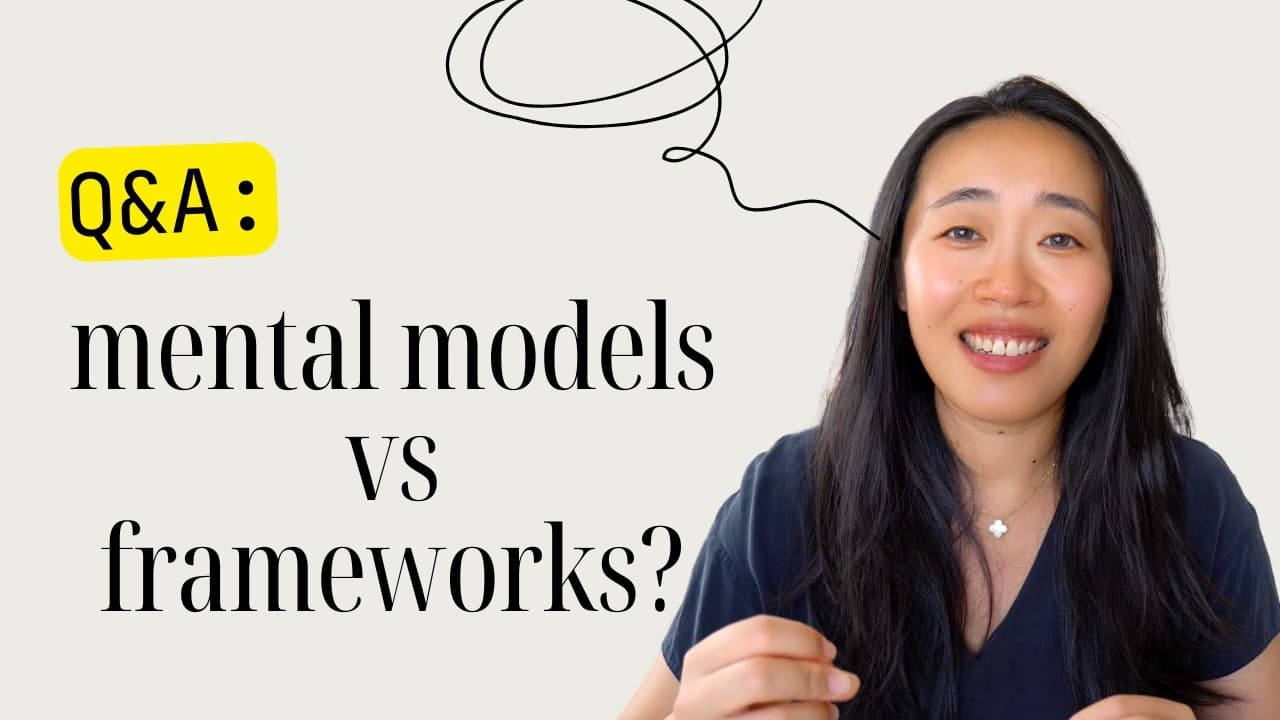
How to use mental models and frameworks effectively
TL;DR
The core idea is to pair mental models with practical frameworks so you can act on understanding. Mental models are the big picture concepts, while frameworks give you a structure to decide and act. By using the experiential learning cycle and metacognition you turn insights into repeatable, working habits.
Transcript
Do you ever wonder why some people seem to solve problems really fast with systems? They understand things at an amazing pace and they learn new things really quickly, and genius leaves clues. They all mention two things: mental mental models and frameworks. So I basically load my head full of mental models. Strategy is not industry-specific. It... Read More
Key Insights
- Mental models are the what, describing how something works in general terms.
- Frameworks are the so what, outlining actions, processes, and decision paths to take.
- Pyramid Principle is a concrete example of a framework used to structure ideas for presentations.
- Experiential learning cycle proves many people skip steps and fail to generalize insights.
- Metacognition helps convert one-time successes into repeatable systems.
- Frameworks help you ignore noise and focus on what matters for decision making.
- Focus and constraints are core themes in many productivity frameworks.
- Distilling patterns from frameworks allows you to build personal, transferable principles.
- More videos from this channel:
- More from this channel: Vicky Zhao
Install to Summarize YouTube Videos and Get Transcripts
Explore YouTube Video Summarizer or Get YouTube Transcript Extractor
Questions & Answers
Q: What is the difference between mental models and frameworks in practical terms?
Mental models are simplified representations of how things work, providing the what of a system. Frameworks are actionable structures that help you decide what to do with that understanding, offering the so what. In practice, you use models to grasp terrain and frameworks to chart a course, enabling effective action.
Q: How can someone move from understanding to applying frameworks at work?
Start with a framework of the task you face, then map your understanding from mental models to concrete steps. Use the Pyramid Principle to structure your reasoning, breaking it into a clear answer and supporting reasons. Practice across contexts to build intuitive application and reduce hesitation in real meetings.
Q: Why do people often fail to apply what they learn from frameworks?
Many readers learn frameworks but lack scaffolding to transfer them to action. Without reflective observation and abstract conceptualization from the experiential learning cycle, the knowledge remains theoretical. Active experimentation then tests whether the framework works in different contexts, turning knowledge into judgment.
Q: What role does metacognition play in mastering frameworks?
Metacognition involves thinking about thinking, which helps you identify when a framework is applicable and how to adapt it. By reflecting on when a framework succeeds or fails, you distill underlying principles, enabling you to reshape mental models and create versatile, reusable approaches.
Q: How can you avoid information overload when learning frameworks?
Focus on a few core frameworks and extract the principles behind them. Use deliberate practice to apply them to varied problems, then distill these experiences into general principles. This avoids overloading and builds transferable judgment rather than rote recall.
Q: What are two recurring themes in productivity frameworks discussed here?
A common thread is focus achieved through constraints, with tools like Eisenhower Matrix, Pomodoro, and time blocking illustrating how prioritization and time management share the same underlying principle. Recognizing this lets you adapt the same principle to different tasks and contexts.
Q: How does the speaker suggest you should start using a new framework?
Begin by identifying the core purpose of the framework and how it helps you decide what to do. Then apply it to one concrete problem, observe the results, reflect on what happened, and progressively expand its use to other areas while distilling the underlying principle.
Q: What is the ultimate benefit of combining mental models with frameworks?
Combining them creates a system where understanding becomes action, and action becomes wisdom. Mental models describe the terrain, frameworks decide the path, and metacognition seals the learning loop so you can repeatedly apply sound reasoning across contexts and scale your impact.
Summary & Key Takeaways
-
Mental models describe big picture concepts and explain how systems work, while frameworks provide actionable structure to apply that understanding in real scenarios.
-
The key to progress is turning knowledge into action through frameworks, not just memorizing models, by pairing, practicing, and testing ideas in real contexts.
-
A disciplined learning loop—concrete experience, reflective observation, abstract conceptualization, and active experimentation—produces durable judgment and transferable skills across domains.
Read in Other Languages (beta)
Share This Summary 📚
Summarize YouTube Videos and Get Video Transcripts with 1-Click
Try YouTube Summary with ChatGPT & Claude or YouTube Transcript Generator
Explore More Summaries from Vicky Zhao 📚






Summarize YouTube Videos and Get Video Transcripts with 1-Click
Try YouTube Summary with ChatGPT & Claude or YouTube Transcript Generator