How to Build a Creative Strategy for DTC Ads
TL;DR
Build a strong creative strategy by identifying gaps in a brand’s creative ecosystem, then connecting customer research to business goals. Analyze the brand, products, reputation, reviews, ad comments, social channels, competitors, and customer language, using AI to organize patterns while preserving human judgment for selecting insights that can inspire effective Meta ad concepts.
Transcript
The worst creative strategy that you can do is just copying what your competitors are doing. And yes, this includes if you are being very clever and you're prioritizing ads library based on what's getting the most impressions. The only thing slightly better than this is just trying to get as many formats as you can. I found that the best creative s... Read More
Key Insights
- • Creative strategy is the process of identifying gaps in a brand’s creative ecosystem and connecting them to the business’s next objectives. Copying competitors or merely producing more formats does not provide the strategic diagnosis needed to build a distinct, scalable advertising plan.
- • Brand analysis begins with the founders, founding story, bestselling products, merchandising strategy, and offers used across the business. This context reveals why the brand exists, what it prioritizes commercially, and which products or offers deserve initial attention in paid social creative.
- • Product analysis should define the product’s initial promise, expected customer transformation, supporting evidence, features, benefits, and bundling opportunities. These elements clarify what an advertisement can credibly communicate and whether the current product assortment supports a compelling problem-and-solution message.
- • Bundling can address paid social economics by increasing average order value when a lower-priced product may be difficult to sell profitably on Meta. A creative strategist can recommend bundles organized around a customer problem, making the offer more suitable for direct-response advertising.
- • Reputation analysis recreates the research journey a customer takes when comparing solutions. Google results, press coverage, Reddit conversations, Amazon listings, social content, YouTube reviews, and comments can reveal red flags, skepticism, trust barriers, pricing concerns, unmet questions, and perceived value.
- • Reddit is a source of candid feedback about brands and customer pain points because users can participate without showing their faces. Its discussions can expose severe criticism, recurring objections, and language that may be less visible in a brand’s controlled website reviews or social content.
- • Review mining should include website reviews, manually selected comments from external platforms, and comments from the top 20 ads over the previous year. Product review counts and ratings also help prioritize analysis, while advertising comments reveal questions and objections raised during actual campaigns.
- • AI analysis can organize research into brand strengths, weaknesses, common complaints, objections, memorable customer phrases, and purchase triggers. Human review remains important because automated systems may compile the material efficiently but lack the judgment to recognize a single unusually valuable comment that could inspire a strong ad.
Install to Summarize YouTube Videos and Get Transcripts
Explore YouTube Video Summarizer or Get YouTube Transcript Extractor
Questions & Answers
Q: How do you build a creative strategy for a DTC brand?
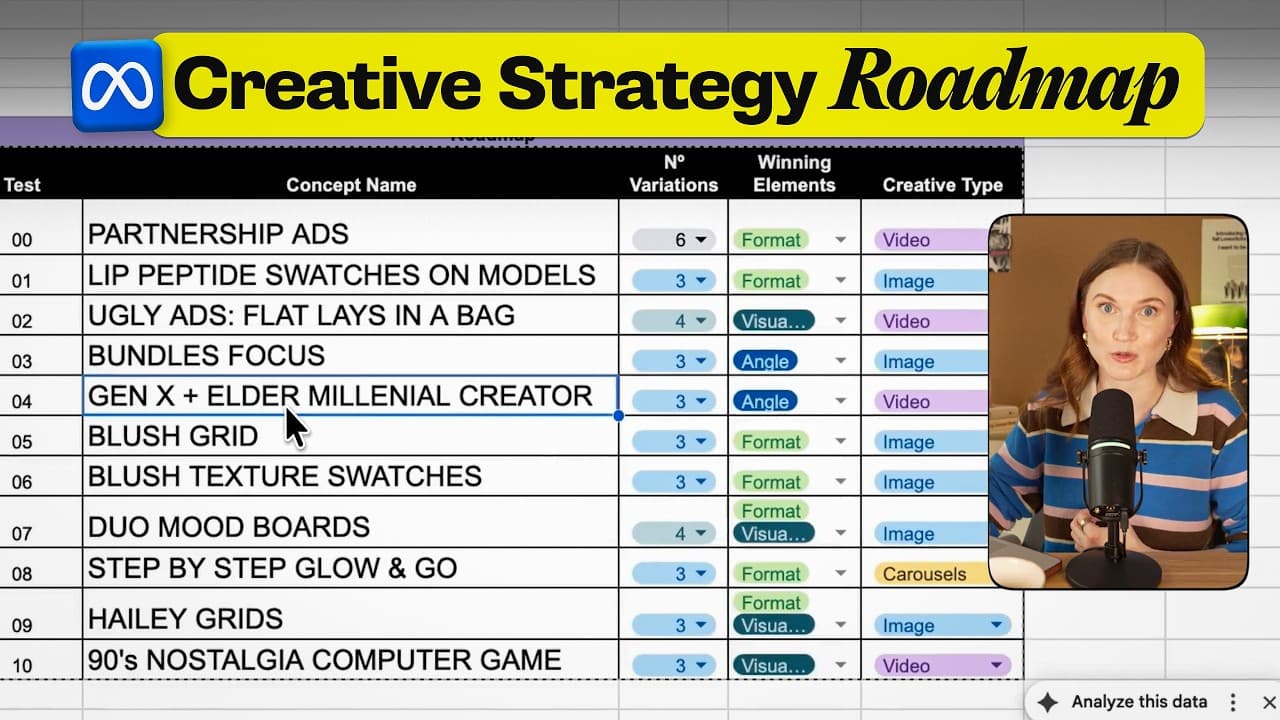
Start by identifying gaps in the brand’s current creative ecosystem and clarifying what the business wants to achieve next. Complete a brand and product analysis, reputation analysis, customer review mining exercise, AI-assisted synthesis, and competitor review. Translate the resulting promises, proof points, objections, customer phrases, purchase triggers, and offer opportunities into original ad concepts and a structured creative roadmap.
Q: Why is copying competitor ads a weak creative strategy?
Copying competitor ads only reproduces ideas already circulating in the market, even when the examples are selected from an ads library according to impressions. It does not diagnose the brand’s own creative gaps or connect advertising decisions to business goals. A stronger strategy uses customer and brand research to find distinct opportunities, rather than treating existing formats as the strategy itself.
Q: What should a brand and product analysis include?
A brand and product analysis should cover the founders, founding team, founding story, bestselling products, merchandising strategy, and offers used across the business and paid social. For the priority product, document its initial promise, intended customer transformation, supporting evidence, features, benefits, and bundling opportunities. This creates a factual foundation for messaging, offers, and creative concepts.
Q: How can product bundling improve a Meta ad strategy?
Bundling can increase average order value when the cost of selling a lower-priced product on Meta would otherwise be too high. The strategist should consider which products belong together and whether the bundle can be framed around a specific customer problem and solution. This makes the assortment more suitable for direct response and may create a more scalable paid social offer.
Q: What is a reputation analysis for creative strategy?
A reputation analysis follows the journey a potential customer might take while researching a brand and alternative solutions. It examines the first page of Google, press coverage, Reddit, Amazon, social media, YouTube reviews, and audience comments. The purpose is to identify purchase objections, trust issues, skepticism about effectiveness, price concerns, weak value communication, frequently asked questions, and useful messaging opportunities.
Q: How should customer reviews and ad comments be mined?
Export the available reviews from the brand’s review platform, rank products by review volume and ratings, and manually save especially notable comments found during broader research. Do not stop with reviews hosted on the brand’s website. Examine comments from the top 20 ads over the previous year, along with relevant material from Reddit, Amazon, YouTube, and other research sources.
Q: How can AI support creative strategy research?
Upload the completed research and review data to an LLM, then ask it to identify brand strengths and weaknesses, common complaints, purchase objections, memorable customer phrases, recurring language patterns, and triggers that cause people to buy. The resulting analysis becomes a context document for later strategic work. AI accelerates organization, but human judgment should still select the most meaningful evidence.
Q: Why is manual research still valuable when AI tools exist?
Manual research allows a strategist to notice an unusually revealing review, comment, objection, or phrase that an automated system may not judge as important. Tools can compile reviews and ad comments efficiently, but compilation is not the same as strategic interpretation. Reading source material directly also helps the strategist understand emotional nuance, compare platforms, and recognize ideas with advertising potential.
Summary & Key Takeaways
-
Effective creative strategy begins with diagnosing gaps rather than copying competitors or collecting ad formats. The strategist examines what the business wants to achieve, studies the existing creative ecosystem, and turns research into a deliberate plan. This broader responsibility can include messaging, offers, product assortment, bundles, content direction, and paid social priorities.
-
The reputation analysis follows the research journey of a potential customer. It covers the founders and brand story, bestselling products, merchandising, promises, proof, features, benefits, press, Google results, Reddit discussions, Amazon listings, social channels, YouTube reviews, and comments. The goal is to uncover trust problems, objections, buying friction, and opportunities.
-
Customer review mining combines website reviews with selected material from Reddit, Amazon, YouTube, and comments on top-performing ads. An LLM can organize this evidence into strengths, weaknesses, complaints, objections, memorable phrases, and purchase triggers. Manual review remains valuable because human judgment can recognize unusually powerful language with potential to inspire successful advertising concepts.
Read in Other Languages (beta)
Share This Summary 📚
Summarize YouTube Videos and Get Video Transcripts with 1-Click
Try YouTube Summary with ChatGPT & Claude or YouTube Transcript Generator
Explore More Summaries from Dara Denney 📚


Summarize YouTube Videos and Get Video Transcripts with 1-Click
Try YouTube Summary with ChatGPT & Claude or YouTube Transcript Generator