How to learn policy gradients and actor critics
TL;DR
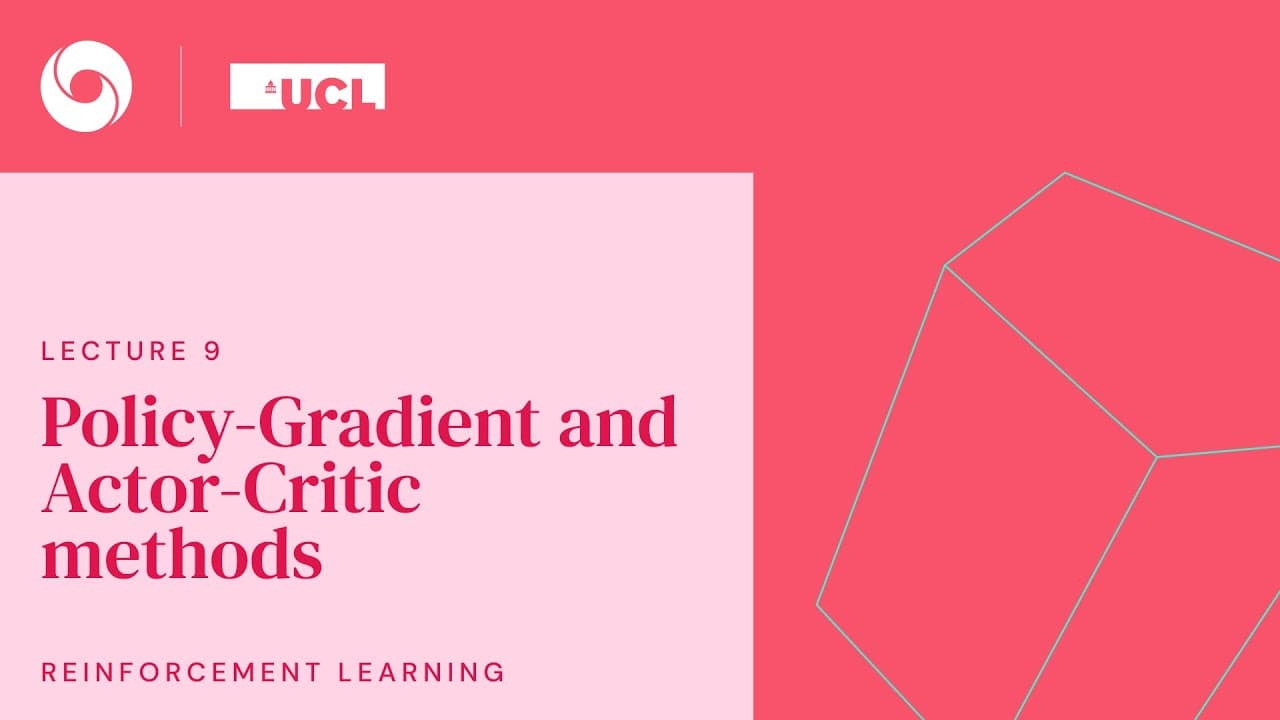
Policy gradients directly optimize the policy parameters, while actor-critic methods blend value predictions with policy updates for efficiency. The lecture contrasts model-based and policy-based approaches, explains why targeting the direct policy objective can be advantageous, and introduces direct policy search without requiring a complete model.
Transcript
hello and welcome to this ninth lecture in this course marine enforcement learning my name is heart of the hustles and today we will be talking about policy gradients and extra critics in terms of background material i recommend that you have a look at chapter 13 from the book by rich sutton and andy bartow and in some sense the motivation for toda... Read More
Key Insights
- Policy gradients optimize the policy parameters theta directly to improve expected return.
- Actor-critic methods use both a value prediction and a policy update to guide learning.
- Model based reinforcement learning learns a model of dynamics and reward to plan actions.
- Policy based methods can be easier to optimize when the true objective is the policy itself.
- Value based methods rely on value functions to derive policies from actions with highest value.
- A mismatch between value errors and policy quality can cause suboptimal actions due to approximation.
- Direct policy search avoids building a full world model, potentially reducing wasted computation.
- Generalization behavior differs between model based, value based, and policy based approaches, influencing data efficiency.
Install to Summarize YouTube Videos and Get Transcripts
Explore YouTube Video Summarizer or Get YouTube Transcript Extractor
Questions & Answers
Q: What is policy gradient learning and how does it work?
Policy gradient learning directly adjusts the parameters of the policy in order to maximize expected returns. It treats the policy as a parametric function that outputs action probabilities or decisions, and uses gradient signals from the estimated returns to update those parameters. This approach focuses on improving the actual decision rule rather than relying on a separate value model.
Q: What is an actor-critic method and why is it used?
An actor-critic method combines a value predictor with a policy updater. The critic estimates value signals that the actor uses to improve its policy, while the actor updates its parameters to select actions that maximize the estimated value. This tandem can improve learning efficiency by using value information to guide policy updates.
Q: How does model based reinforcement learning differ from policy based methods?
Model based reinforcement learning tries to learn a model of the environment and rewards, enabling planning and simulated rollouts to derive a policy. In contrast, policy based methods optimize a policy directly, potentially avoiding the need to build a full environmental model and focusing on direct improvement of action selection.
Q: Why might directly optimizing the policy be advantageous?
Direct policy optimization targets the actual objective of choosing the best actions, which can avoid some inefficiencies of learning an accurate world model. It can be easier in cases where a good policy can be found without modeling every environmental detail, reducing data and compute requirements for certain problems.
Q: What is a potential drawback of relying on value functions for policy derivation?
Relying on value functions can lead to policy errors when function approximation introduces errors that misrank actions. A small value error may cause a large policy error if the chosen action based on estimated values turns out to be suboptimal, especially when different actions have similar values.
Q: How do policy based methods generalize differently from model based approaches?
Policy based methods generalize in a way that emphasizes improving the decision rule directly, which can behave differently from model based generalization. The focus is on the policy's ability to select good actions across states rather than on accurately modeling dynamics, which shapes data efficiency and robustness.
Q: What is meant by direct policy search in this context?
Direct policy search refers to optimizing the policy parameters directly without constructing or relying on a complete model of the environment. This can simplify learning when the policy can be improved through gradient information from returns, potentially reducing unnecessary complexity associated with modeling the world.
Q: What role does function approximation play in these methods?
Function approximation is used to represent value functions or policies as parameterized models, such as neural networks or linear functions. Approximation enables handling large or continuous spaces but introduces the risk of generalization errors that can affect both value estimates and policy quality, influencing learning dynamics.
Summary & Key Takeaways
-
Policy gradients directly optimize the policy parameters to improve decisions, using a parameterized policy.
-
Actor-critic methods combine value function estimates with policy updates to improve learning efficiency.
-
The talk compares model based reinforcement learning with policy based approaches and discusses when direct policy optimization can be beneficial.
Read in Other Languages (beta)
Share This Summary 📚
Summarize YouTube Videos and Get Video Transcripts with 1-Click
Try YouTube Summary with ChatGPT & Claude or YouTube Transcript Generator
Explore More Summaries from Google DeepMind 📚

Summarize YouTube Videos and Get Video Transcripts with 1-Click
Try YouTube Summary with ChatGPT & Claude or YouTube Transcript Generator