How to Follow Up on Cold Emails to Get More Replies
TL;DR
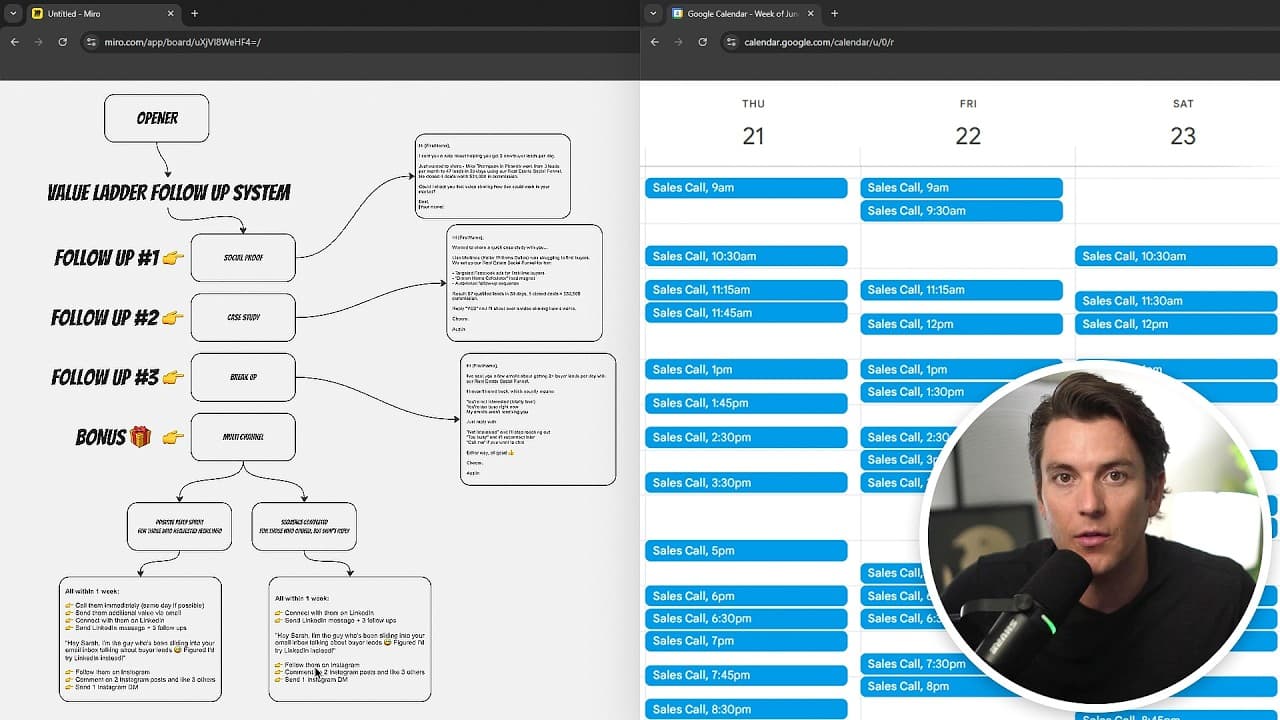
The most effective cold email follow-up uses a three-email 'value ladder' that scales trust through proof: social proof first, a detailed case study second, and a breakup email third. Over 80% of business comes from follow-ups, not the opener. Keep the sprint short and reiterate your original offer each time.
Transcript
There's a famous saying that says, "The money is in the follow-up." But here's the thing. 99% of people are doing follow-up completely wrong, leaving thousands of dollars on the table every single month. So, in this video, I'm going to show you the only cold email follow-up system that you need to implement inside of your business to get hundreds o... Read More
Key Insights
- The value ladder follow-up system is a short three-email sprint sent after the opener, designed to scale trust rather than introduce new offers. It reportedly tripled the creator's reply rate and tripled the number of booked calls.
- Social proof is the first follow-up because cold email is faceless and prospects only know your email address. Proof accelerates trust quickly, which giving them your deliverables or offer cannot do.
- The detailed case study is the second follow-up, going deeper by naming the company, the problem faced, the solution delivered, and the measurable result, then tying it back to the original opener's call to action.
- The breakup email is the third follow-up. It states you've sent a few emails and haven't heard back, then invites a simple reply like 'not interested' or 'too busy' to provoke closure or a response.
- The no-follow-up strategy relies on chance, since studies show 80% of business is done after follow-ups. Sending one email and expecting results is a core mistake to abolish.
- The 21-step follow-up system fails because recipients get hundreds of emails daily and do not remember an email from weeks ago. Spacing follow-ups a month apart is a quick way to land in spam.
- Prospects who complete the sequence without replying are moved into a new campaign with a new offer, rather than being followed up indefinitely with the same thread.
- The bonus multi-channel approach targets people who requested more information: call them immediately, reply with the value via email, and message them on LinkedIn with three additional follow-ups, all within one week.
Install to Summarize YouTube Videos and Get Transcripts
Explore YouTube Video Summarizer or Get YouTube Transcript Extractor
Questions & Answers
Q: What is the value ladder follow-up system for cold email?
The value ladder follow-up system is a short sprint of three follow-up emails sent after your opener. Rather than creating new offers, each email scales trust with proof: the first is social proof, the second is a detailed case study, and the third is a breakup email. The creator says this system tripled his reply rate and tripled the number of booked calls, and that over 80% of business comes from the follow-ups, not the opener.
Q: How many follow-up emails should you send after a cold email opener?
You should send three follow-up emails after the opener, kept as a short sprint. The reasoning is that if you send too many, prospects will forget about you, so a tight sequence lets you reiterate what your opener said and provoke a response. The three emails are social proof, a detailed case study, and a breakup email. Prospects who still don't reply are moved into a new campaign with a new offer rather than being followed up indefinitely.
Q: Why is social proof the first follow-up email?
Social proof is the first follow-up because cold email is faceless and prospects don't know you, your business, or anything beyond your email address. Giving them your deliverables or offer won't build trust, but proof will, and it accelerates trust quickly. The example email references a real client result, such as Mike Thompson in Phoenix going from three leads per month to 47 leads in 30 days and closing four deals worth $24,000 in commission, then reiterates the offer to share a video.
Q: What is a breakup email in cold email follow-ups?
A breakup email is the third and final follow-up in the value ladder system. It states that you've sent a few emails about your offer and haven't heard back, which usually means the person isn't interested, is too busy, or your emails aren't landing. It then invites a simple reply such as 'not interested' so you'll stop, or 'too busy' so you'll reconnect later. The goal is to provoke closure or a response by making it easy to reply.
Q: Why doesn't the 21-step follow-up system work?
The 21-step system, which sends automated check-ins every few weeks or months, fails because the recipient does not remember the email you sent them weeks earlier. People receive hundreds of emails every day, so a follow-up a month later cannot spark a memory of an earlier message. The creator warns that this long, spaced-out follow-up process is a quick way to go to spam, making it an ineffective strategy that should be avoided.
Q: What are the four cold email follow-up mistakes to avoid?
The four mistakes are: the no follow-up strategy, where you send one email and rely on chance even though 80% of business happens after follow-ups; the manual follow-up strategy, which wastes hours you should spend closing deals; the generic follow-up, using empty lines like 'bump' or 'did you get my email?' with no substance; and the 21-step system, which spaces check-ins so far apart that recipients forget you and the emails go to spam.
Q: How should you follow up with prospects who reply asking for more information?
The bonus multi-channel approach creates a positive reply sprint, all done within one week. Immediately after they reply saying yes, pick up the phone and call them to offer more info and set up a call. Second, reply to the email delivering the value you promised. Third, find them on LinkedIn and send a message plus three follow-ups if they haven't replied or booked. The LinkedIn message can reference that you've been emailing them and are trying LinkedIn instead.
Q: What percentage of business comes from cold email follow-ups?
According to the video, over 80% of business comes from the follow-ups rather than from the opener email. The creator repeats this figure multiple times to stress that follow-ups, not the initial message, drive most replies and booked calls. He also cites studies showing 80% of business is done after follow-ups, which is why having a structured follow-up strategy is essential rather than relying on a single email and chance.
Summary & Key Takeaways
-
The video identifies four follow-up mistakes to abolish: sending no follow-up at all, manually following up by hand, using generic 'just bumping this' messages with no substance, and the 21-step system that spaces check-ins months apart and gets forgotten or flagged as spam.
-
The recommended solution is the value ladder follow-up system: a short three-email sprint sent after the opener. Email one delivers social proof, email two delivers a detailed case study, and email three is a breakup email. Each follow-up scales trust with proof rather than new offers.
-
As a bonus, a multi-channel approach handles prospects who reply requesting more information: call them immediately, reply with value by email, and send a LinkedIn message plus three follow-ups, all within one week. Non-repliers are recycled into a new campaign with a new offer.
Read in Other Languages (beta)
Share This Summary 📚
Summarize YouTube Videos and Get Video Transcripts with 1-Click
Try YouTube Summary with ChatGPT & Claude or YouTube Transcript Generator
Explore More Summaries from Instantly 📚



Summarize YouTube Videos and Get Video Transcripts with 1-Click
Try YouTube Summary with ChatGPT & Claude or YouTube Transcript Generator