How do solar panels work? - Richard Komp
TL;DR
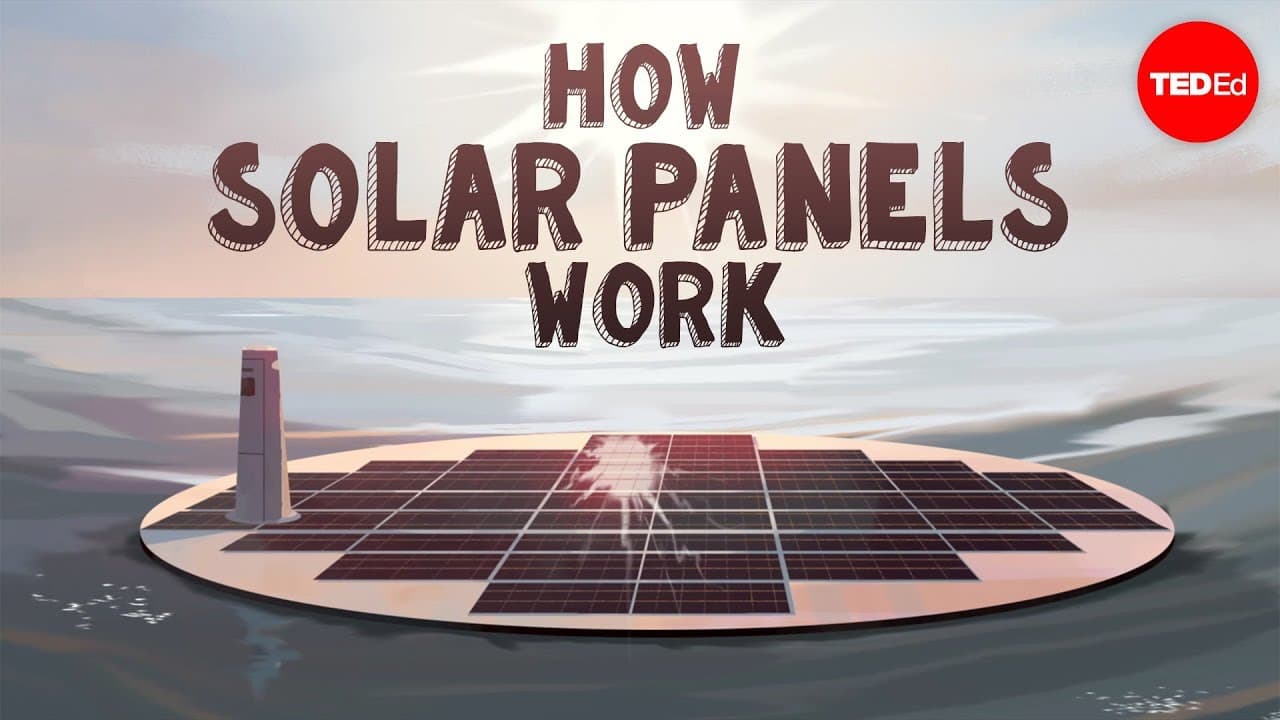
Solar panels convert sunlight into electricity using silicon solar cells, which generate a flow of electricity when photons knock electrons free. However, challenges such as energy distribution, efficiency (currently 15-20%), and infrastructure must be overcome to fully rely on solar energy globally. Despite these hurdles, advancements like floating solar farms are making solar energy increasingly competitive.
Transcript
The Earth intercepts a lot of solar power: 173 thousand terawatts. That's ten thousand times more power than the planet's population uses. So is it possible that one day the world could be completely reliant on solar energy? To answer that question, we first need to examine how solar panels convert solar energy to electrical energy. Solar panels a... Read More
Key Insights
- 🥪 Solar panels convert sunlight into electricity using silicon solar cells sandwiched between conductive layers.
- ❓ Challenges to complete reliance on solar energy include distribution, efficiency, and infrastructure.
- 🧑🌾 Solar technology is advancing, with innovations like floating solar farms, making solar energy more competitive.
- 🦺 Solar energy is already a cost-effective and safer alternative for areas without reliable electric grids.
- 👾 The Sahara Desert alone offers enough space for solar energy infrastructure to power the entire world.
- 🪡 The efficiency of solar cells, currently around 15-20%, needs improvement to maximize energy conversion.
- 😀 Solar energy faces both physical and political challenges, but technological advancements make a total reliance feasible.
Install to Summarize YouTube Videos and Get Transcripts
Explore YouTube Video Summarizer or Get YouTube Transcript Extractor
Questions & Answers
Q: How do solar panels convert sunlight into electricity?
Solar panels use silicon cells to capture photons from the sun, which excites electrons to produce an electric current that flows through an external circuit.
Q: What are the main challenges to complete reliance on solar power?
Challenges include uneven distribution of sunlight, inefficiencies in solar cell technology, and the need for effective energy storage and distribution systems.
Q: Why are some areas more suitable for solar energy than others?
Areas with more sunlight are better suited for solar energy generation, as less sunlight is available in cloudy regions or during nighttime.
Q: How do solar cells compare to other energy sources in terms of durability?
Solar cells are durable and can last for decades due to the absence of moving parts, making them a reliable source of renewable energy.
Summary
The Earth receives an enormous amount of solar power, raising the question of whether it is conceivable for the world to be fully dependent on solar energy. To answer this, we need to delve into the functioning of solar panels, which convert solar energy into electrical energy. Solar cells, the building blocks of solar panels, are made from silicon, a semiconductor. Within a solar cell, two different layers of silicon create a p/n junction, where electrons can move, creating a positive charge on one side and a negative charge on the other. When a photon strikes the cell, it can dislodge an electron, resulting in the flow of negatively charged electrons and positively charged holes. Due to the electric field at the p/n junction, they move in opposite directions – electrons towards the n-side and holes towards the p-side. Collected by metal fingers, the mobile electrons travel through an external circuit, providing electricity before returning through a conductive aluminum sheet. Although solar cells only produce half a volt individually, they can be connected to generate more power. The lifespan of solar cells is extensive, as they have no moving parts. However, despite these technological advancements, challenges remain, including political and logistical issues, uneven distribution and intermittent availability of solar energy, and the efficiency of solar cells. Overcoming these obstacles requires effective electricity transmission and storage, improved cell efficiency, and significant funding and space. Nonetheless, solar energy already serves as a cheaper and safer alternative for over a billion people without access to a reliable electricity grid, particularly in sunny developing countries.
Questions & Answers
Q: How do solar panels convert solar energy into electrical energy?
Solar panels consist of smaller units called solar cells, typically made from silicon. Within a solar cell, two different silicon layers create a junction where electrons and holes can move. When a photon strikes the cell, it can knock an electron free, resulting in negatively charged electrons and positively charged holes. Due to the electric field, electrons are drawn to the n-side, while holes move towards the p-side. Collected by metal fingers, the electrons flow through an external circuit, providing electrical energy.
Q: How are solar cells connected to generate more power?
Although individual solar cells produce only half a volt, they can be connected in modules to produce more power. By stringing together multiple solar cells, the voltage increases, allowing for greater electricity output. For example, while twelve photovoltaic cells are enough to charge a cellphone, powering an entire house typically requires multiple modules.
Q: How long can solar cells last?
Solar cells have an extensive lifespan as they have no moving parts. Since there is nothing to wear out or get used up, solar cells can last for decades. This durability makes them a long-term and sustainable energy option.
Q: What are the challenges preventing the world from relying entirely on solar power?
Beyond political factors and resistance from vested interests, there are physical and logistical challenges to widespread adoption of solar energy. One significant challenge is the uneven distribution of solar energy across the planet. Different areas receive varying amounts of sunlight, which affects the availability of solar power. Additionally, solar energy is inconsistent, with less energy accessible on cloudy days or during the night. Thus, achieving complete reliance on solar power necessitates finding efficient ways to transport electricity from sunny locations to cloudy ones and developing effective energy storage solutions. Furthermore, the efficiency of solar cells is another challenge, as any reflection of sunlight or failure to capture dislodged electrons leads to energy loss. The most efficient solar cell currently converts only 46% of available sunlight into electricity, while commercial systems generally operate at 15-20% efficiency.
Q: Would it be possible to power the entire world with current solar technology?
Despite the aforementioned challenges, it is indeed possible to power the entire world with existing solar technology. However, achieving this goal requires substantial funding for infrastructure development and an ample amount of space to accommodate the necessary solar panels. Estimates suggest that tens to hundreds of thousands of square miles may be required, which, although seemingly vast, is relatively small compared to the 3-million-square-mile Sahara Desert alone. Furthermore, as solar cell technology continues to improve and become more affordable, it competes with conventional electricity sources. Additionally, innovative ideas, such as floating solar farms, have the potential to transform the solar energy landscape.
Q: In which areas is solar energy already a viable and economical alternative?
Over a billion people worldwide lack access to a reliable electric grid, particularly in developing countries that often benefit from sunny climates. For these regions, solar energy is already a much cheaper and safer alternative compared to the available alternatives, such as kerosene. In such places, solar energy has the potential to provide a sustainable and affordable source of electricity. However, for areas with less sun exposure, like Finland or Seattle, effective solar energy adoption may still require further advancements.
Summary & Key Takeaways
-
Solar panels convert solar energy to electricity using silicon solar cells.
-
Photons from the sun excite electrons in the cell, creating a flow of electricity.
-
Challenges to full solar power reliance include distribution, efficiency, and infrastructure.
Read in Other Languages (beta)
Share This Summary 📚
Summarize YouTube Videos and Get Video Transcripts with 1-Click
Try YouTube Summary with ChatGPT & Claude or YouTube Transcript Generator
Explore More Summaries from TED-Ed 📚




Summarize YouTube Videos and Get Video Transcripts with 1-Click
Try YouTube Summary with ChatGPT & Claude or YouTube Transcript Generator