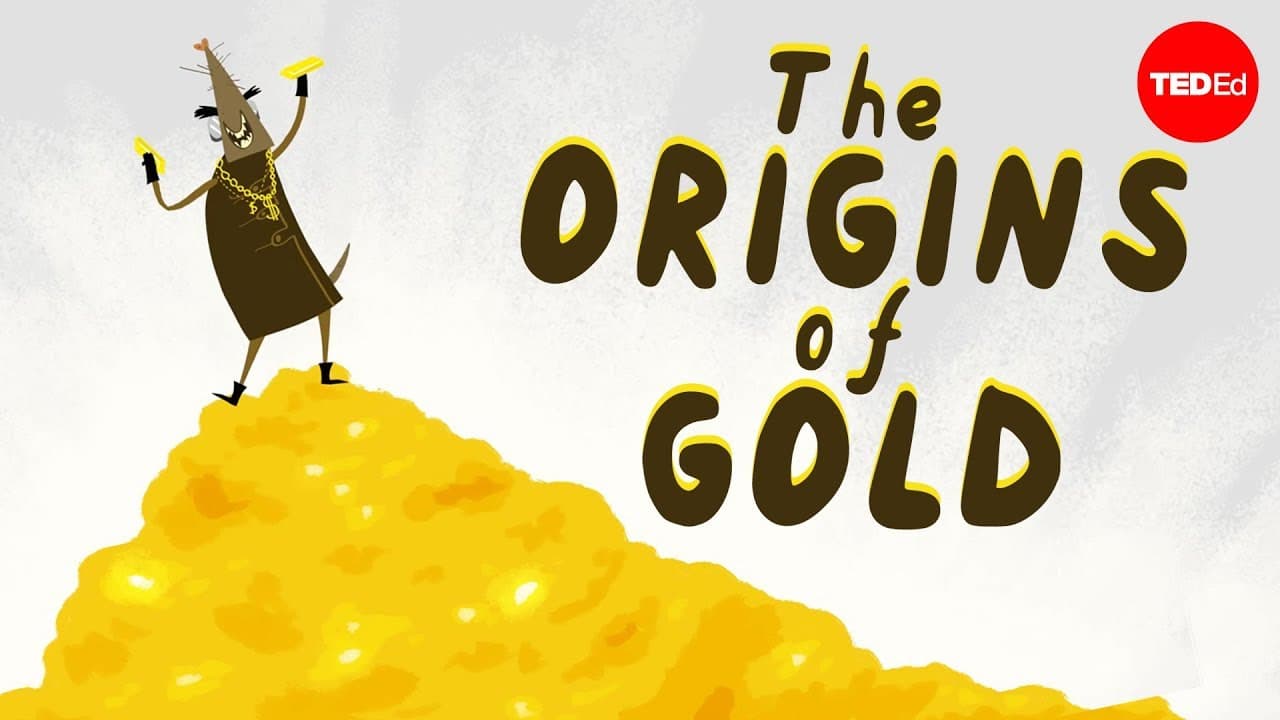
Where does gold come from? - David Lunney
TL;DR
Gold comes from supernova explosions that create heavier elements through nuclear fusion in stars. After these explosions, gold is released into space and later condensed into planets, including Earth. This cosmic origin explains gold's rarity and high value, as it is primarily mined from the Earth's crust, with potential sources like the ocean existing at extremely low concentrations.
Transcript
In medieval times, alchemists tried to achieve the seemingly impossible. They wanted to transform lowly lead into gleaming gold. History portrays these people as aged eccentrics, but if only they'd known that their dreams were actually achievable. Indeed, today we can manufacture gold on Earth thanks to modern inventions that those medieval alche... Read More
Key Insights
- 🤩 Gold's creation originates from supernovae explosions, forming through nuclear fusion in stars.
- 🛟 Earth's gold reserves were deposited by cosmic debris, distributed by stellar explosions.
- 🏅 The rarity of gold on Earth drives up its value, with mining being an expensive and intricate process.
- 🪐 Alternative sources of gold, like oceans and other planets, offer potential for future exploration.
- 🏅 The technology exists to artificially produce gold in particle accelerators.
- 🏅 Ancient alchemical dreams of transmutation contrast with the scientific reality of gold's extraterrestrial origins.
- ❣️ Supernovae play a crucial role in the creation of heavy elements, including gold, through rapid nuclear reactions.
Install to Summarize YouTube Videos and Get Transcripts
Explore YouTube Video Summarizer or Get YouTube Transcript Extractor
Questions & Answers
Q: How did medieval alchemists' aspirations compare to modern achievements in gold production?
Medieval alchemists sought to transmute lead into gold through mystical means, whereas modern science reveals gold's origins in supernovae explosions and its extraction on Earth through mining technologies.
Q: What role do supernovae play in the creation of gold?
Supernovae explosions forge gold by triggering rapid nuclear reactions that surpass the normal evolution of elements, producing heavy metals like gold, silver, and uranium through neutron captures.
Q: How is Earth's gold distributed and sourced?
Earth's gold originated from cosmic debris delivered by supernovae explosions, with geothermal activity depositing gold into veins that are later mined due to its scarcity on the planet.
Q: Could alternative sources of gold beyond Earth be explored in the future?
Potential sources of gold include the oceans with dissolved gold, other planets in our solar system, and the possibility of future supernovae enriching Earth with more gold.
Summary
In this video, we learn about the extraterrestrial origin of gold and how it is created through supernovae explosions in space. We explore the process of nuclear fusion in stars and how it leads to the formation of heavier elements, including gold. The video also discusses how gold is delivered to Earth through supernova shockwaves and geothermal activity. We then delve into the rarity of gold and the limitations of producing it artificially. Finally, we consider the possibility of finding gold in other locations, such as the ocean and other planets in our solar system.
Questions & Answers
Q: How is gold created in the universe?
Gold is created through the process of nuclear fusion in stars. Initially composed of hydrogen, stars undergo fusion to form heavier elements such as helium, carbon, and oxygen. Through subsequent transformations, the fusion process eventually reaches iron and nickel. When nuclear fusion can no longer release sufficient energy, the star collapses, leading to a supernova explosion. The extreme pressure during this event allows the formation of heavier elements like gold.
Q: How long does it take for gold to be created in a supernova?
While the transformation of hydrogen into heavier elements occurs over millions of years, the creation of the heaviest elements, including gold, takes place in a matter of seconds during a supernova explosion.
Q: What happens to gold after a supernova explosion?
The expanding shockwave of a supernova propels debris containing gold through the interstellar medium. This triggers the condensation of gas and dust into new stars and planets, where the gold becomes embedded. Geothermal activity on Earth eventually kneads the gold into veins, making it accessible for mining.
Q: How rare is gold on Earth?
Gold is considered rare on Earth. In fact, all the gold ever mined in history could be piled into just three Olympic-size swimming pools. Despite this, gold is significantly denser than water, making its mass considerable compared to its volume.
Q: Can gold be artificially produced?
Yes, gold can be produced artificially using particle accelerators. However, these machines can only create gold atom by atom, making the process extremely time-consuming and costly. Producing just one gram of gold in this manner would take nearly the age of the universe and would far exceed the current value of gold.
Q: Where else could we find gold apart from Earth?
While Earth's gold reserves are limited, there are other potential sources of gold. The ocean is estimated to contain around 20 million tons of dissolved gold, but at such low concentrations that the recovery process is currently impractical. It is also possible that other planets in our solar system hold mineral wealth, and future exploration could uncover deposits of gold.
Q: What are the potential risks and rewards of finding gold from other sources?
If we were to mine all of Earth's buried gold and still require more, finding gold in the ocean or on other planets could provide a solution. However, the costs and complexity of extraction would need to be carefully evaluated. Additionally, the possibility of a nearby supernova explosion showering Earth with gold treasure raises the potential for devastating consequences, such as the eradication of all life on the planet.
Q: What is the feasibility of extracting gold from the ocean?
The recovery of gold from the ocean is currently prohibitively expensive due to the extremely low concentrations of dissolved gold. While there is a significant amount of gold in the ocean, the cost of extraction is far greater than the value of the recovered gold at this time.
Q: How do we currently extract gold on Earth?
Gold is primarily extracted through mining processes. These involve locating gold deposits, either through geological surveys or exploration, and then extracting the ore from the ground. The ore is subsequently processed to separate the gold from other minerals and compounds.
Q: What are the potential future methods for extracting gold?
As technology advances, new methods for extracting gold may be developed. These could include innovative mining techniques, more efficient processing methods, or even futuristic approaches such as mining asteroids or other celestial bodies. However, these methods would require significant advancements and investments to become viable options.
Takeaways
Gold originates from supernovae explosions in space, where heavy elements are formed through nuclear fusion. The rarity of gold on Earth, coupled with the limitations of artificial production, makes it a valuable and sought-after commodity. While the ocean and other planets in our solar system may contain gold, the challenges and costs of extraction currently outweigh the benefits. However, future advancements in technology and exploration could potentially change this situation.
Summary & Key Takeaways
-
Medieval alchemists aspired to turn lead into gold but lacked modern knowledge.
-
Gold is created in supernovae explosions, forming heavier elements like silver and gold.
-
Earth's gold is sourced from interstellar debris, deposited by ancient supernovae, and mined due to its rarity.
Read in Other Languages (beta)
Share This Summary 📚
Summarize YouTube Videos and Get Video Transcripts with 1-Click
Try YouTube Summary with ChatGPT & Claude or YouTube Transcript Generator
Explore More Summaries from TED-Ed 📚





Summarize YouTube Videos and Get Video Transcripts with 1-Click
Try YouTube Summary with ChatGPT & Claude or YouTube Transcript Generator