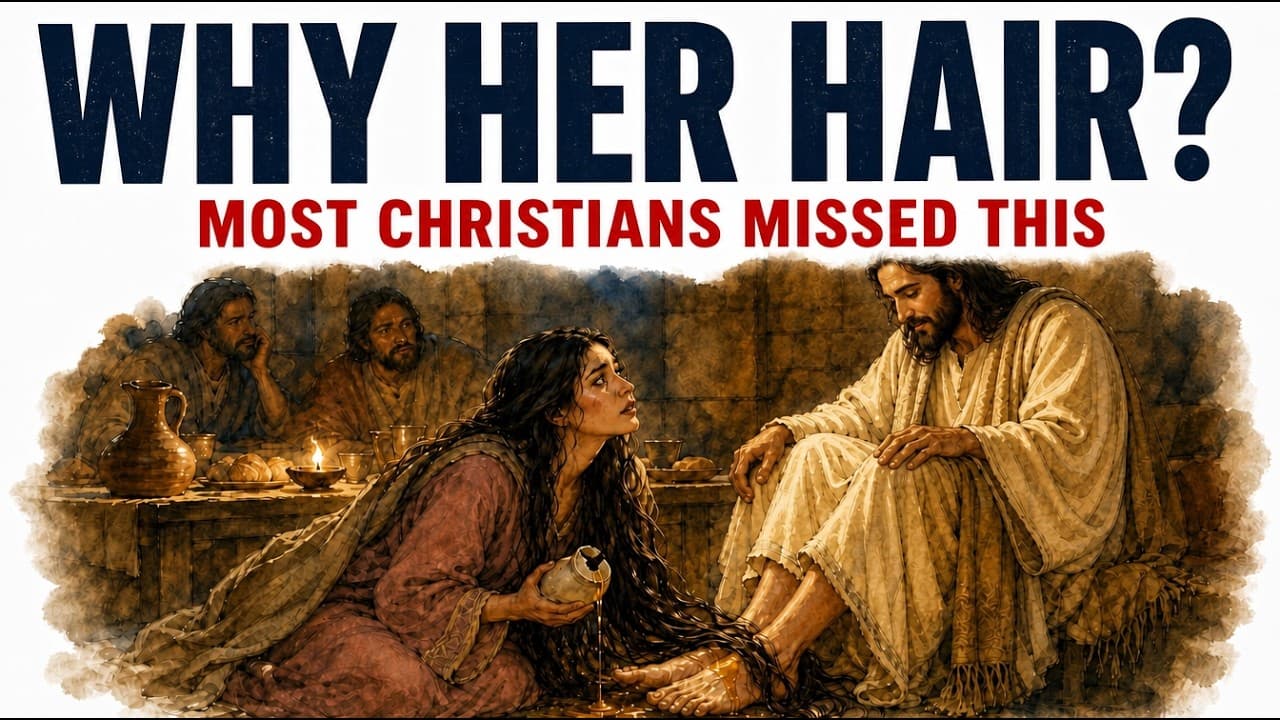
Why did Mary anoint Jesus with costly nard in Bethany?
TL;DR
Mary of Bethany breaks an alabaster flask of costly oil and anoints Jesus, signaling more than generosity. The scene reveals royal coronation symbolism and a prelude to burial, with the perfume’s price and origin deepening the meaning beyond a simple gift. Jesus interprets the act as preparation for his death.
Transcript
A woman walks into a room full of men, breaks open a sealed jar worth an entire year of wages, and pours the whole thing out over the head of a man who is about to die. The smell fills the house instantly. It gets into the walls, the cushions, the clothes of everyone reclining at the table, and it does not fade for days. When those same men watched... Read More
Key Insights
- Mary of Bethany performs two intertwined acts by anointing Jesus head and feet, fulfilling both kingship symbolism and funeral preparation. The gesture links to the Old Testament oil anointing ceremony that marks someone as chosen or set apart. This frames Jesus as the expected Messiah in a concrete ritual.
- The term Christ or Messiah is tied to the act of pouring oil on the head, making the title literal in this moment and revealing a significance that goes beyond a simple gift or compliment.
- The 300 denarii price mark shows the oil’s extraordinary value, illustrating the tension between reverence for Jesus and concern for the poor, which Jesus addresses by prioritizing the anointing as a prophetic act.
- The perfume’s origin from Himalayan plants underscores the length of trade and the wealth represented by the gift, reinforcing the notion that this was a once in a lifetime purchase with deep symbolic weight.
- The double gesture of anointing head and feet communicates coronation and burial in one motion, highlighting the multifaceted meaning Mary intended and Jesus affirmed.
- The narrative insists on distinguishing Mary of Bethany from other Mary figures in the gospels, preventing false conflation and preserving the text’s historical integrity.
- The study demonstrates how careful biblical reading can reveal layers of meaning that connect a single act to broader gospel themes like kingship, sacrifice, and prophecy.
Install to Summarize YouTube Videos and Get Transcripts
Explore YouTube Video Summarizer or Get YouTube Transcript Extractor
Questions & Answers
Q: What is the significance of the alabaster flask and costly oil in Bethany?
The alabaster flask holds a costly oil described as pure nard, which makes the gift extraordinary in value and symbolic weight. The act of breaking the flask and pouring the oil on Jesus’s head and feet elevates the gesture from personal generosity to a ceremonial, prophetic act. It signals deep reverence for Jesus as the one who will be anointed king and also foreshadows his burial. The price indicates wealth and devotion, showing Mary’s willingness to sacrifice a substantial inheritance for Jesus’s mission, and it creates a moment where royal coronation and funeral preparation intersect.
Q: How does the gesture connect to Old Testament oil ceremonies?
In the Old Testament, pouring oil on someone’s head is a commissioning ceremony that marks the recipient as chosen for a sacred role, such as a king or priest. By pouring oil on Jesus, Mary performs the literal enactment of the title Messiah, the anointed one, establishing Jesus in a role that readers recognize as fulfilling prophetic expectations. This ceremonial act ties Jesus’s identity to divine appointment and highlights the holiness of the moment, turning a normal act of praise into a recognition of what Jesus represents.
Q: Why does Jesus call the act a preparation for his burial?
Jesus explains that Mary has done what she could to prepare his body for burial. The act, while seemingly lavish, is interpreted by Jesus as a funeral preparation because fragrant oils were used in burial rites. This reframes the gesture as something more than generosity, presenting it as a prophetic action that anticipates his death. The timing and setting amplify this meaning, as it occurs just before Passover, aligning with themes of sacrifice and salvation that run through the gospel narrative.
Q: How does the narrative treat Mary of Bethany in relation to other Mary figures?
The narrative stresses distinguishing Mary of Bethany from the unnamed sinful woman in Luke, and from Mary Magdalene. It emphasizes her identity as the sister of Martha and Lazarus, noted for sitting at Jesus’s feet and learning. This careful distinction preserves the text’s integrity and prevents conflating different characters whose actions are sometimes described in parallel but belong to distinct scenes and theological threads.
Q: What does the term nardos pistic imply about the perfume?
Nardos pistic is the Greek phrase tied to the perfume used in the anointing. The passage explains that it likely denotes genuine, pure, or faithful nard, indicating that the oil was unadulterated and of high quality. The exact nuance can be debated among scholars, but the consensus is that the perfume was the finest form of its kind, making the gesture exceptionally valuable and meaningful in the narrative context.
Q: What is the broader theological message of this scene?
The scene carries a dual message: it crowns Jesus as the Messiah through a royal anointing and simultaneously prepares him for burial, foreshadowing the events of his crucifixion. This combination intertwines kingship and sacrifice, showing that true recognition of Jesus’s identity involves acknowledging both his rule and his suffering. The act invites readers to see Jesus’s mission as divinely appointed and sacrificial in nature.
Q: Why is the economic value of the oil important to the interpretation?
The value, described as roughly a year’s wages, emphasizes the extraordinary generosity and vow of devotion Mary makes. It also creates a tension in the room with those who question the cost in terms of helping the poor. Jesus reframes the concern, indicating that this act, though expensive, serves a larger prophetic purpose and shows an appropriate priority given his upcoming death and the gospel’s message to be proclaimed globally.
Q: How does this video approach biblical interpretation differently?
The video emphasizes careful reading across the Gospel accounts, distinguishing between text and later tradition, and explaining the ceremonial language of oil and anointing. It combines linguistic, historical, and theological insights to reveal the layered meaning of Mary’s act, showing how royal coronation and burial preparation are simultaneously present in a single moment and how Jesus affirms this multifaceted act.
Summary & Key Takeaways
-
In Bethany, six days before Passover, Mary anoints Jesus with a jar of costly oil, a scene that blends royal symbolism with preparation for burial. The analysis clarifies who Mary is, the perfume, and how the gesture transcends generosity to enact prophetic meaning. The passage connects with Mark, Matthew, and John.
-
The perfume is described as pure nard from a plant grown far away, making the gift exceptionally valuable. The study examines how the act crowned the Messiah and foreshadowed Jesus’ death, fitting the gospel narrative.
-
The video emphasizes careful reading of Scripture to distinguish tradition from text, showing that Mary of Bethany is not the same as the unnamed sinful woman or Mary Magdalene, and explaining the linguistic and ceremonial layers of anointing.
Read in Other Languages (beta)
Share This Summary 📚
Summarize YouTube Videos and Get Video Transcripts with 1-Click
Try YouTube Summary with ChatGPT & Claude or YouTube Transcript Generator
Explore More Summaries from Discernment Made Clear 📚


Summarize YouTube Videos and Get Video Transcripts with 1-Click
Try YouTube Summary with ChatGPT & Claude or YouTube Transcript Generator