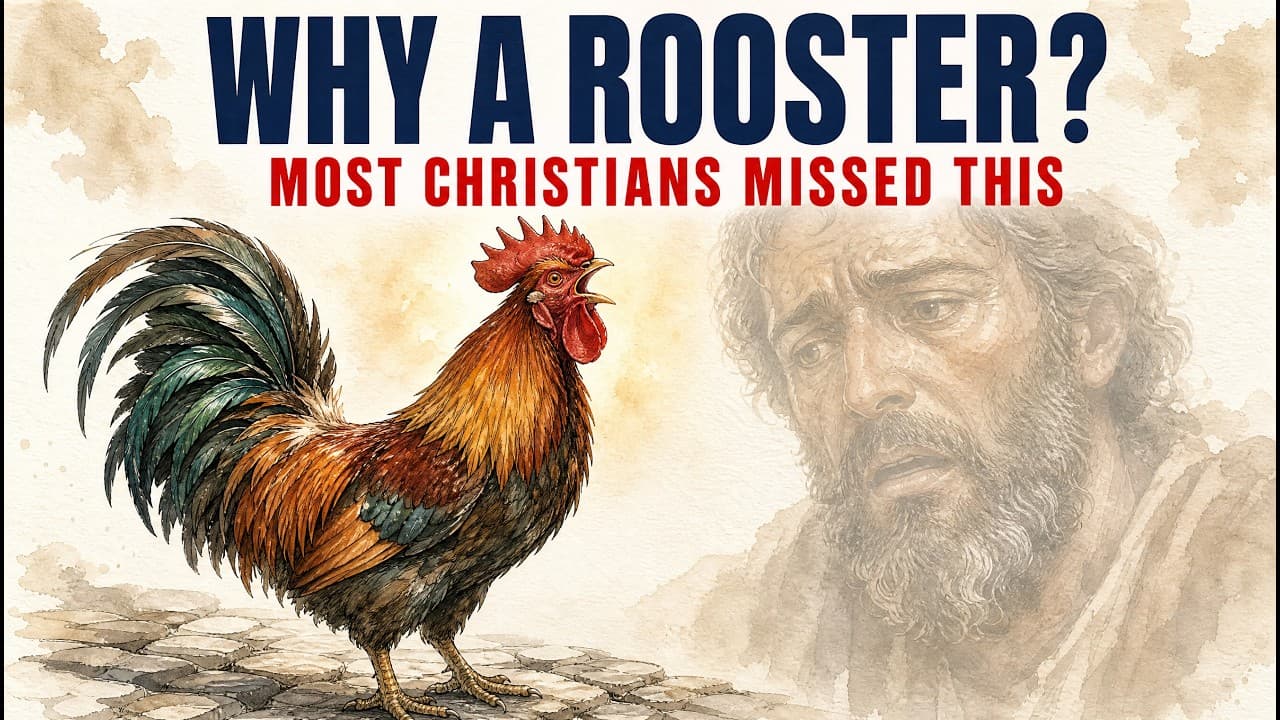
What does the rooster signal in Peter's denial?
TL;DR
The rooster marks the exact hour of Peter's denial and ties to four gospel watches. It shows Jesus predicted the denial, the Greek words, and the symbolism of the cockcrow across Mark, Luke, Matthew, and John. The sound becomes a redeeming moment later in John 21.
Transcript
It is the coldest hour of the night in Jerusalem. A group of servants and temple officers has built a fire in an open courtyard, and a fisherman from Galilee is standing as close to the coals as he can get, holding his hands out, trying very hard to look like he belongs there. Somewhere in the rooms behind him, the man he has followed for 3 years i... Read More
Key Insights
- The rooster crowing is a deliberate time cue, not incidental noise.
- Alektor combines rooster and sound, forming a clock signal in the text.
- Mark names four watches of the night and aligns his passion narrative with them.
- Luke 22:31-32 shows a shift from plural you to singular you, highlighting a personal prophetic moment for Peter.
- The third watch corresponds to the rooster and to Peter’s denial scene in Mark.
- Archaeological and rabbinic evidence supports roosters in context, challenging the no-roosters claim.
- The fire of coals in John 18:18 and 21 plays a symbolic role in Peter’s restoration.
- John 21 revisits the same type of fire and questions to redeem the earlier denial.
Install to Summarize YouTube Videos and Get Transcripts
Explore YouTube Video Summarizer or Get YouTube Transcript Extractor
Questions & Answers
Q: What is the basic function of the rooster in the narrative scope?
The rooster serves as a time cue and a symbolic hinge that unites the denial scene across the Gospel accounts. It marks the third watch of the night, connects to the predicted moment in Luke, and becomes the sound later associated with Peter’s restoration in John. This function is central to the argument that the rooster is intentional and meaningful.
Q: How does the Greek wording in Luke 22:31-32 affect interpretation?
Luke 22:31-32 uses hymas in the plural to indicate Satan has asked for all of you, the group, but then shifts to sou, singular, when Jesus speaks to Peter. This linguistic shift emphasizes a collective trial for the group and a personal, targeted intercession for Peter, setting up the denial scene as a personal test within a wider context.
Q: Why does the video insist the rooster is a time signal as well as a bird?
The video notes that cockcrow is literally a clock term in Mark 13:35, which names four watches including the rooster watch. This dual meaning creates a precise emotional and chronological pivot in the narrative, showing that the moment of denial and its timing are inseparable elements of the gospel timeline.
Q: What evidence supports roosters being present in Jerusalem despite rabbinic rules?
The video cites Mishnah Bava Kama and a temple scroll fragment that imply some restrictions, yet other Mishnah passages and archaeology show roosters were present and even common in the region. This evidence undermines a blanket prohibition and supports the likelihood that Peter could hear a rooster during the events.
Q: What is the significance of the fire imagery in John 18:18 and John 21?
The fire of coals, anthrakia, appears in both John 18:18 and John 21, linking the denial scene to a later restoration moment. The repeated fire imagery frames Peter’s defection and subsequent repentance, suggesting a deliberate narrative symmetry that reinforces the redemptive arc across the Johannine account.
Q: How does the four-watch structure influence the reading of Peter’s denial?
Mark’s ordering of events around the four watches maps the passion narrative onto a precise night sequence: evening, midnight, cockcrow, and morning. Peter denies Jesus during the cockcrow cue, aligning his personal failure with the larger pattern of watchful failure and creating a cohesive clockwork reading of the night.
Q: What is the scholarly point about the wings of the rooster in the text?
The term alektorophonia explicitly combines rooster and voice, signaling not just a bird but the audible cue of cockcrow. This lexical choice reinforces the dual sensing of sound and hour, making the rooster a literal and figurative voice that binds the narrative while signaling the approaching dawn and transformation.
Q: How does the video relate the cockcrow to the later restoration in John 21?
The video draws a throughline from the rooster’s crow to the shoreline fire in John 21, where Jesus asks Peter a series of questions and renews him. This linkage frames the earlier denial as part of a pattern of testing and restoration, culminating in reclamation rather than mere failure.
Summary & Key Takeaways
-
Peter’s denial is tied to the third watch of the night, marked by the crowing rooster in Mark’s chronology and Luke’s gospel. The bird’s crow is a clock and a sign, not mere background noise, linking four gospel accounts around a single, shared moment.
-
The Greek word alektor signals both the bird and the hour, creating a compound cue that Jesus uses to anchor the prophecy and the later restoration of Peter.
-
The video argues that rooster presence in Jerusalem is historically plausible and that cockcrow is a deliberate literary device used by the gospel writers to synchronize the events of the Passion narrative.
Read in Other Languages (beta)
Share This Summary 📚
Summarize YouTube Videos and Get Video Transcripts with 1-Click
Try YouTube Summary with ChatGPT & Claude or YouTube Transcript Generator
Explore More Summaries from Discernment Made Clear 📚

Summarize YouTube Videos and Get Video Transcripts with 1-Click
Try YouTube Summary with ChatGPT & Claude or YouTube Transcript Generator