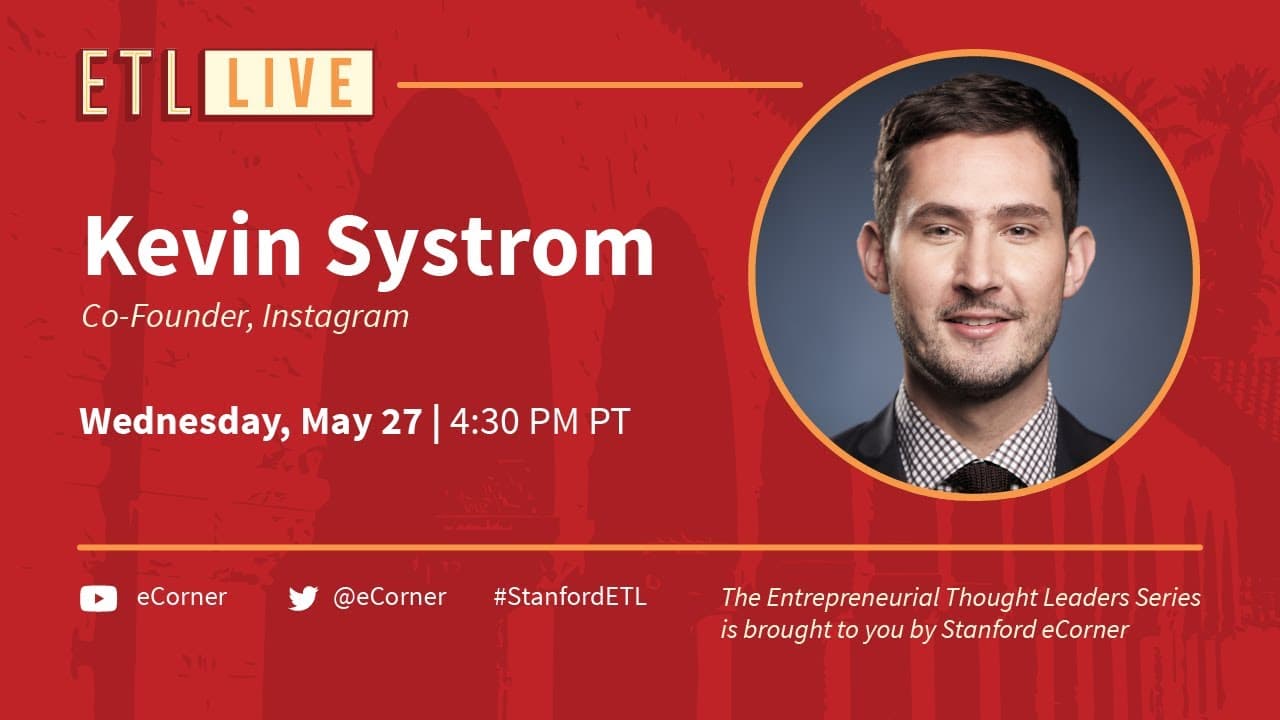
ETL Speaker Series: Kevin Systrom, Instagram
TL;DR
Start a company when your skills, network, and circumstances are ready, even though the broader world may never offer a clearly perfect moment. Build around strong people, choose investors as carefully as employees, and treat creating something that people use as a meaningful reward independent of later outcomes.
Transcript
hi I'm Tina Seelig and I'd like to welcome you to the entrepreneurial thought leader series which is presented by stvp the Entrepreneurship Center at Stanford School of Engineering and also by basis the Business Association of Stanford entrepreneurial students today we are super excited to welcome Kevin Systrom back to our et on stage when Kevin wa... Read More
Key Insights
- Personal readiness is more important than macroeconomic timing when deciding to start a company. Markets can rise or fall, but founders must evaluate whether they possess enough skills, relationships, experience, and commitment to begin pursuing a specific opportunity.
- Entrepreneurship rarely feels completely safe because prospective founders can always identify more knowledge to acquire or another practical concern to resolve. Waiting for total certainty can therefore postpone action indefinitely, even after someone has assembled a workable foundation for starting.
- Professional experience can supply essential ingredients for a future venture. Systrom connected meeting his co-founder at Stanford, encountering early investors through Google, and learning to build a service at another company with his eventual ability to launch Instagram.
- Creating something and placing it before real users is a reward independent of financial or public outcomes. Systrom emphasizes the excitement of getting a product off the ground, observing whether people value it, and learning directly from that act of creation.
- Innovation is not limited to favorable business cycles because useful ideas can emerge during uncertain or difficult periods. A market lull may leave promising areas less crowded, allowing committed founders to pursue problems that more hesitant people are temporarily avoiding.
- Investors should be selected as carefully as employees because they become part of the broader company team. Compatibility, relevant knowledge, and a shared understanding of the venture can matter more than maximizing the valuation attached to an early financing decision.
- A startup is a company, not merely a product, and the product represents only one portion of what founders must build. Teams, working relationships, leadership, financing partners, and organizational capabilities determine whether an appealing product idea becomes a resilient operation.
- Strong people enable recovery when a company encounters problems. A promising product cannot guarantee success if the surrounding team lacks the ability to respond to setbacks, while highly capable colleagues can help the organization learn, adjust, and continue moving forward.
Install to Summarize YouTube Videos and Get Transcripts
Explore YouTube Video Summarizer or Get YouTube Transcript Extractor
Questions & Answers
Q: When is the right time to start a company?
The right time depends more on the founder than on the broader economy. Systrom says there is no universally correct market moment, since companies and useful ideas can emerge under very different conditions. A prospective founder should instead consider whether personal skills, relationships, experience, and motivation provide a sufficient foundation, while accepting that the decision will probably never feel completely safe.
Q: How should founders prepare before launching a startup?
Founders should build the skills, network, and practical experience their particular idea requires. Systrom says he benefited from meeting his future co-founder at Stanford, connecting with early investors while working at Google, and learning how to build a service at another company. His preparation came through several chapters that combined to make the eventual launch possible.
Q: Why might working before founding a company be useful?
Working at other organizations can help a future founder gain technical ability, understand how services are built, and develop relationships with collaborators or investors. Systrom says starting immediately after college can suit some people, but it was not right for him. His employment experiences supplied capabilities and connections that later supported Instagram, showing that preparation can be highly personal.
Q: Can uncertain economic conditions create startup opportunities?
Uncertain conditions can be both frightening and promising. Systrom notes that people may lack a reliable model for how business will operate, making decisions harder. At the same time, innovation continues across business cycles. When others hesitate, a determined founder may find an open area with fewer people pursuing it and use genuine enthusiasm for the problem to make progress.
Q: How should entrepreneurs choose venture capital investors?
Entrepreneurs should evaluate venture capitalists as prospective members of the team. Systrom recommends looking for people whose knowledge, interests, and approach fit the company rather than optimizing primarily for valuation. An investor relationship can shape the venture over time, so compatibility and the ability to work together are important safeguards against conflict and poor support during difficult moments.
Q: Why is a startup more than its product?
A product is only one part of the company a founder must create. Systrom distinguishes building a useful offering from building the organization that can sustain, improve, and scale it. That broader work includes hiring employees, selecting investors, developing teams, and establishing productive partnerships. A good product idea without strong people around it can still leave the company unable to recover from setbacks.
Q: Why are strong teams essential to startup success?
Strong teams provide the judgment and resilience needed when plans fail or unexpected challenges appear. Systrom says people can determine whether a company succeeds or fails because even an excellent product idea may stumble. Capable colleagues help the organization recover, adapt, and continue executing. Team quality therefore matters across early hiring, later expansion, investor selection, and strategic partnerships.
Q: What is the personal reward of starting a company?
The act of creating something, launching it, and seeing whether people use it can be rewarding regardless of the venture's later outcome. Systrom describes the thrill of getting an idea off the ground and putting it before users as one of the best rewards available. This view places experimentation, creation, and direct contact with users at the center of entrepreneurship.
Summary
In this video, Kevin Systrom, co-founder of Instagram, reflects on his 10 years of experience in entrepreneurship. He discusses topics such as the right time to start a venture, the importance of building a strong team, the balance between product development and other business aspects, and the process of deciding to sell the company. He also shares insights on his current projects related to the COVID-19 pandemic.
Questions & Answers
Q: Was there a right time for you to start Instagram?
There is no right time in the world to start a venture, but there is a right time for an individual. Kevin believes that it's important to have the right skill set and network before starting a company. He reflects on how his technical skills, network, and experience gained from working at Google and Nextstop prepared him to start Instagram. However, he notes that you will never feel like it's the right time because there's always more to learn and it may not feel safe.
Q: Is it a great time or a scary time to start something during the COVID-19 pandemic?
Kevin believes that it's both a great and scary time to start something during the pandemic. While there is uncertainty and a lack of prior knowledge on where the world is heading, many successful companies have been started during downturns. He suggests that innovative ideas can come even in uncertain times, as there may be opportunities in unexplored areas. It's important to be ambitious and excited about solving a problem, as that can lead to starting something spectacular.
Q: How did you choose the people on your team and what is the importance of team building?
Kevin believes that building the right team is crucial for success. He reflects on the importance of finding people who believe in the mission and have the necessary skills. He shares that his partnership with Mike Krieger, his co-founder, worked well because they had complementary personalities and skills. Kevin also highlights the importance of hiring venture capitalists who align with your company's vision. He emphasizes that people are the reason for success, and a strong team can help recover from failure and come up with new ideas.
Q: How did the balance of responsibilities in building Instagram change over time as the company grew?
In the early stages, Kevin was more involved in product development and coding, while later on, his role shifted to finding the right people to scale the company. He mentions the concept of leverage, where one's hour of work should produce more output through the work of others. As the company grew, Kevin's job became dynamic, with new challenges every day. He highlights the need to embrace discomfort and evolution in leadership roles and the importance of having a team that you can learn from.
Q: In the clip, you mention that the hard part is finding the right problem, not the solution. Can you discuss the problems you're currently trying to solve?
Kevin mentions that he and Mike are working on a project related to the COVID-19 pandemic. They noticed a lack of a clear metric to understand how things were going amidst the crisis. They wanted to provide a dashboard that could effectively manage the situation by modeling the data to correct biases and show the truth about the virus's spread. They focused on the effective reproduction number (Rt) as a metric to track the virus's spread. Kevin also mentions that this project is not their next company, but an opportunity to work together and solve a pressing problem.
Q: How did you achieve such explosive growth at the beginning of Instagram?
Kevin believes that the key to Instagram's rapid growth was solving the core problems people had with digital photography. They focused on making the app faster, enabling seamless sharing, and providing filters to enhance photo quality. By solving these problems, the product was valuable to users and created a viral loop through shares on other social networks. Kevin emphasizes the importance of addressing real problems and not just building something neat or fancy.
Q: Why did you decide to sell Instagram to Facebook?
Kevin explains that the decision to sell Instagram to Facebook was driven by the desire to supercharge their mission and vision. Combining forces with one of the best social companies at the time allowed Instagram to reach more households and scale faster. While there are trade-offs in terms of control and compromise, the opportunity to work with a larger team and bring their mission to more people was exciting. Kevin also mentions that staying at Facebook for six years post-acquisition was a testament to their commitment to see the mission through.
Q: How much was analysis versus experimentation in the early stages of Instagram's growth?
Kevin compares entrepreneurship to playing poker, where you have limited hands to play before you find a winning combination. He believes that experimentation is key and that entrepreneurs need to maximize their opportunities to find what works. While analysis is important, it's essential to take action and see if things work, learning from both successes and failures. Kevin suggests that plans are necessary but they often need to be adjusted as things rarely go according to plan.
Q: How did you feel transitioning from being a leader to debugging JavaScript in your current projects?
Kevin shares his satisfaction in getting back to the technical aspect of building products. He mentions that after leaving Instagram, he spent time coding, setting up servers, and crunching data. He highlights the importance of leveraging the skills and expertise of others, allowing his own role to evolve from leadership to more hands-on work. Kevin also mentions the importance of feeling uncomfortable and embracing ambiguity in entrepreneurship, as it signifies that you are working hard and pursuing new opportunities.
Q: What was the most important thing you learned in school that helped you in your entrepreneurship journey?
Kevin reveals that the most valuable lesson he learned in school was to focus on solving a problem rather than just building a solution. He emphasizes that entrepreneurs need to identify the biggest problems people have and create products that address those issues. By considering the magnitude and broadness of the problem they want to solve, entrepreneurs can ultimately impact the world and build successful companies.
Q: How did you decide to pivot from addressing one problem to creating the product that solved multiple problems with Instagram?
Kevin explains that the decision to address multiple problems came from the realization that people had different pain points with digital photography. By identifying the main issues with speed, sharing, and photo quality, they created a solution that solved multiple problems for users. Kevin highlights the need to consider a holistic approach when developing a product and emphasizes the importance of understanding the underlying problems people face.
Summary & Key Takeaways
-
Systrom argues that the world does not provide a universally correct moment for launching a venture. A founder should instead assess personal readiness, including technical abilities, relevant relationships, and practical experience. The decision may still feel unsafe because opportunities to learn more and reasons to delay will always remain available.
-
His preparation for Instagram came from several connected experiences. Stanford introduced him to his co-founder, work at Google helped connect him with early investors, and another company taught him how to build a service. Together, these chapters supplied the skills and network that made launching Instagram more achievable.
-
Systrom treats investors as members of the company team rather than sources of money alone. He recommends choosing people whose knowledge, interests, and working style fit the venture instead of focusing primarily on valuation. Products matter, but strong colleagues help organizations recover when difficulties inevitably test the original idea and its execution.
Read in Other Languages (beta)
Share This Summary 📚
Summarize YouTube Videos and Get Video Transcripts with 1-Click
Try YouTube Summary with ChatGPT & Claude or YouTube Transcript Generator
Explore More Summaries from Stanford eCorner 📚
![Morris Chang: An Emphasis on Excellence [Entire Talk] thumbnail](/_next/image?url=https%3A%2F%2Fi.ytimg.com%2Fvi%2FcwlsNJuCgQI%2Fhqdefault.jpg&w=750&q=75)

![Reimagining Meat [Entire Talk] thumbnail](/_next/image?url=https%3A%2F%2Fi.ytimg.com%2Fvi%2FXHkdgLaHM5U%2Fhqdefault.jpg&w=750&q=75)
![Ted Zoller: Building an Entrepreneurial Career [Entire Talk] thumbnail](/_next/image?url=https%3A%2F%2Fi.ytimg.com%2Fvi%2F4nHkKu3FfHA%2Fhqdefault.jpg&w=750&q=75)

Summarize YouTube Videos and Get Video Transcripts with 1-Click
Try YouTube Summary with ChatGPT & Claude or YouTube Transcript Generator