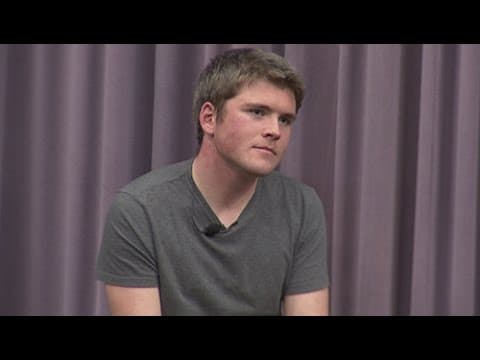
Tim Kentley-Klay: Self-Driving Cars for Everyone [Entire Talk]

TL;DR
Autonomous mobility will redefine urban transport by removing human drivers and using ground-up robot cars designed without traditional controls. Zoox details a path to launch a full autonomous mobility service with a private test history and a 2020 roadmap, aiming to replace conventional car ownership with a city fleet experience.
Transcript
^(applauding) - So, we have our CTO and our CEO of this company. Can you give us a little story of how you got here? Maybe each of you can give us a little bit of time to tell your story of how you ended up here, sitting here on this stage. - Sure. I think for me, my journey in robotics started around 2012, when I was watching from Melbourne, Austr... Read More
Key Insights
- Zoox defines AI mobility as a move from the automobile age to a new mobility age based on robotics.
- The company wants to deploy a ground up autonomous vehicle platform, not just an autopilot feature for existing cars.
- The vehicle design removes the steering wheel, instrument panel, mirrors, and other hardware to reduce complexity.
- The team envisions a future where a fleet of self driving robots offers on demand mobility in cities.
- Development started with a two person minimum setup and progressed toward field testing and licensing while refining the platform.
- The product focus is on software and sensing capabilities to achieve safe autonomous operation in urban environments.
- The speakers stress that the experience will be entirely passenger driven, with no requirement for human control.
- Stealth mode is used to maintain focus on core technology rather than marketing distractions.
- More videos from this channel:
- More from this channel: Stanford eCorner
Install to Summarize YouTube Videos and Get Transcripts
Explore YouTube Video Summarizer or Get YouTube Transcript Extractor
Questions & Answers
Q: What problem is Zoox trying to solve with autonomous mobility in cities?
Zoox is pursuing a full realization of AI mobility to reboot urban transportation by removing the human driver from the loop. The idea is to create a new platform for autonomous mobility, enabling a city service that can operate without traditional car ownership models, backed by a fleet of ground up robots.
Q: How did Zoox begin its development journey according to the speakers?
Zoox started with a small team and a laptop, building towards a full autonomous mobility service. The founders recount a long process of research and iteration, moving from Stanford and DARPA inspired ideas to real world testing and a strategy focused on creating a scalable platform for city use.
Q: What is the envisioned user experience when a Zoox robot picks you up?
The vision is a ride hailing like service where the autonomous robot comes to your location, takes you to your destination, and operates without a steering wheel or dashboard. The emphasis is on a seamless, driverless journey, with the vehicle handling navigation and safety autonomously.
Q: Why did Zoox choose stealth mode during development?
Stealth mode was chosen to maintain focus on perfecting the fundamental art and science of building the autonomous technology without marketing distractions. The teams aim to thoroughly develop the core capabilities first before public demonstrations and broad industry exposure.
Q: What was the role of Stanford and the DARPA Urban Challenge in this project?
Stanford provided early inspiration and talent for autonomous vehicle research, while the DARPA Urban Challenge demonstrated how autonomous vehicles interact with dynamic objects. These experiences informed Zoox’s approach to building a ground up autonomous system capable of real world urban operation.
Q: What is the timeline Zoox mentions for deploying their autonomous mobility service?
Zoox outlines a five year vehicle development program beginning in 2015 and concluding around 2020, with the goal of launching and scaling a fully autonomous mobility service in cities within that period, including testing in California and private test tracks.
Q: How does Zoox view the future relationship between human drivers and autonomous vehicles?
The speakers describe a future where human drivers are removed from the vehicle loop, with AI powered mobility becoming the primary means of urban transportation. They emphasize shifting from the traditional car ownership model to a service based fleet experience.
Q: What design considerations differentiate Zoox's vehicle from current cars?
Zoox vehicles are designed from the ground up without a steering wheel, dashboard, windows, or mirrors. This architecture is intended to reduce hardware complexity, improve sensor integration, and optimize machine vision, enabling a more efficient and scalable autonomous mobility solution for city environments.
Summary
In this video, the CEO and CTO of Zoox, Tim Kentley-Klay and Jesse Levinson, discuss their journey in robotics and their vision for the future of autonomous vehicles. They discuss the challenges and opportunities in building a fully autonomous vehicle from the ground up, including the design considerations, business model, and potential risks. They also address the impact of autonomous vehicles on society, the environment, and the traditional car industry.
Questions & Answers
Q: How did Tim Kentley-Klay's journey in robotics begin?
Tim Kentley-Klay's journey in robotics started in 2012 when he was inspired by Google's self-driving car program. He realized that AI and mobility could revolutionize transportation and create a new mobility age.
Q: What is Zoox's insight about AI mobility?
Zoox believes that AI mobility will take us from the age of the automobile into the next mobility age, which is robotics. They see the potential of bringing narrow AI to vehicles and taking the human out of the loop.
Q: How does Zoox envision the future of autonomous vehicles?
Zoox envisions a future where fully autonomous vehicles provide on-demand mobility services in cities. They aim to create a magical moment where a ground-up robot picks up a customer and takes them to their destination.
Q: How does Zoox design a product that doesn't compare to anything existing?
Zoox designs its autonomous vehicles from the ground up by removing traditional components like steering wheels, dashboards, windows, and mirrors. They optimize the architecture for machine vision and create a purpose-built product.
Q: What will the user experience be like with Zoox's autonomous vehicles?
The user experience is not revealed due to their stealth mode. However, they focus on creating a character for the vehicle and plan to use active LED illumination and other features to communicate with passengers.
Q: What are the trade-offs Zoox considers in developing autonomous vehicles?
Zoox considers various trade-offs, such as the technical challenges, market dynamics, and regulatory aspects of the technology. They aim to launch their fleet of autonomous vehicles by 2020.
Q: Is Zoox dependent on changes in infrastructure for their autonomous vehicles?
Zoox designs their autonomous vehicles to work in existing infrastructure without requiring significant changes. They have a purpose-built product that can operate in mixed-mode environments in cities.
Q: How does Zoox deal with risks and unknowns in their autonomous vehicle development?
Zoox focuses on bringing domain experts on board to address unknowns and mitigate risks. They value transparency and collaboration within the company and seek advice from experienced advisors and investors.
Q: What is Zoox's business model?
Zoox aims to create a fully autonomous mobility service, similar to Uber and Lyft, where customers can use their vehicles on-demand. They plan to own and operate the fleet instead of selling the vehicles to customers.
Q: Who are Zoox's biggest competitors?
Since Level 5 autonomous technology is not yet available in the market, it is difficult to pinpoint direct competitors. However, Zoox competes with companies working on autonomous vehicles and those developing disruptive transportation technologies.
Q: How does Zoox prevent accidents and deal with emotional factors?
Zoox's autonomous vehicles have advanced perception systems that can detect and react to the surrounding environment faster than humans. They have 360-degree sensing coverage and can make use of depth sensing technologies like radar and lidar. The technology is designed to minimize human errors and improve overall safety.
Takeaways
Zoox's vision for the future of autonomous vehicles is to provide on-demand, fully autonomous mobility services in cities. Their ground-up approach, holistic thinking, and emphasis on continuous improvement make them unique in the market. They focus on creating a product that is safe, efficient, and environmentally friendly. While there are risks and challenges associated with developing such a complex technology, Zoox's team, investors, and advisors are committed to building a constructive company that can disrupt the traditional car industry and create new opportunities.
Summary & Key Takeaways
-
Zoox founders discuss a future where AI powered vehicles operate without human intervention in cities, redefining how people move and how car ownership could evolve.
-
The talk covers building a purpose built autonomous vehicle rather than retrofit adaptations, aiming for a scalable urban mobility service by 2020.
-
The speakers emphasize a design philosophy that removes steering wheels and dashboards to simplify hardware and accelerate market deployment.
Read in Other Languages (beta)
Share This Summary 📚
Summarize YouTube Videos and Get Video Transcripts with 1-Click
Try YouTube Summary with ChatGPT & Claude or YouTube Transcript Generator
Explore More Summaries from Stanford eCorner 📚

Summarize YouTube Videos and Get Video Transcripts with 1-Click
Try YouTube Summary with ChatGPT & Claude or YouTube Transcript Generator