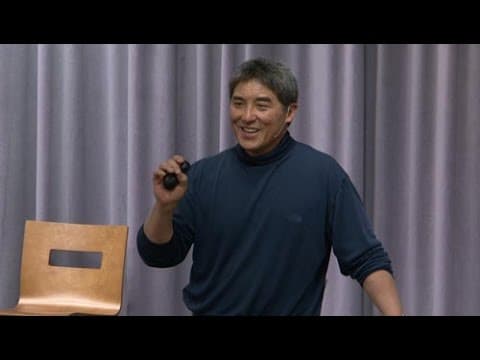
Scott Cook: Accounting for Intuit's Success [Entire Talk]

TL;DR
Scott Cook started Intuit after his wife’s frustration with paying bills revealed a widespread problem technology could solve. Customer research showed that 65% of surveyed software users had tried personal-finance software, but only 4% still used it because existing products were too hard and slow. Cook and Stanford junior Tom Proulx therefore focused on making financial software intuitive for regular people. Read on for their validation and product-building lessons.
Transcript
So we're going to do this audience driven. So I'm going to ask you for questions. I'm going to put them up here. So then I'll address the questions that's on your mind. And I'll probably group them and mush them around a little bit. But let's do this around your questions. Yes, sir? How'd your experience at Bain lead you to start Intuit? How did Ba... Read More
Key Insights
- Big businesses come from a repeatable formula: find a pain or problem that lots of people have, then solve it using technology. Cook learned this pattern at P&G, where products like Pampers, Tide, and Crest solved everyday problems with chemistry.
- Customer research validated the idea before building. Cook called households from the Palo Alto and Winnetka phone books, asking what they did with their finances, and confirmed that everyone paid bills but stuck to the basics because they disliked the task.
- The key metric revealing a product problem was the gap between trial and use. Among computer-store users, 65% had tried personal finance software but only 4% still used it, proving people liked the proposition but hated the existing products.
- Users quit existing finance software because it was too hard, too slow, and took more time than it was worth. The market leader, likely Home Accountant, made the task slower and harder than doing it by hand.
- Always ask what improvement in the customer's life they most want. Cook's theory was people wanted to eliminate the time and hassle of managing bills, not more accounting features.
- In 1982-83, software was obscure and hard, with big 500-page manuals, key combos like Control-Alt-Delete for normal operation, and no investment in user interface or testing.
- Intuit's name came from its founding philosophy: solving people's financial problems with software that was intuitively easy for regular people to use, a rare priority at the time.
- Cook deliberately delayed venture capital, choosing to build most of the product while paying themselves nothing, planning to raise money only once investors could actually use a working product.
Install to Summarize YouTube Videos and Get Transcripts
Explore YouTube Video Summarizer or Get YouTube Transcript Extractor
Questions & Answers
Q: How did Scott Cook get the idea to start Intuit?
The idea began when Cook’s wife complained about the time wasted paying household bills by hand. He recognized that paying bills was a widespread pain that emerging personal computers could potentially solve.
Q: What business formula did Scott Cook learn at P&G?
Cook learned to find a pain or problem shared by many people and solve it with technology. He saw that pattern in P&G products such as Pampers, Tide, and Crest, which addressed common everyday problems using chemistry.
Q: How did Scott Cook validate the demand for Intuit?
Cook obtained the Palo Alto and Winnetka phone books and called households to ask how they managed their finances and what they liked or disliked. His research confirmed that everyone paid bills, but people generally limited themselves to basic tasks because they disliked the work.
Q: What did the 65% versus 4% statistic reveal?
Among people recruited through computer stores and publications, 65% had tried personal-finance software, but only 4% still used it. The gap showed that customers liked the idea of financial software but disliked the available products.
Q: Why did customers abandon existing personal-finance software?
Existing products were too hard, too slow, and required more time than users felt they were worth. Instead of removing the hassle of financial tasks, the software could make those tasks slower and harder than doing them by hand.
Q: How did Tom Proulx become involved with Intuit?
Cook looked around Stanford for a software engineer and met junior Tom Proulx. Proulx agreed to work with him and shared his enthusiasm for creating software that regular people could use easily.
Q: Why was the company named Intuit?
Cook and Proulx wanted to solve financial problems with software that felt intuitively easy for ordinary users. That emphasis on ease of use inspired the name Intuit at a time when software commonly had difficult interfaces and manuals that could reach 500 pages.
Q: Why did Scott Cook delay raising venture capital?
Cook chose to build most of the product before seeking venture capital, while he and Proulx initially paid themselves nothing. His plan was to approach investors only after they could use a mostly working product.
Summary
In this video, the CEO of Intuit, Scott Cook, answers a variety of questions related to his career, the challenges he has faced, and his views on business. He discusses how his experience at Bain led him to start Intuit, the changing landscape of Silicon Valley, competition, his involvement in politics (or lack thereof), and his lowest point as an entrepreneur. He also talks about the concept of success and the goals for Intuit, the importance of savoring surprises, fostering counterculture within the company, and his favorite business and non-business books.
Questions & Answers
Q: How did your experience at Bain lead you to start Intuit?
My experience at Bain provided me with valuable lessons in applied economics and slide presentations, but it was my time at P&G where I learned how to actually do things and solve problems in a real company. This experience, combined with my observation of the pain points people had with personal finance and the emerging personal computer industry, led me to start Intuit.
Q: Is Intuit a monopoly with its dominant position, and what scares you for the future?
I wish we were a monopoly, but we actually have tough competitors in all of our businesses. Our growth has also slowed down in some areas, which is a cause for concern. Competition is always a worry, and we constantly have to stay on our toes and adapt to the changing market.
Q: Tell us about your most challenging career transition.
One of the most challenging career transitions for me was when we were facing financial difficulties in the early days of Intuit. We were running out of money, and I had to make the tough decision of laying off employees and trying to keep the company afloat. It was a difficult time, but we managed to survive and eventually thrive.
Q: How have you seen Silicon Valley change in the past two decades and how do you view it in the next few years?
Silicon Valley has changed tremendously in the past few decades. There has been a shift from hardware-based companies to software and internet-based companies. The pace of innovation has also accelerated, and competition has become fiercer. Looking ahead, I believe there will continue to be a lot of innovation and disruption in Silicon Valley, but it will also face challenges related to privacy, regulation, and societal impact.
Q: How do you see competition, and how did you beat your competition?
Competition is like gravity - it's ever-present and something we have to deal with. In our industry, the market is very competitive, but we approach competition by focusing on solving the biggest, most painful problems for our customers. We constantly test and iterate our products to ensure they are easy to use and deliver the key benefits people want. Additionally, word of mouth has been one of our most powerful sales tools, as satisfied customers recommend our products to others.
Q: Why have you decided to get involved in politics?
I haven't actually decided to get involved in politics. Despite the question being asked, I have no plans to enter politics at this time.
Q: What is your lowest point in your life as an entrepreneur and how did you overcome it?
One of the lowest points in my entrepreneurial journey was when we were running out of money and had no revenue coming in. We had to lay off employees and I had exhausted all personal sources of funding. It seemed like the end for us. However, I kept pushing forward, looking for solutions and opportunities. Eventually, we secured funding from a few individuals and managed to keep the doors open. It was a challenging time, but we persevered and eventually turned things around.
Q: Do you see Intuit becoming more than a software company?
The future is always uncertain, but we are focused on solving financial problems for individuals and businesses through software and technology. While we have expanded our offerings over the years, such as into the tax preparation and financial services space, software remains at the core of our business.
Q: How did you start Intuit and what advice would you give to others who want to start something?
Starting Intuit was a result of identifying a pain point that many people had - the hassle of managing their personal finances. We focused on creating a software solution that was easy to use and delivered the key benefit of saving time. My advice to others who want to start something is to find a big problem that needs solving, stay focused on delivering the key benefit customers want, and be willing to iterate and test your ideas.
Q: What is the biggest challenge for Intuit to go to the next level?
The biggest challenge for Intuit to go to the next level is to continuously innovate and adapt to the changing needs and expectations of our customers. We need to stay ahead of the curve in terms of technology and provide solutions that make people's financial lives easier and more effective. It's about constantly improving and never becoming complacent.
Q: How do you foster counterculture within your community?
As a company, we foster counterculture by setting grand challenges that push the boundaries of what is possible. We encourage experimentation and running experiments, allowing employees at all levels to test their ideas and prove their value. We also encourage open-mindedness and learning from surprises, rather than dismissing them. It's about creating an environment where new and unconventional ideas are welcomed and valued.
Q: How do you set goals for Intuit?
We set goals for Intuit by declaring grand challenges that align with our mission of solving financial problems for individuals and businesses. These challenges serve as guiding principles for the organization and inspire our teams to think differently and find innovative solutions. We also empower individuals to run experiments and measure the outcomes to determine the success of our goals.
Q: What advice would you give to your 1983 self?
If I could go back and give advice to my 1983 self, I would tell myself to savor surprises. I have learned over the years that surprises often hold valuable lessons and insights, and rather than disregarding them, it's important to embrace and learn from them. Surprises can lead to breakthroughs and new opportunities that we may not have considered otherwise.
Q: What important truth do very few people agree with you on?
This is a thought-provoking question. I believe one important truth that very few people agree with me on is that the key to success lies in embracing and solving the biggest, most painful problems. Many people tend to focus on incremental improvements or small optimizations, but I believe that true success comes from tackling the most significant challenges head-on and providing substantial value to customers.
Q: Who are your heroes, and what have you learned from them?
My heroes are often the people who challenge conventional thinking and make a significant impact on society. There are many individuals I admire and learn from, but to name a few, I would mention Steve Jobs, Elon Musk, and Gary Hamel. Each of them has demonstrated the ability to think differently, drive innovation, and push the boundaries of what is possible. From them, I have learned the importance of dreaming big, taking risks, and embracing the unknown.
Q: How do you make this world a better place?
I believe that through solving meaningful problems, creating great products, and delivering value to individuals and businesses, we can make the world a better place. By providing tools and solutions that help people manage their finances more effectively, we empower them to achieve their goals and lead better lives. It's about using technology to address real challenges and improve people's financial well-being.
Q: What keeps you up at night as an entrepreneur?
As an entrepreneur, the constant drive for innovation and the pursuit of excellence keeps me up at night. I am always thinking about how we can continue to deliver value to our customers, navigate the ever-changing business landscape, and stay ahead of our competitors. It's a restless pursuit to ensure that we are continuously evolving and meeting the needs of our customers.
Q: When you set out, what was your concept of success and have you achieved that?
When I first set out, my concept of success was to solve a problem that many people faced and make a positive impact in their lives. It was about creating a product that was easy to use and provided real value. In that sense, I would say that we have achieved success. However, success is an ongoing journey, and we are always striving to improve and innovate further.
Q: What are your two favorite business books and two non-business books?
Two of my favorite business books are "The Lean Startup" by Eric Ries and "Getting Real" by 37signals (now Basecamp). These books provide practical insights and strategies for building successful software companies. As for non-business books, I would recommend "The Power of Habit" by Charles Duhigg and "Dataclysm" by Christian Rudder. These books offer fascinating perspectives on human behavior and data analysis.
Summary & Key Takeaways
-
Scott Cook founded Intuit after his wife complained about the time wasted paying bills by hand. He recognized this fit a formula he learned at P&G: find a widespread pain and solve it with technology. Personal computers like the Apple II and IBM PC were just entering homes in 1982.
-
To validate the idea, Cook called households from Palo Alto and Winnetka phone books and interviewed software users. Research showed 65% had tried personal finance software but only 4% still used it, confirming people liked the concept but found existing products too hard and slow.
-
Cook partnered with Stanford junior Tom Proulx, who was excited about making software easy for regular people, inspiring the name Intuit. They built slowly for a year, paying themselves nothing, planning to seek venture capital only after the product was mostly working.
Read in Other Languages (beta)
Share This Summary 📚
Summarize YouTube Videos and Get Video Transcripts with 1-Click
Try YouTube Summary with ChatGPT & Claude or YouTube Transcript Generator
Explore More Summaries from Stanford eCorner 📚


![Gurjeet Singh: Shaping the Future of Data [Entire Talk] thumbnail](/_next/image?url=https%3A%2F%2Fi.ytimg.com%2Fvi%2FBgyuQXrFEn8%2Fhqdefault.jpg&w=750&q=75)

![Jocelyn Goldfein: Deep Inside Facebook [Entire Talk] thumbnail](/_next/image?url=https%3A%2F%2Fi.ytimg.com%2Fvi%2F2m8vFsdOFNY%2Fhqdefault.jpg&w=750&q=75)
Summarize YouTube Videos and Get Video Transcripts with 1-Click
Try YouTube Summary with ChatGPT & Claude or YouTube Transcript Generator