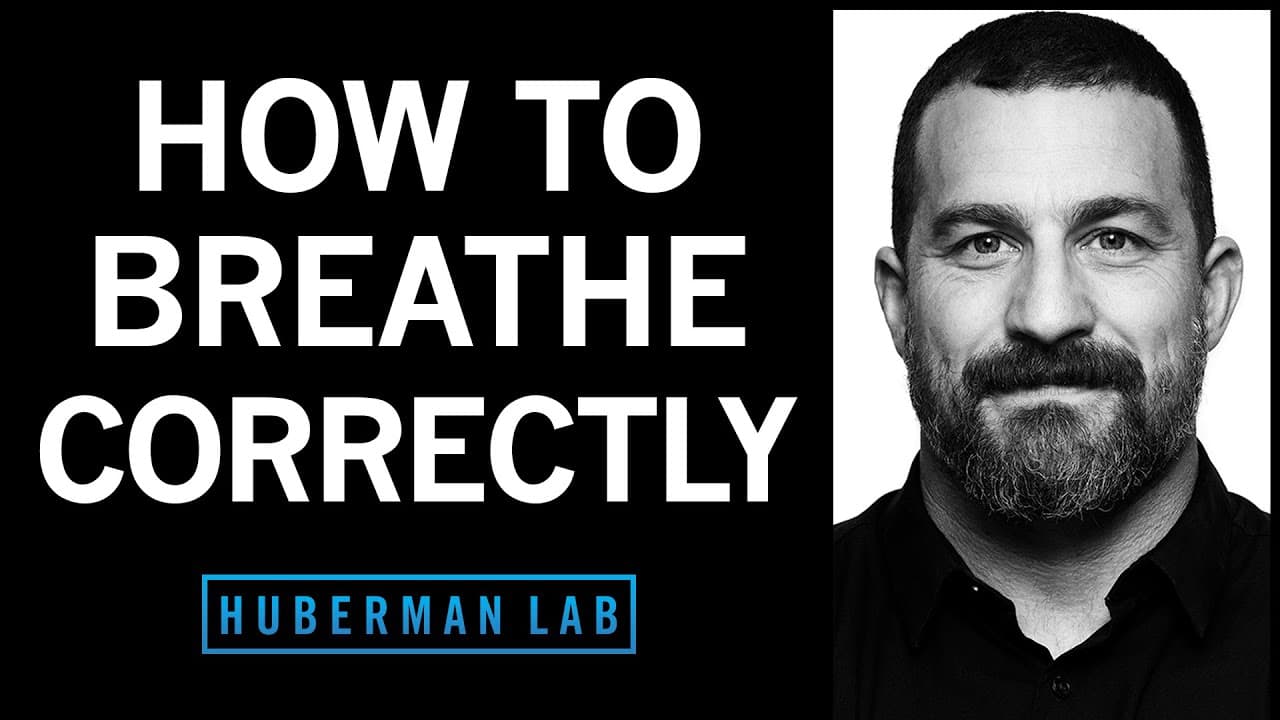
How to Breathe Correctly for Better Health and Performance
TL;DR
To breathe correctly for optimal health, use diaphragmatic breathing through your nose to enhance oxygen delivery and reduce stress. Proper breathing positively impacts mental health, physical performance, and can alleviate issues like sleep apnea. Techniques like the physiological sigh can rapidly decrease stress by balancing oxygen and carbon dioxide levels.
Transcript
ANDREW HUBERMAN: Welcome to the Huberman Lab podcast, where we discuss science and science-based tools for everyday life. [MUSIC PLAYING] I'm Andrew Huberman, and I'm a professor of neurobiology and ophthalmology at Stanford School of Medicine. Today, we are discussing breathing. Now, breathing is something that we are all familiar with because, fr... Read More
Key Insights
- 😪 Breathing correctly during sleep is crucial for preventing sleep apnea and improving overall health.
- 😪 Shifting to nasal breathing during sleep can alleviate sleep apnea symptoms.
- 😪 Underbreathing during sleep can have serious consequences for cardiovascular health, cognitive function, and physical performance.
- ✋ High-altitude breathing requires more effort due to lower air pressure, leading to hypoxia. Conscious effort to breathe deeply can help adapt to high altitudes.
Install to Summarize YouTube Videos and Get Transcripts
Explore YouTube Video Summarizer or Get YouTube Transcript Extractor
Questions & Answers
Q: What are the consequences of underbreathing during sleep?
Underbreathing during sleep can lead to sleep apnea, which can cause excessive daytime sleepiness, cardiovascular problems, sexual dysfunction, cognitive dysfunction, and exacerbate certain health conditions like dementia or traumatic brain injuries.
Q: How can nasal breathing during sleep help with sleep apnea?
Nasal breathing during sleep can reduce sleep apnea symptoms by increasing resistance and promoting a more efficient breathing pattern. Using medical tape to hold the mouth closed or consciously practicing nasal breathing during the day can help train the body to nasal breathe during sleep.
Q: How does high altitude affect breathing?
High altitude has lower air pressure, making it harder to breathe. The decreased pressure gradient between the outside air and the lungs requires more effort to fill the lungs with air. This can cause lightheadedness, headache, and oxygen deprivation.
Q: What brain areas control breathing?
The pre-Botzinger complex in the brainstem controls rhythmic breathing, while the phrenic nerve controls the diaphragm, the main muscle involved in the mechanical process of breathing.
Summary & Key Takeaways
-
Breathing is essential for life and is important for mental health, physical health, and performance.
-
Proper breathing involves both mechanical (nose, mouth, lungs, diaphragm) and chemical (oxygen, carbon dioxide) components.
-
Underbreathing during sleep can lead to sleep apnea, which has negative health effects. Shifting to nasal breathing during sleep can help alleviate sleep apnea symptoms.
-
High-altitude breathing requires more effort due to reduced air pressure, leading to hypoxia. Conscious effort to breathe deeply can help adapt to high altitudes.
-
The phrenic nerve controls the diaphragm, and the pre-Botzinger complex in the brainstem controls rhythmic breathing.
Read in Other Languages (beta)
Share This Summary 📚
Summarize YouTube Videos and Get Video Transcripts with 1-Click
Try YouTube Summary with ChatGPT & Claude or YouTube Transcript Generator
Explore More Summaries from Andrew Huberman 📚




Summarize YouTube Videos and Get Video Transcripts with 1-Click
Try YouTube Summary with ChatGPT & Claude or YouTube Transcript Generator