How to Understand AI-Generated Code Better
TL;DR
Understanding AI-generated code keeps humans able to contribute ideas, not merely verify correctness. Developers can reduce cognitive debt by asking agents for personalized explainer documents, literate code diffs, interactive figures, quizzes, and microworlds that build intuition while preserving the speed benefits of agent-assisted development.
Transcript
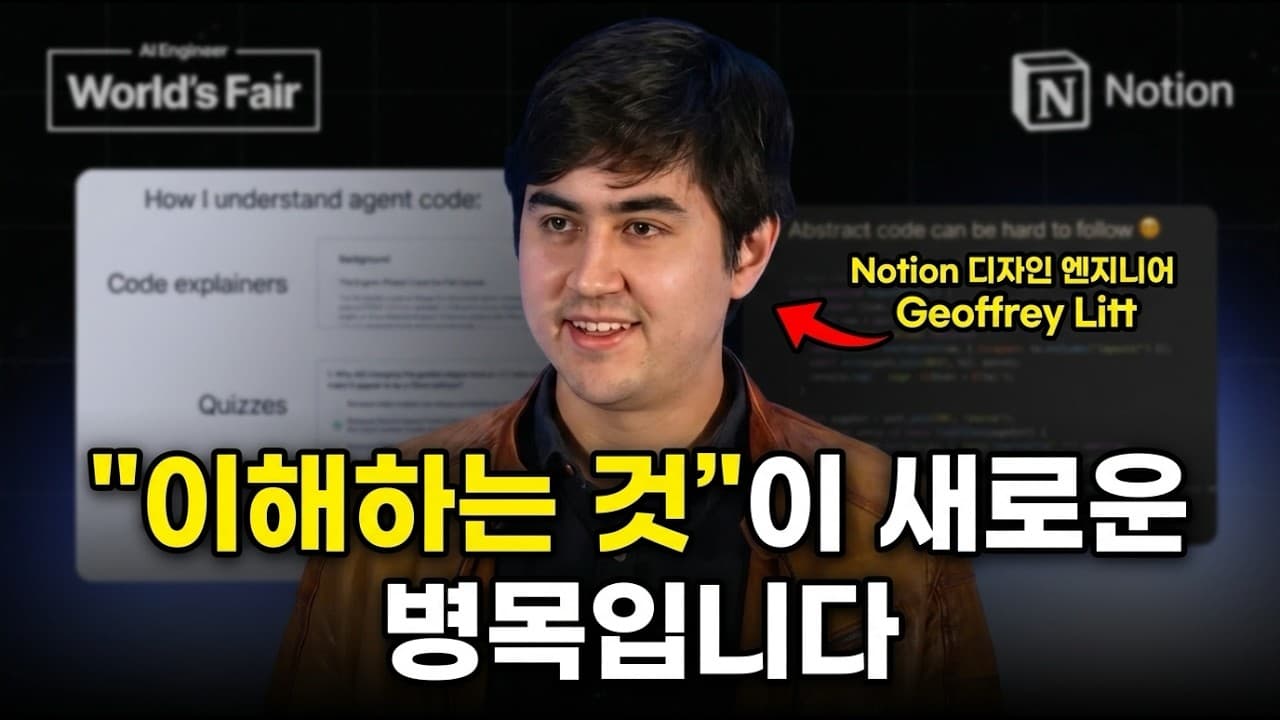
What's up? Yeah, thank you for coming to the design engineering track at AI. Is everyone having fun? Yeah, I think this is going to be a great track, so get excited. All right, let's get going. Um, my name's Jeffrey Litt. I'm a design engineer at Notion currently. And I'm here to drop a hot take for this room, maybe. I think it is still important f... Read More
Key Insights
- Human understanding is primarily a foundation for creative participation, not only a mechanism for verifying whether an agent produced correct code. What a developer understands after one development loop shapes the ideas and decisions they can contribute during every later loop.
- Correctness checking is increasingly suitable for agents when they receive an effective verification loop. A human still needs to understand the resulting system because approving or rejecting an implementation is different from developing the conceptual structures required to generate the next useful idea.
- Cognitive debt is the loss of practical understanding that accumulates when software changes faster than a person can follow. A developer may initially move quickly through vibe coding, then reach a point where the system feels opaque and meaningful participation becomes difficult.
- Education provides useful models for understanding agent-generated code. Instead of treating a raw diff as the complete explanation, developers can ask what a personalized curriculum for one change would include, then use background, intuition, examples, interaction, and structured code commentary.
- An effective explainer document begins with the system's background rather than the latest modification. It can describe the engine, coordinate system, and relevant subsystems first, allowing the reader to build enough context to understand why the new implementation works.
- Intuition should precede implementation details in a code explanation. A concise description of the change's essential goal, supported by examples, gives readers a conceptual anchor before they encounter files, functions, coordinates, or other lower-level details.
- Interactive figures can reveal behavior that static prose may not communicate as directly. In the Zen garden example, moving rocks in a simulation exposes coordinate changes and drawing-layer behavior, although interactivity must be used carefully rather than added without purpose.
- Quizzes and microworlds can test and deepen understanding beyond passive reading. Quizzes reveal when someone only believes they understood an explanation, while microworlds let a person inhabit a simplified system and develop intuition about its behavior through exploration.
Install to Summarize YouTube Videos and Get Transcripts
Explore YouTube Video Summarizer or Get YouTube Transcript Extractor
Questions & Answers
Q: Why should developers understand AI-generated code?
Developers should understand AI-generated code so they can remain active creative participants in a project. Verification only asks whether an implementation is acceptable, but participation requires conceptual structures that can be recombined into new ideas. The understanding gained from one development loop becomes the foundation for decisions, insights, and creative leaps in the next loop.
Q: What is cognitive debt in AI-assisted development?
Cognitive debt is the accumulated loss of understanding that occurs when code changes faster than a developer can follow. Like technical debt, it may appear manageable for a while, especially when vibe coding is producing rapid progress. Eventually, the developer may realize they no longer know how the system works and cannot participate effectively in further development.
Q: Why is code verification not enough for human developers?
Code verification usually produces a limited decision, such as whether a change matches a specification, avoids taking down production, or uses an acceptable architecture. Those judgments matter, but they do not automatically create a rich mental model. Human contributors need that model to connect concepts fluently, suggest improvements, and originate the next direction for the project.
Q: How can an AI agent explain a code change effectively?
An AI agent can create a personalized explainer document that starts with relevant background, introduces the change through intuition and examples, includes interactive figures where they genuinely help, and finishes with a structured walkthrough of the code. This approach teaches the surrounding system and the change's purpose instead of presenting a raw list of modified files.
Q: What is a literate code diff?
A literate code diff is a code change presented in a deliberate explanatory sequence with prose surrounding the implementation. Rather than listing modified files without context, it tells the reader what is happening before each relevant section and arranges the material in an order that supports comprehension. The result can resemble a textbook chapter about a pull request.
Q: How do interactive figures improve code understanding?
Interactive figures let developers manipulate a simplified representation and observe how internal behavior changes. In the Zen garden example, a person can move rocks and inspect coordinate and drawing-layer changes related to an isometric perspective. Such interaction can provide intuition that is difficult to achieve with prose or static pictures, but it should be used selectively.
Q: Why should AI-generated code explanations include quizzes?
Quizzes help reveal the gap between reading an explanation and genuinely understanding it. A person can finish a document feeling confident, then discover through a basic question that the core idea was not retained. Having an agent create comprehension checks makes understanding observable and reduces the chance that passive reading produces false confidence about the code.
Q: What are microworlds for understanding software systems?
Microworlds are simplified environments built by agents so developers can explore a system and form an intuitive model of its behavior. The talk describes them as richer than written documentation and cites their use for a Prolog interpreter and a website migration. They support learning through direct exploration while helping humans stay involved in agent-assisted work.
Summary & Key Takeaways
-
Human understanding remains important as agents write increasingly large amounts of code. Its deeper purpose is participation, not merely checking whether an implementation is correct. A rich mental model lets a developer recombine concepts, make creative leaps, propose the next idea, and remain actively involved across successive development cycles.
-
Failing to understand accumulated agent-generated work creates cognitive debt, a condition similar in spirit to technical debt. Development may initially proceed quickly, but eventually the human can lose track of how the system works and become unable to participate effectively. Better agents do not remove this need for sustained comprehension.
-
Educational methods can make code comprehension more efficient. An agent-generated explanation can establish background, present intuition before implementation details, add carefully chosen interactive figures, and organize changes as literate code diffs. Quizzes expose false confidence, while microworlds provide an intuitive environment for exploring how systems behave beyond written explanations.
Read in Other Languages (beta)
Share This Summary 📚
Summarize YouTube Videos and Get Video Transcripts with 1-Click
Try YouTube Summary with ChatGPT & Claude or YouTube Transcript Generator
Explore More Summaries from Tech Bridge 📚



Summarize YouTube Videos and Get Video Transcripts with 1-Click
Try YouTube Summary with ChatGPT & Claude or YouTube Transcript Generator