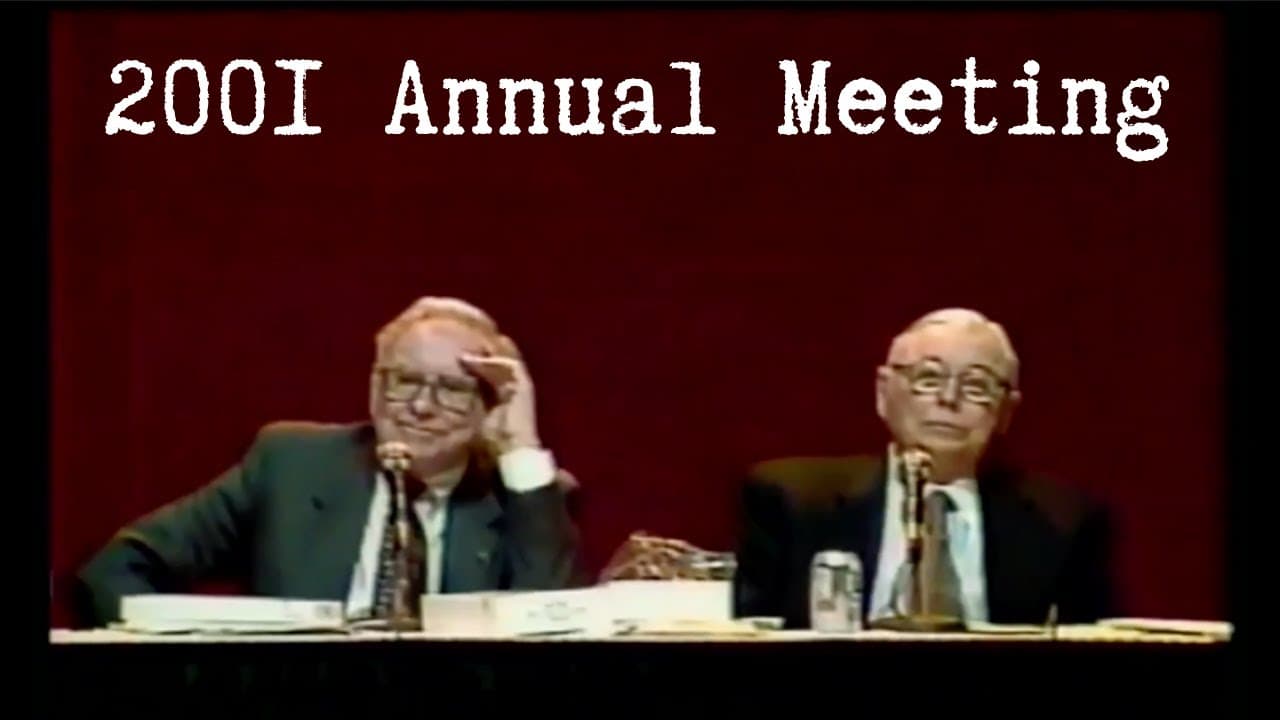
2001 Berkshire Hathaway Annual Meeting (Full Version)
TL;DR
Berkshire prefers buying outstanding operating businesses with strong management at acceptable prices, rather than relying primarily on marketable securities. Warren Buffett said the company hoped to add roughly 40 businesses over about 14 years, retain its existing businesses, and avoid any appreciable increase in shares outstanding, while Charlie Munger distinguished pharmaceuticals from technology by emphasizing predictability and the risk of permanent casualties.
Transcript
right and y Andy if you're here you can stand up uh I think the crowd would like to say thanks [Applause] we have one others will guest who uh after uh doing uh an incredible job for uh all Berkshire shareholders and particularly for Charlie and Maine uh uh roushay uh retired this year but Ralph and Lucy I believe are hearing Ralph and Lucy would s... Read More
Key Insights
- Berkshire’s first investment preference is buying outstanding operating businesses with strong management at prices consistent with the quality received. Buffett said this had been the company’s preference for many decades, even though many observers apparently had not recognized that priority.
- Successful operating businesses can fund additional acquisitions. Buffett credited Ralph’s profits at Scott Fetzer with making ownership of many other Berkshire companies possible, showing how earnings generated by one acquisition can support the purchase and development of a broader collection of businesses.
- Berkshire also owns marketable securities, including investments purchased in the mid-1970s that performed very well. Buffett nevertheless said the climate had become less friendly for making money from marketable securities and expressed a preference for the activities associated with owning and operating businesses over time.
- Berkshire’s long-term objective included adding roughly 40 businesses over about 14 years. Buffett paired that expansion goal with two other aims: retaining every business Berkshire already owned and avoiding any appreciable increase in the number of shares outstanding.
- Share count discipline was central to Buffett’s answer about future shareholder value. He hoped Berkshire could expand its collection of businesses without issuing materially more shares, meaning the benefits of additional operating businesses would not be accompanied by an appreciable increase in ownership units.
- The pharmaceutical sector was considered easier to predict than the high-technology sector. Munger said almost everybody did well in pharmaceuticals, with some companies performing extremely well, while the technology sector contained many permanent casualties.
- Sector-wide decline does not automatically create an equally attractive investment opportunity. The discussion contrasted pharmaceuticals around 1993 with recently decimated technology businesses, and Munger identified the predictability of industry outcomes as the important difference between the two situations.
- Berkshire’s 2001 formal shareholder business included confirming a quorum, approving the procedural motion on prior minutes, and electing seven directors. A proposal submitted by shareholder Bartlett Naylor was withdrawn on April 20, 2001, so shareholders did not consider it at the meeting.
Install to Summarize YouTube Videos and Get Transcripts
Explore YouTube Video Summarizer or Get YouTube Transcript Extractor
Questions & Answers
Q: How does Berkshire Hathaway choose businesses to buy?
Berkshire’s first preference is to buy outstanding operating businesses that combine high business quality with high-quality management. The purchase price must also be consistent with those qualities. Buffett said this approach had been Berkshire’s preference for many decades and noted that the company had experienced somewhat more success finding such acquisitions during the preceding 16 or 18 months.
Q: Why does Berkshire prefer operating businesses over marketable securities?
Berkshire prefers the activities associated with owning and operating businesses over time. Buffett acknowledged that Berkshire owned many marketable securities and that securities purchased in the mid-1970s had performed very well. However, he said the climate had become less friendly for making money from marketable securities, reinforcing the company’s preference for acquiring outstanding operating companies.
Q: What was Berkshire Hathaway’s long-term acquisition goal in 2001?
Buffett hoped Berkshire would add roughly 40 businesses by the time the young shareholder asking the question was ready for college, which he estimated would be in about 14 years. He also hoped Berkshire would retain every business it already owned and would not have an appreciably larger number of shares outstanding after completing that expansion.
Q: Why did Warren Buffett praise Ralph at the 2001 annual meeting?
Buffett praised Ralph for doing what he described as an incredible job for Berkshire shareholders, particularly for Charlie and himself. He called Scott Fetzer one of Berkshire’s best acquisitions and said the acquisition ranked among the best because of Ralph. Buffett also credited the profits Ralph delivered with making many other Berkshire company purchases possible.
Q: How did Munger compare pharmaceutical and technology investments?
Munger said the future of the pharmaceutical industry was easier to predict than the future of the high-technology sector. In pharmaceuticals, almost everybody did well and some companies did extremely well. By contrast, he said the high-technology sector included many permanent casualties, making a broad technology investment less predictably successful despite the sector’s decline.
Q: Why was a pharmaceutical sector investment considered more predictable?
The pharmaceutical sector appeared more predictable because, according to Munger, almost everybody in the sector did well and some companies performed extremely well. That pattern reduced the importance of identifying the single eventual winner. Technology presented a different outcome distribution because many participants could become permanent casualties, even after the broader sector had been decimated.
Q: What happened during Berkshire Hathaway’s formal 2001 shareholder meeting?
The meeting confirmed that enough Class A and Class B shares were represented to establish a quorum. Shareholders approved dispensing with the reading of the previous meeting’s minutes and elected Warren Buffett, Susan Buffett, Howard Buffett, Malcolm Chase, Charles Munger, Ronald Olson, and Walter Scott Jr. as directors. The formal meeting then adjourned before shareholder questions began.
Q: What happened to the shareholder proposal scheduled for the meeting?
A proposal had been submitted by Berkshire shareholder Bartlett Naylor and was scheduled as an item of business. Buffett stated that Naylor advised Berkshire on April 20, 2001 that he was withdrawing the proposal. Because it had been withdrawn, the proposal was not presented or acted upon during the April 28 shareholder meeting.
Summary
This video is from the 2001 annual meeting of Berkshire Hathaway shareholders. Warren Buffett introduces the directors present and provides updates on the company's performance. He also highlights Ralph Willard, a retired executive who made important contributions to the company. The meeting includes discussions on various topics such as corporate regulations, election of directors, and the impact of liabilities on companies. Buffett and Charlie Munger, Vice Chairman of Berkshire Hathaway, answer questions from shareholders regarding investments, mistakes made in the past, and the influence of labor costs on businesses.
Questions & Answers
Q: Who is Ralph Willard and why is he being acknowledged?
Ralph Willard is a retired executive who made significant contributions to Berkshire Hathaway. Buffett expresses gratitude for the profit Ralph delivered over the years, which enabled the company's ownership of many other companies.
Q: How many shares of Berkshire Hathaway were outstanding at the time of the meeting?
There were 1,343,041 shares of Class A Berkshire Hathaway common stock and 5,505,791 shares of Class B Berkshire Hathaway common stock outstanding. These shares represented a quorum for the meeting.
Q: What was the first order of business at the meeting?
The first order of business was to elect directors. Shareholders were given the opportunity to withdraw their proxy and vote in person, or request a ballot if they hadn't already submitted a proxy.
Q: How many directors were elected at the meeting?
Warren E. Buffett, Susan T. Buffett, Howard G. Buffett, Malcolm G. Chase, Charles T. Munger, Ronald L. Olson, and Walter Scott Jr. were elected as directors.
Q: Who are the proxy holders for the meeting?
Walter Scott Jr and Mark D. Hamburg were the proxy holders for the meeting.
Q: Did the number of votes cast for each nominee meet the required majority?
Yes, the number of votes cast for each nominee exceeded a majority of the total votes related to all Class A and Class B shares outstanding.
Q: Was there any other business to be discussed at the meeting?
A proposal put forth by Berkshire shareholder Bartlett Naylor was originally scheduled to be presented, but he later withdrew the proposal. Therefore, it was not discussed at the meeting.
Q: Was there any mention of mistakes made by Berkshire Hathaway?
Yes, Buffett and Munger admitted to making mistakes of omission, particularly in not buying certain companies or stocks that would have been profitable. They emphasized the importance of learning from missed opportunities and not repeating the same errors.
Q: Does the potential for damage liabilities reduce the intrinsic value of companies?
Buffett explained that while some industries, such as tobacco, have faced large damage liabilities, he doesn't believe it reduces the intrinsic value of companies like Coca-Cola, See's Candies, or Dairy Queen. He cited his personal positive experience with these products and the fact that they are widely consumed without causing significant harm.
Q: Is Buffett concerned about the erosion of the legal principle of caveat emptor?
Buffett expressed concern about the increasing power of plaintiff's contingency bar and the lack of strong action by judges in cases involving junk science, junk economic testimony, and poor lawyers. He acknowledged that the lottery-like potential for large awards in liability lawsuits attracts lawyers to pursue such cases.
Q: How does Berkshire Hathaway evaluate and select companies to invest in?
Buffett and Munger explained that they look for businesses with enduring competitive advantages and top-notch management. They focus on understanding the cost structure of the business and its industry, but their main criteria for investment is a strong competitive advantage.
Q: Can the PE Ratio effectively evaluate investments?
Buffett noted that the PE Ratio is commonly used in financial analysis but it doesn't take into consideration factors such as cash or debt. He mentioned that Berkshire Hathaway evaluates each business individually based on its specific cost structure, competitive advantage, and potential for future earnings.
Q: Is hoarding cash discouraged by Berkshire Hathaway?
Buffett and Munger explained that they want to have all their money working in decent businesses, and cash is only retained when they can't find suitable investment opportunities. They emphasized the importance of deploying cash effectively and not leaving it unutilized for long periods, but they also recognized the need for a margin of safety.
Q: How do labor costs impact companies like airlines and Executive Jet?
Labor costs play a significant role in the profitability of airlines. If an airline's labor costs are significantly higher than its competitors, it will struggle to compete. In contrast, companies like Executive Jet operate differently, attracting employees with other benefits such as living flexibility and preferred shift schedules.
Takeaways
This video provides insights into the annual meeting of Berkshire Hathaway shareholders in 2001. In addition to updates on the company's performance, the meeting tackles various topics such as regulation, elections, and liabilities. Buffett and Munger's discussions shed light on their investment approach, mistakes made in the past, and the impact of labor costs on different industries. These insights provide valuable lessons for investors and businesses alike.
Summary & Key Takeaways
-
Warren Buffett opened Berkshire Hathaway’s April 28, 2001 shareholder meeting by recognizing former executive Ralph and describing Scott Fetzer as one of Berkshire’s best acquisitions. He credited Ralph’s profits with helping make many other company purchases possible, illustrating how successful operating businesses can finance Berkshire’s continuing expansion without depending entirely on securities investments.
-
The formal proceedings established a quorum, approved dispensing with the prior meeting’s minutes, and elected seven directors. A shareholder proposal was withdrawn before the meeting, so it was not presented. After the formal meeting adjourned, Buffett explained the microphone arrangement and began the shareholder question period, which was scheduled around a midday break.
-
Answering a young shareholder, Buffett said Berkshire’s first preference was acquiring outstanding operating businesses with excellent management at suitable prices. He hoped Berkshire could add around 40 businesses over approximately 14 years, retain every business it already owned, and issue no appreciable number of additional shares, thereby strengthening value for existing shareholders.
Read in Other Languages (beta)
Share This Summary 📚
Summarize YouTube Videos and Get Video Transcripts with 1-Click
Try YouTube Summary with ChatGPT & Claude or YouTube Transcript Generator
Explore More Summaries from Investor Archive 📚

Summarize YouTube Videos and Get Video Transcripts with 1-Click
Try YouTube Summary with ChatGPT & Claude or YouTube Transcript Generator