How diffusion models generate AI images from prompts
TL;DR
Diffusion models learn to add noise to an image and then reverse the process to reconstruct it, enabling text guided image generation. They balance forward diffusion with Gaussian noise and a trained reverse process using a U-Net, guided by text embeddings and guidance methods to produce new images from prompts.
Transcript
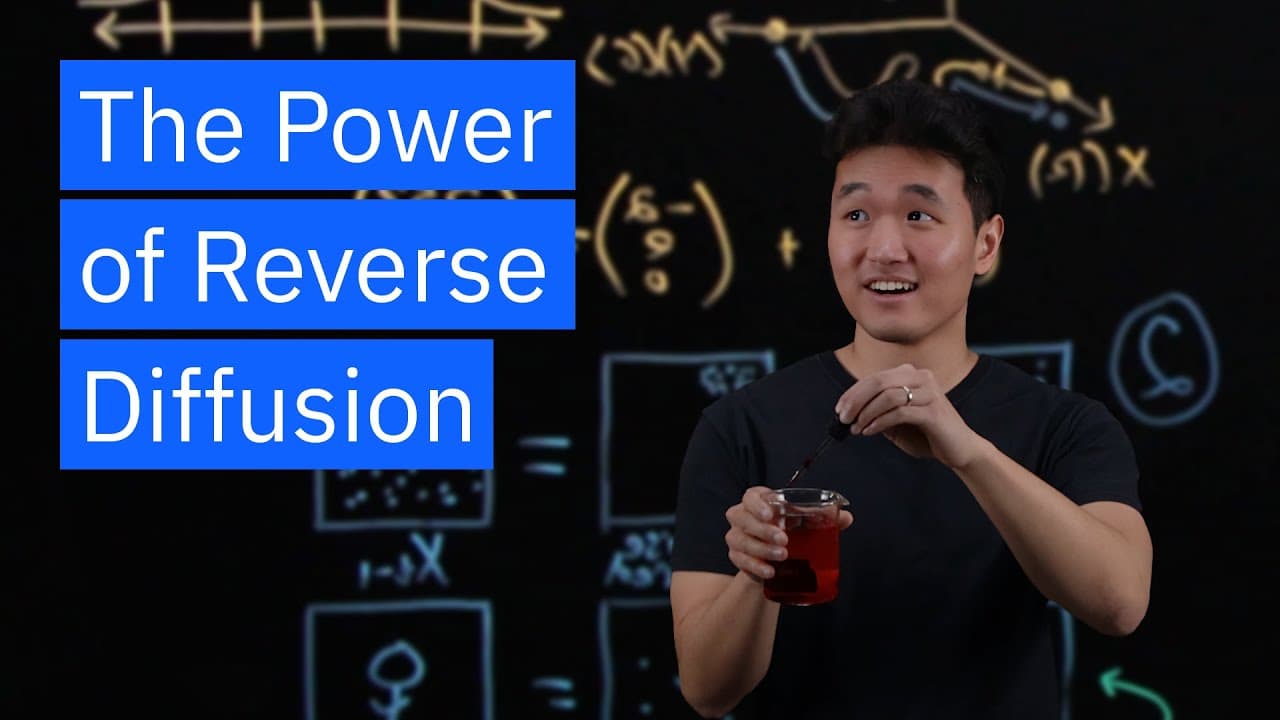
If I drop red dye into this beaker of water, the laws of physics say that the particles will diffuse throughout the beaker until the system reaches equilibrium. Now, what if I wanted to somehow reverse this process to get back to the clear water? Keep this idea in mind because this concept of physical diffusion is what motivates the approach for te... Read More
Key Insights
- Diffusion models simulate forward diffusion by adding Gaussian noise to images over time steps.
- The reverse diffusion learns to predict the original noise, enabling reconstruction of a clean image from noisy input.
- A U-Net based model is trained to reverse the diffusion process and recover details step by step.
- Text prompts are incorporated via embeddings to guide which image features are revealed during denoising.
- Self attention guidance and classifier free guidance adjust how strongly words in the prompt shape the output.
- Conditional diffusion enables controls from text inputs to affect shape, color, and composition.
- The diffusion process can be extended to other modalities like image to image editing and even audio or video.
- Applications span marketing, medicine, and molecular modeling as diffusion frameworks are applied broadly.
Install to Summarize YouTube Videos and Get Transcripts
Explore YouTube Video Summarizer or Get YouTube Transcript Extractor
Questions & Answers
Q: What is diffusion in AI image generation and why is it used?
Diffusion in AI image generation refers to the process of adding noise to an image over many steps and then learning to reverse that process to recover a clean image. This framework is used because it provides a controllable way to generate high quality images from random noise, with the ability to incorporate text prompts to guide the reconstruction.
Q: How does forward diffusion affect an image step by step?
Forward diffusion progressively adds Gaussian noise to an image through a Markov chain, causing features and structure to degrade and eventually produce full random noise. The amount of noise at each step is governed by a scheduler that controls the variance, impacting how quickly the image loses its original content.
Q: What role does a U-Net play in diffusion models?
A U-Net is trained to predict the noise added to an image at a given time step during reverse diffusion. By estimating this noise, the model can remove it to obtain a slightly less noisy image, enabling the gradual reconstruction of the original scene from random noise.
Q: How are text prompts incorporated into diffusion models?
Text prompts are encoded into embeddings that capture semantic meaning. These embeddings are used during the reverse diffusion process to condition the denoising steps, guiding which features and structures should emerge in the final image to match the prompt.
Q: What are self attention guidance and classifier free guidance?
Self attention guidance directs the model to focus on how specific parts of the prompt influence different regions of the image. Classifier free guidance amplifies the effect of selected prompt words on the generation, helping to control the prominence of described features in the result.
Q: Can diffusion models be used beyond text to image generation?
Yes, diffusion models can be extended to other use cases such as image to image editing, in painting missing components, and generating other media types like audio or video, thanks to the flexible structure of forward and reverse diffusion and conditioning on various inputs.
Q: What are some practical applications of diffusion models mentioned?
Applications include marketing and medicine, as diffusion models can generate high quality images from descriptions, edit existing images, and model complex patterns. The approach has broad utility in domains that require realistic image synthesis aligned with textual descriptions.
Q: What is conditional diffusion and how does it differ from unconditional diffusion?
Conditional diffusion constrains the denoising process using external information such as a text embedding, guiding the generation toward outputs that satisfy the given condition. Unconditional diffusion generates images without such guidance, relying solely on learned priors from the training data.
Summary & Key Takeaways
-
Diffusion models work by gradually turning a clear image into noise in a forward process, then learning to recover the image in a reverse process.
-
The reverse diffusion is learned with a neural network that predicts added noise at each step, allowing structured image reconstruction.
-
Text conditioning is achieved through embeddings and guidance methods that influence how noise is removed to match the prompt.
Read in Other Languages (beta)
Share This Summary 📚
Summarize YouTube Videos and Get Video Transcripts with 1-Click
Try YouTube Summary with ChatGPT & Claude or YouTube Transcript Generator
Explore More Summaries from IBM Technology 📚

Summarize YouTube Videos and Get Video Transcripts with 1-Click
Try YouTube Summary with ChatGPT & Claude or YouTube Transcript Generator