Why Did Ice Age People Paint Inside Caves?
TL;DR
Paleolithic cave paintings may have supported religious rituals that used images, music, dancing, and the cave’s darkness and acoustics to connect human communities with animals and an imagined spiritual world. Their exact meaning remains uncertain, but their locations and associated instruments suggest that they served a communal purpose beyond creating art for display.
Transcript
okay to review last class we discussed uh three PR prehistorical sites right including goe Jericho and K Hoak and the argument I made to you um last class which is the general scholarly consensus is that um what drove what compelled the transition to agriculture was was the religious beliefs of the people at that time okay so it was Humanity's reli... Read More
Key Insights
- Religion is presented as a fundamental human impulse that helped people interpret existence, purpose, nature, life, and death. The lecture argues that this impulse mattered alongside economic and biological needs and may also have contributed to humanity’s later transition toward agriculture.
- Cave-painting interpretations are highly uncertain because Paleolithic communities left no written explanations and cannot be questioned directly. The lecturer identifies his account as a personal interpretation based on limited evidence and emphasizes that scholars do not agree about how the paintings were produced, used, or understood.
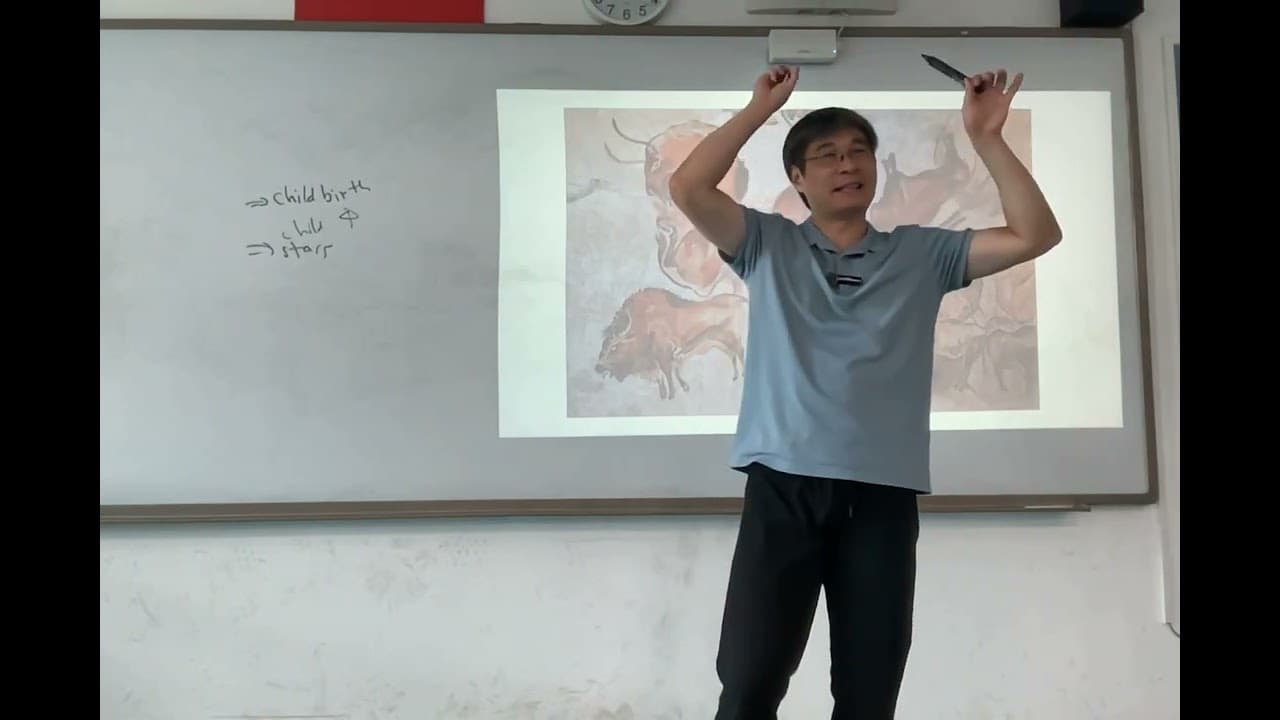
- Paleolithic cave art is artistically sophisticated and often depicts animals such as lions, horses, rhinoceroses, and bison. The compositions do not always have a single visual focus, which can make nature appear interconnected rather than divided into isolated subjects or organized around one central figure.
- Cave artists created color mainly with red ochre and black charcoal. Because the chambers were dark, they used burning animal fat for illumination, although this lighting could not brighten every part of the cave and made painting there physically demanding.
- The location of cave paintings provides evidence for ritual use because images were found in cave areas with especially strong acoustics. Musical instruments, including flutes, were also discovered, leading to the interpretation that people combined painted images with music, dancing, and periodic religious gatherings.
- Childbirth could inspire supernatural explanations because life appeared to emerge from the darkness of the womb. In the lecture’s reconstruction, the womb becomes a portal through which a soul travels from another world into the human world, linking birth with a wider spiritual order.
- Burial could represent the return of a soul to its place of origin. The proposed belief system uses symmetry: a soul enters life through the darkness of the womb, then the dead body is placed in darkness so the soul can travel back to another world.
- Caves could symbolize portals because their darkness and tunnel-like form resemble a womb. Under this interpretation, entering a cave to celebrate painted animals was a religious action involving respect for animal souls, nature, and the hidden processes connecting different worlds.
- More videos from this channel:
- More from this channel: Predictive History
Install to Summarize YouTube Videos and Get Transcripts
Explore YouTube Video Summarizer or Get YouTube Transcript Extractor
Questions & Answers
Q: Why did Paleolithic people paint animals inside caves?
The lecture proposes that Paleolithic people painted animals as part of religious rituals rather than simply to produce art for display. Paintings occurred in cave areas with strong acoustics, and musical instruments such as flutes were also found. These clues suggest gatherings that combined animal images, music, dancing, and communal worship, possibly honoring animal souls and relationships between nature, humanity, and another world.
Q: How were Paleolithic cave paintings created?
Cave artists mainly used ochre, a type of clay, to produce red pigment and charcoal to produce black pigment. Since the chambers were dark, people burned animal fat to provide light while working. The process required them to remain in spaces described as dark, cold, difficult to breathe in, and only partly illuminated, which indicates considerable effort and commitment.
Q: What evidence connects cave paintings with religion?
The principal evidence is the placement of paintings in parts of caves where the acoustics were especially strong. Musical instruments, including flutes, were also found, suggesting that sound accompanied the images. The lecturer therefore interprets the caves as gathering places for periodic festivals involving music, dancing, painted animals, and shared rituals that expressed the community’s religious beliefs.
Q: What did Paleolithic cave paintings mean?
Their exact meaning is unknown because the people who made them were preliterate and left no written account. The lecture offers a speculative interpretation in which caves functioned as portals between worlds and animal paintings expressed respect for animal souls. However, it repeatedly stresses that the evidence is unclear and that many competing interpretations remain possible.
Q: Why might caves have symbolized a spiritual portal?
The lecture compares a cave’s dark, tunnel-like form with a mother’s womb. If the womb was imagined as a doorway through which a soul entered the human world, a similar natural structure could also be understood as a passage between worlds. Entering caves for ritual gatherings may therefore have symbolized approaching the source of life, animals, souls, and spiritual renewal.
Q: How does the lecture connect childbirth and burial?
Childbirth is interpreted as the arrival of a soul through the darkness of the womb, which functions symbolically as a portal from another world. Burial reverses that journey by placing a dead person back into darkness, allowing the soul to return to its original world. This symmetrical explanation provides a simple religious framework for understanding both life and death.
Q: Why is the interpretation of cave art uncertain?
Interpretation is uncertain because cave painters wrote nothing explaining their beliefs, intentions, methods, or ceremonies. Modern observers cannot return to their society or ask them what particular animals and locations meant. Although pigments, instruments, acoustics, and image placement provide clues, those clues do not establish one definitive explanation, so the lecturer presents his argument as a personal reconstruction.
Q: How does cave art support the idea that religion is fundamentally human?
Cave art shows that people devoted substantial effort to symbolic activity under harsh conditions. They entered dark, cold spaces, created sophisticated animal images, and may have combined them with music and dancing. The lecture argues that such behavior reflects a persistent need to explain birth, death, nature, the stars, illness, and humanity’s place in the world, not merely immediate economic survival.
Summary & Key Takeaways
-
The lecture argues that humanity’s religious impulse existed long before agriculture and may be a fundamental part of being human. Paleolithic cave paintings provide the central evidence because people repeatedly entered difficult, dark environments to create elaborate animal images, suggesting motivations that extended beyond convenience, survival, or ordinary decoration.
-
Cave artists mainly obtained red pigment from ochre and black pigment from charcoal. They illuminated dark chambers by burning animal fat. The paintings often appeared where caves had especially strong acoustics, while musical instruments such as flutes were also found, supporting the interpretation that images, music, and dancing formed parts of communal rituals.
-
The proposed interpretation connects caves with birth, death, and spiritual passage. A womb could be imagined as a portal through which a soul entered this world, while burial in darkness could return it to another world. Because caves resemble wombs, gatherings around painted animals may have honored animal souls and nature’s regenerative powers.
Read in Other Languages (beta)
Share This Summary 📚
Summarize YouTube Videos and Get Video Transcripts with 1-Click
Try YouTube Summary with ChatGPT & Claude or YouTube Transcript Generator
Explore More Summaries from Predictive History 📚






Summarize YouTube Videos and Get Video Transcripts with 1-Click
Try YouTube Summary with ChatGPT & Claude or YouTube Transcript Generator