How to Become AI Researcher with Math and PyTorch
TL;DR
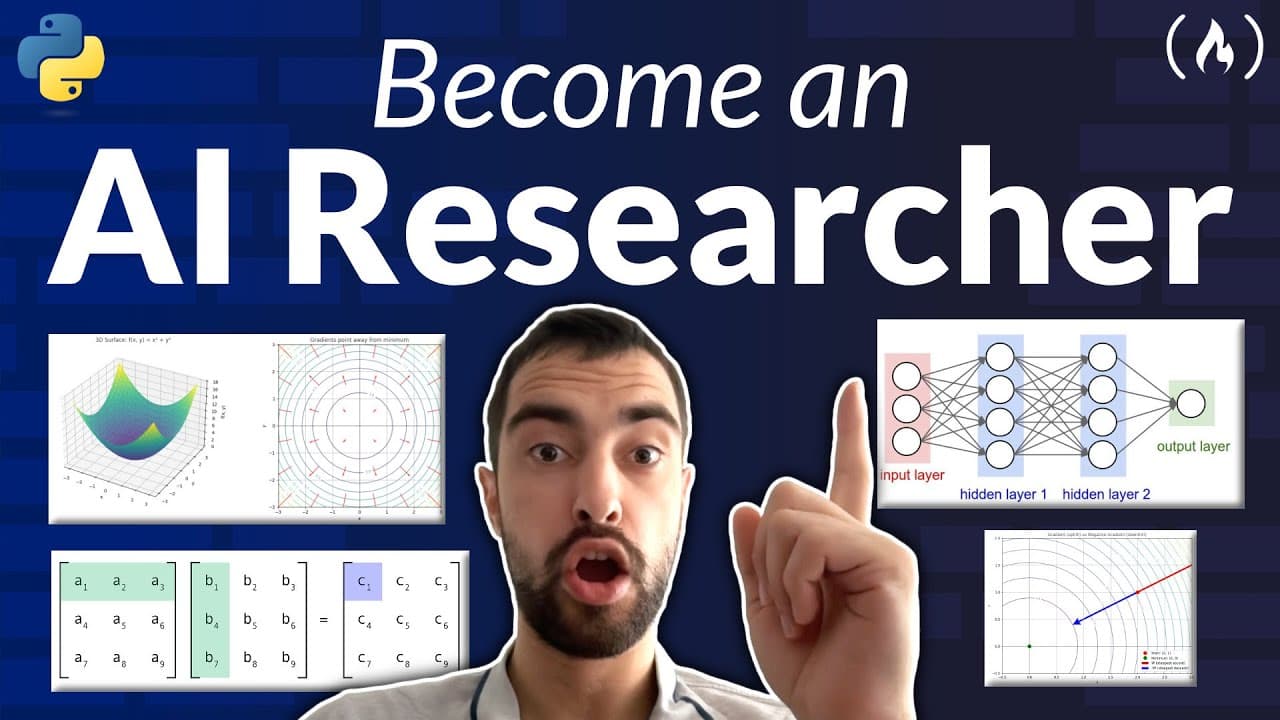
This course teaches foundational mathematics for AI, PyTorch fundamentals, neural networks, and transformers to enable readers to understand and critique AI research. It guides learners from functions and derivatives to gradients, matrices and probability, then through tensors, backpropagation, and attention in transformers, equipping them to read papers and start their own research.
Transcript
Welcome to this full course on becoming an AI researcher. This course will guide you step by step starting with the foundational mathematics essential for understanding modern AI before diving into PyTorch fundamentals. You will then learn about the building blocks of AI from simple neuronet networks to the complexities of multi-layer architectures... Read More
Key Insights
- The course covers foundational mathematics essential for AI research, including functions, derivatives, vectors, gradients, matrices and probability.
- Gradients are explained as the mechanism by which neural networks learn, guiding weight updates to minimize error.
- Matrices and matrix multiplications are described as central to neural networks and are performed efficiently on GPUs.
- PyTorch fundamentals focus on creating tensors, data types, and basic tensor operations used in AI models.
- Neural networks are introduced starting from a single neuron to multi layer architectures with back propagation.
- Activation functions are discussed as crucial for transforming linear combinations into nonlinear decision boundaries.
- Transformers are presented as the base of modern AI models, detailing attention, self attention, multi head attention and feed forward networks.
- The course includes a practical roadmap and a GitHub repository to support self-study and hands on experimentation.
Install to Summarize YouTube Videos and Get Transcripts
Explore YouTube Video Summarizer or Get YouTube Transcript Extractor
Questions & Answers
Q: What is the stated goal of the AI researcher course and what topics are covered to achieve it?
The goal of the course is to equip learners with the fundamental knowledge needed to read, understand, and begin contributing to AI research papers. It starts with foundational mathematics such as functions, derivatives, vectors, gradients, matrices and probability, then moves to PyTorch fundamentals, neural networks, and finally transformers, providing a complete road map to becoming an AI researcher.
Q: How does the course describe gradients in the context of neural networks?
Gradients are described as the direction of steepest ascent or descent used in learning. They indicate how to adjust weights to reduce error in a neural network. By computing partial derivatives with respect to each weight, the network updates its parameters during training to minimize loss, enabling learning and improvement over time.
Q: What hardware or software setups are suggested for running the course materials?
The course mentions running code in Google Colab or locally, with options to connect Colab to GPU, CPU, or TPU. It emphasizes installing required Python packages from a requirements.txt file and potentially using a Colab extension to streamline execution, reflecting a flexible setup for learners across environments.
Q: What is highlighted about transformers in the course description?
Transformers are highlighted as the base technology for today’s large language models, image and video generation, and many AI systems. The course covers attention mechanisms, self attention, multi head attention, feed forward networks, tokenization, and how these components come together to form modern AI architectures capable of modeling complex data.
Q: What is the scope of math topics covered before the PyTorch module?
Before PyTorch, the course covers functions (linear, quadratic, cubic, square root), derivatives (rate of change), vectors (magnitude, dot product, normalization), gradients (steepest ascent/descent, partial derivatives), matrices (multiplication, transpose, identity), and probability (expected value, conditional probability). This sequence builds the necessary mathematical intuition for AI model training.
Q: What practical resources are provided to learners for hands on practice?
The course references a GitHub repository with Jupiter notebooks and example code, including a first module on math and subsequent PyTorch tutorials. It encourages learners to run notebooks in Google Colab or locally, use Colab GPU/CPU/TPU, and install required packages so students can experiment and build their own AI models.
Q: What is the role of PyTorch in the course sequence?
PyTorch serves as the practical framework to implement the mathematical concepts taught earlier. Learners create tensors, explore data types, perform matrix multiplications, transpositions, reshaping, and indexing. The module also covers building neural networks from scratch, including backpropagation, to bridge theory with implementable AI systems.
Q: How does the course propose learners engage with AI research papers after completion?
The course positions itself as a roadmap enabling learners to read AI research papers critically and to publish their own work. By mastering the math foundations, PyTorch skills, neural network concepts, and transformer architectures, students will be able to understand the math inside papers and contribute to ongoing AI research endeavors.
Summary & Key Takeaways
-
A comprehensive roadmap is presented from basic math to advanced AI concepts, including gradients and transformers, enabling a reader to follow AI research literature.
-
Key modules include math foundations, PyTorch fundamentals, neural networks, and transformers, with practical examples and a GitHub repository for hands-on practice.
-
The course emphasizes critical reading of AI research papers and provides a step by step path to becoming capable of contributing to the field.
Read in Other Languages (beta)
Share This Summary 📚
Summarize YouTube Videos and Get Video Transcripts with 1-Click
Try YouTube Summary with ChatGPT & Claude or YouTube Transcript Generator
Explore More Summaries from freeCodeCamp.org 📚



Summarize YouTube Videos and Get Video Transcripts with 1-Click
Try YouTube Summary with ChatGPT & Claude or YouTube Transcript Generator