How Do Plain Lenses Perform Fourier Transforms on Images?
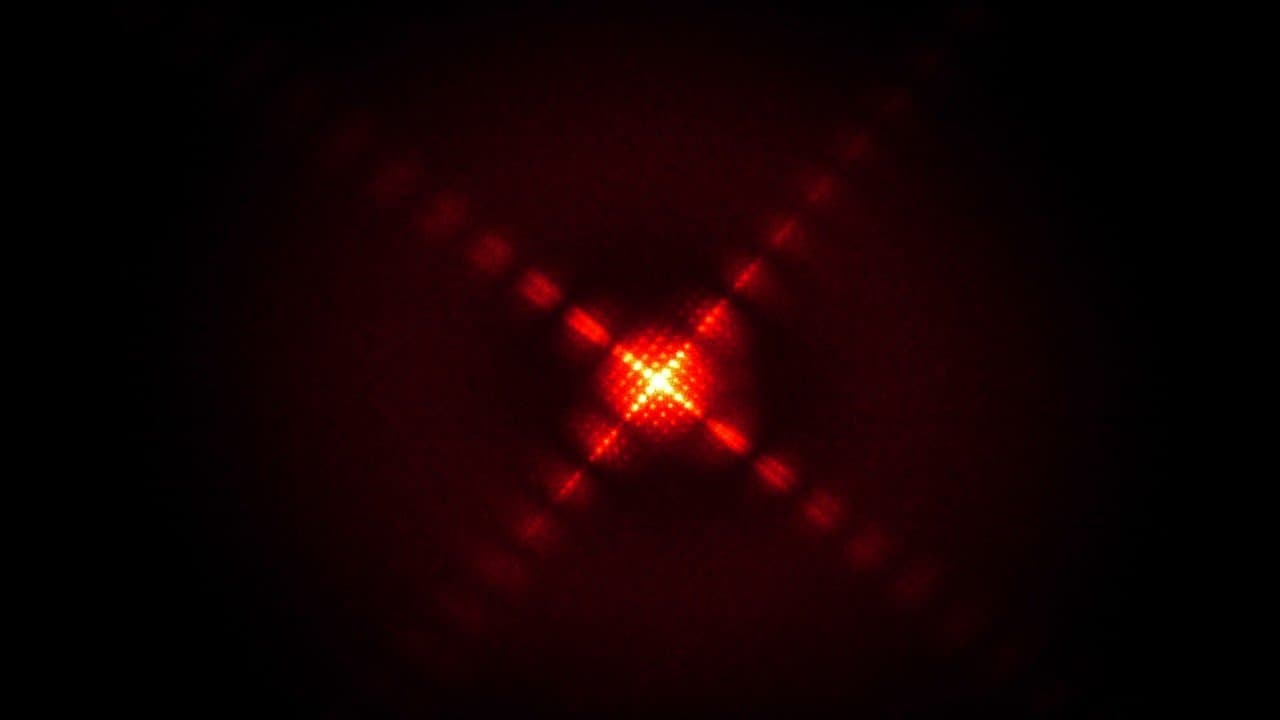
TL;DR
Plain lenses can perform Fourier transforms on images by focusing light to visualize spatial frequencies without capturing phase information. This allows for the identification and processing of image features using amplitude data alone, as demonstrated by the 4f correlator setup. Understanding this principle is essential for image processing applications.
Transcript
hey everyone recently someone at work said that plain old lenses actually take the Fourier transform of the image that you put into them so at first it seems pretty weird how does a plain old piece of glass like this perform of complex mathematical operations such as a Fourier transform so I looked into it and let me show you what I found out most ... Read More
Key Insights
- ❓ Fourier transforms using lenses demonstrate spatial frequencies crucial in image processing.
- 💁 Phase information is absent in Fourier transforms focusing on magnitude only.
- 💁 4f correlators utilize lenses and pinholes to filter images based on amplitude information.
- 🦻 Spatial frequency analysis via Fourier transforms aids in image feature identification.
- 💁 Fourier transforms visualize complex spatial information essential in image processing.
- 👻 Optical setups like the 4f correlator allow for simple image processing without digital aids.
- 💿 Understanding Fourier transforms in optics helps extract crucial frequency components from images.
Install to Summarize YouTube Videos and Get Transcripts
Explore YouTube Video Summarizer or Get YouTube Transcript Extractor
Questions & Answers
Q: How do plain lenses perform complex mathematical operations like Fourier transforms?
Plain lenses can perform Fourier transforms on images due to the nature of lenses focusing diffraction patterns, showcasing spatial frequencies without phase information.
Q: What insights do Fourier transforms provide in image processing?
Fourier transforms visualize spatial frequencies in images, allowing for the identification of fundamental components and harmonics important in image processing tasks.
Q: Why is phase information not captured in a Fourier transform?
The Fourier transform represents only the magnitude of the frequency components in an image, neglecting phase information crucial for a complete image reconstruction.
Q: How does a 4f correlator work in Fourier optics?
A 4f correlator uses lenses and a pinhole to display amplitude information and filter images in the frequency domain efficiently for image processing tasks.
Summary & Key Takeaways
-
Plain lenses can perform complex mathematical operations like Fourier transforms on images.
-
Fourier transforms visualize spatial frequencies in images similar to temporal waveforms.
-
Phase information is not captured in a Fourier transform, highlighting only magnitude.
Read in Other Languages (beta)
Share This Summary 📚
Summarize YouTube Videos and Get Video Transcripts with 1-Click
Try YouTube Summary with ChatGPT & Claude or YouTube Transcript Generator
Explore More Summaries from Applied Science 📚



Summarize YouTube Videos and Get Video Transcripts with 1-Click
Try YouTube Summary with ChatGPT & Claude or YouTube Transcript Generator