How to Learn Faster With the Three Learning Pillars
TL;DR
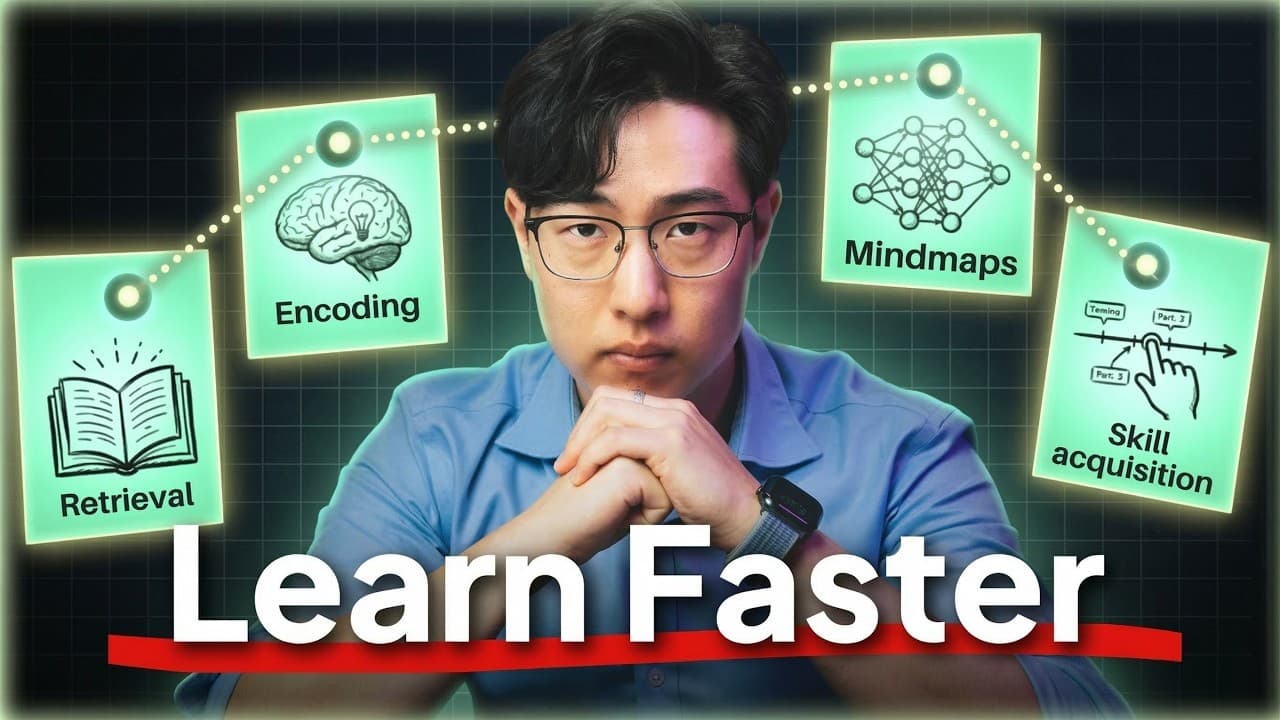
Becoming a top learner rests on three pillars: encoding (putting information into memory), retrieval (using and testing that memory), and enablers (the self-management and growth skills that let you show up and improve). Develop them in reverse order of importance: enablers first, then retrieval, then encoding, which matters most but is learned last.
Transcript
I've been a learning coach for the past 14 years. I've spent thousands of hours understanding and synthesizing the research on how to be a better and faster learner. In this 4-hour guide, I've put together some of my most important videos on learning. It's designed for you to watch from start to finish in order, and I've divided it into four chapte... Read More
Key Insights
- Getting better at learning is not the same as making it faster or easier. Effective, high-quality learning takes effort, often feels uncomfortable, and involves thinking really hard, which most people avoid, so they never actually improve.
- Encoding is the process of putting information into memory, and retrieval is the process of using information from memory. Encoding determines how many gaps your memory has, while retrieval finds those gaps and strengthens long-term memory.
- The Anki or flashcard grind fails when almost all learning is done through retrieval and testing while encoding stays low quality. The result is constantly forgetting nearly everything and endlessly relearning the same material.
- Enablers are skills that let you show up and do the work consistently, not direct learning skills. They split into self-management (stopping procrastination, time management, prioritization, focus) and growth skills (experimentation and critical reflection).
- The two biggest growth skills are experimentation and critical reflection. Learners who try a technique immediately, then reflect on what went well and wrong and design the next experiment, improve far faster than those who hold back.
- Enablers should be developed first because self-management or growth skills act as rate limiters. No matter how strong your encoding, retrieval, apps, or notes are, poor enablers make none of it matter.
- Encoding is arguably the most important pillar because phenomenal encoders retain so well they have few gaps and reach deep mastery quickly, yet it should be the last pillar you learn to master.
- Retrieval should be aligned with how you need to use your knowledge. Flashcards suit detailed factual recall, while solving complex problems, teaching, brain dumps, practice essays, or AI-generated tests suit applying multiple concepts together.
Install to Summarize YouTube Videos and Get Transcripts
Explore YouTube Video Summarizer or Get YouTube Transcript Extractor
Questions & Answers
Q: What are the three pillars of effective learning?
The three pillars are encoding, retrieval, and enablers. Encoding is putting information into memory and determines how many gaps your memory has. Retrieval is using information from memory, which finds those gaps and strengthens and consolidates long-term memory. Enablers are the supporting skills that let you show up and do the work consistently. Mastering all three lets you study to a higher quality in less time and get better results.
Q: Why is getting better at learning not the same as making it faster and easier?
Effective, high-quality learning takes effort, often feels uncomfortable, and involves thinking really hard. Most people assume they can improve without hard thinking, so they avoid that effort and never get better. Instead they try to cover content faster, but fast coverage means nothing unless you can retain the material and use it the way you need to. Retaining a hundred facts is useless if what you actually needed was to solve problems.
Q: What is the difference between encoding and retrieval?
Encoding is the process of putting information into memory, and retrieval is the process of using that information from memory, such as through a quiz or practice questions. Encoding determines how many gaps your memory has in the first place, so poor encoding leaves superficial memory full of holes. Retrieval helps you find those gaps and strengthens and consolidates your long-term memory, so practicing retrieval makes your knowledge stronger.
Q: Why does the flashcard or Anki grind fail for many learners?
The flashcard grind fails when almost all learning is done through retrieval and self-testing while encoding is not done at a high quality. Because encoding is weak, the memory is full of gaps, so you constantly forget almost everything and overwhelm yourself with the need to endlessly relearn what you keep forgetting. Great encoding reduces the gaps in the first place, so strong learners barely forget and rarely need to relearn.
Q: What are enabler skills and what are their two types?
Enablers are not direct learning skills; they are the skills that allow you to show up and do the work you need to do consistently. They divide into two types. Self-management includes stopping procrastination, time management, prioritizing tasks, and managing focus and concentration. Growth skills are those that let you improve over time, and the two biggest are experimentation and critical reflection. Weak enablers act as rate limiters that undermine everything else.
Q: In what order should you develop the three learning pillars?
You should develop enablers first, then retrieval, then encoding. Enablers come first because self-management or growth skills act as rate limiters, so no matter how good your encoding, retrieval, apps, or notes are, weak enablers make none of it matter. Retrieval is second because you already have information encoded and can test it. Encoding, though arguably the most important skill, is the last thing you should learn to master.
Q: How do experimentation and critical reflection speed up learning?
Experimentation and critical reflection are the two biggest growth skills. A learner who tries a new technique immediately, then reflects on what went well, what went wrong, and what to improve, and designs the next experiment right away improves much faster than someone afraid to try or unable to evaluate results. In the coach's program some students learn 20 times faster, and 99 out of 100 slow learners hold back on experimentation or rarely do critical reflection.
Q: What retrieval strategies can you use and how do you choose?
Retrieval strategies include flashcards for detailed factual recall, solving complex problems to apply multiple concepts together, building something like an app, teaching someone, answering questions, making your own questions and answer sheets, quizzing friends, brain dumps, mind map brain dumps, writing practice essays, and using AI to generate practice tests. No single strategy is best; each has its own purpose. You choose by figuring out how you need to use your knowledge and aligning your retrieval strategy with that use.
Summary & Key Takeaways
-
A learning coach of 14 years condenses research into a guide built around four chapters (retrieval, encoding, mind mapping, skill acquisition) and three learning pillars. Mastering the pillars lets students learn more, to higher quality, in less time, producing better results than chasing faster content coverage.
-
Learning means encoding information into memory and retrieving it for use. Retrieval finds and consolidates knowledge gaps; encoding determines how many gaps exist. The flashcard grind fails because heavy retrieval with weak encoding causes endless forgetting and relearning, overwhelming the learner with holes that never fully close.
-
Enablers, split into self-management and growth skills like experimentation and critical reflection, must be built first since they limit everything else. Retrieval comes second, matched to how you will use knowledge, and encoding, though most important, is developed last for lasting, efficient mastery.
Read in Other Languages (beta)
Share This Summary 📚
Summarize YouTube Videos and Get Video Transcripts with 1-Click
Try YouTube Summary with ChatGPT & Claude or YouTube Transcript Generator
Explore More Summaries from Justin Sung 📚
Summarize YouTube Videos and Get Video Transcripts with 1-Click
Try YouTube Summary with ChatGPT & Claude or YouTube Transcript Generator