How to Learn Faster Using Prediction Errors Today
TL;DR
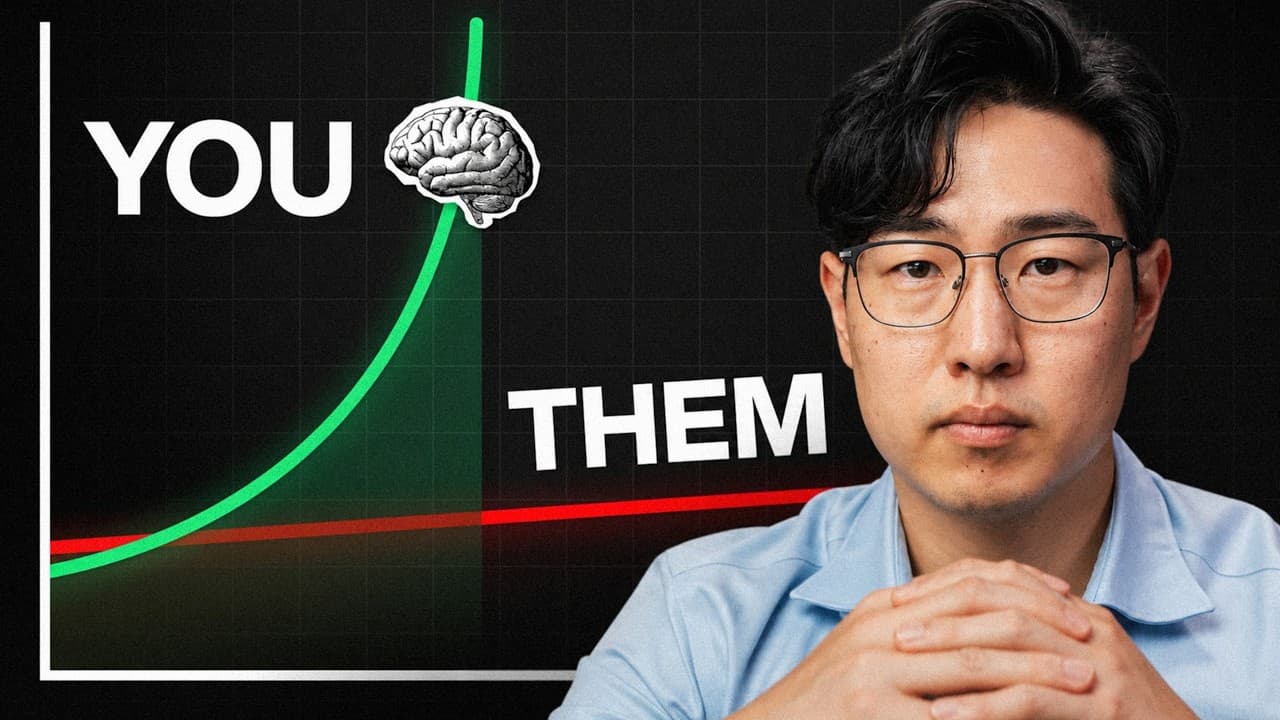
Prediction errors occur when you guess what you will learn and are wrong, signaling the need to adjust your understanding. By increasing the frequency of making and correcting these predictions, you create deeper learning and stronger memories. Balance faster coverage with meaningful rehearsal to reach true mastery more quickly.
Transcript
So, the topic of today is the simplest ways of learning faster. I'm going to give you two methods to anchor on to. And I call these the two simplest methods because there are many ways to learn faster. And there are lots of different learning strategies and lots of different learning techniques. Some of these techniques are very difficult to learn.... Read More
Key Insights
- Prediction errors act as a learning signal that drives deeper understanding and memory strengthening.
- Make predictions before reading to trigger a useful prediction error when you are wrong.
- Do not rely on random guesses; use logical reasoning and connect to prior knowledge to maximize learning impact.
- Time to outcome is more important than raw speed; slower initial study can reduce total rehearsal time.
- Rehearsal and testing are essential for moving from recall to higher-level mastery.
- The technique is applicable in exams, work-based upskilling, and new project learning.
- Frequent, small prediction errors lead to faster skill acquisition over time.
- The approach helps identify gaps quickly, guiding focused revision and practice.
Install to Summarize YouTube Videos and Get Transcripts
Explore YouTube Video Summarizer or Get YouTube Transcript Extractor
Questions & Answers
Q: How can prediction errors accelerate learning according to the video?
Prediction errors accelerate learning by generating a signal that tells your brain you need to adjust your understanding. By predicting before engaging with new material, you force your brain to connect existing knowledge to the new content, and when your predictions are wrong, you receive concrete feedback. This process strengthens memory and deepens comprehension, making subsequent study more efficient.
Q: What is time to outcome and why does it matter?
Time to outcome is the total time required to reach a desired learning result, not just how quickly you cover material in a single session. It matters because a technique that seems fast in coverage might require extensive rehearsal later, whereas a slower coverage method could yield faster overall mastery with less repetition. Focusing on time to outcome helps you optimize for real-world results.
Q: What role does rehearsal play in learning faster?
Rehearsal is the process of revisiting material, relearning forgotten parts, and testing yourself to reveal gaps in understanding. It’s essential because coverage alone does not guarantee mastery. Effective rehearsal shortens the distance to the outcome by strengthening connections, clarifying relationships, and ensuring you can apply knowledge in complex scenarios.
Q: How should one approach making predictions before learning?
Approach predictions by scanning the material, listing keywords and objectives, and then guessing what the main points will be about. Predictions should be thoughtful and connected to what you already know, not random guesses. Even incorrect predictions generate a learning signal that improves subsequent understanding when corrected.
Q: What is multi-pass encoding as described in the video?
Multi-pass encoding refers to revisiting material multiple times with the goal of encoding information more deeply each pass. The first pass builds a rough framework, and subsequent passes fill gaps, strengthen recall, and integrate knowledge. This approach reduces long-term forgetting by reinforcing memory through spaced, purposeful repetition.
Q: Why might fast per-session coverage fail to improve learning speed?
Fast per-session coverage can fail because it often prioritizes breadth over depth, leading to shallow retention and fewer genuine connections. If you don’t engage in adequate rehearsal, you forget material quickly, slowing overall progress toward the outcome. Slower, deliberate study with strong rehearsal typically yields faster long-term mastery.
Q: How can you apply these methods to real-world upskilling or exams?
Apply the methods by predicting key concepts before studying, then using deliberate rehearsal to test understanding, solve representative problems, and explain concepts aloud. Track your time to reach the required level of mastery rather than just how much material you cover. This helps you identify gaps early and adjust your study plan for efficient progress.
Q: What is the difference between retention and mastery in this framework?
Retention is the ability to recall information accurately, while mastery involves applying knowledge to solve complex problems and reason through connections. The framework emphasizes retention through prediction and rehearsal, culminating in mastery as you can integrate concepts, relate ideas, and apply them to new situations beyond mere fact recall.
Summary & Key Takeaways
-
Prediction errors are a simple, universal tool that boosts comprehension by forcing you to confront gaps in your understanding and revise your mental models. This process strengthens memory traces and builds robust knowledge networks. Framing learning around prediction helps you move beyond passive reading toward active, self-correcting study.
-
The two core ideas are prediction based learning and multi-pass encoding. Start by predicting content before deepening your understanding, then revisit material multiple times to reinforce retention and close gaps. This approach optimizes the time you spend studying by focusing on outcomes rather than sheer volume.
-
Correct use of the approach means prioritizing outcome time. You aim for the overall time to reach mastery, not just fast per-session coverage. Slower initial learning but deeper understanding can reduce total rehearsal time and improve long-term retention and application.
Read in Other Languages (beta)
Share This Summary 📚
Summarize YouTube Videos and Get Video Transcripts with 1-Click
Try YouTube Summary with ChatGPT & Claude or YouTube Transcript Generator
Explore More Summaries from Justin Sung 📚
Summarize YouTube Videos and Get Video Transcripts with 1-Click
Try YouTube Summary with ChatGPT & Claude or YouTube Transcript Generator