How to Train Your Brain to Think in English
TL;DR
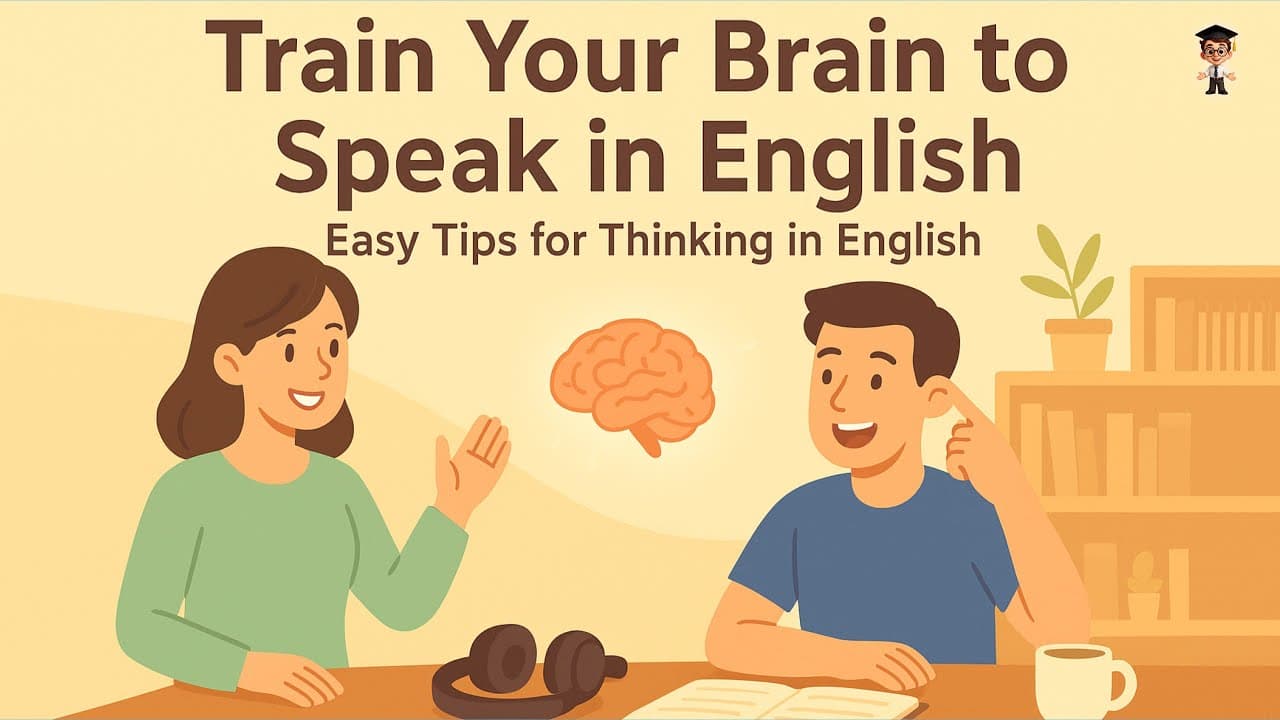
Stop translating from your native language by building three daily habits: think in small English sentences all day, feed your brain input by listening to and watching simple English about topics you enjoy, and speak English out loud to yourself. Progress is slow, so practice 10-15 minutes daily and treat mistakes as normal.
Transcript
Hello everyone and welcome back to Mr. English channel where learning English is easy and fun. I'm Emily. Hello Emily. Hi everyone. I'm Paul. How are you today Paul? I'm great thank you. Ah, I am very happy today. Oh, why are you happy? The sun is shining. I like sunny days. And you, Emily? How are you? I am very good, thanks. I am also happy. I am... Read More
Key Insights
- Translating in your head is slow because you think a word in your first language, translate it, then speak the English word; the goal is to think directly in English with no translation, which is faster and more natural.
- Tip one is thinking in small sentences all day, such as 'this is my pen' or 'my pen is blue', rather than single words, connecting English to your life instead of to your native language.
- Everyday moments are training opportunities: on waking you can think 'I am awake' or 'I am hungry', and on a bus you can think 'I see a red car' or 'a man is walking'.
- Tip two is input, meaning English going into your ears and eyes through listening and watching, which lets your brain hear the patterns, rhythm, and 'music' of English like 'I am, you are, he has'.
- Good input is easy A1-level English such as simple podcasts, simple and repetitive pop songs you like, and simple videos, because when you enjoy the material listening becomes fun rather than work.
- Choosing input about your interests keeps learning interesting: a cooking fan can watch simple cooking videos ('I cut the tomato, I add salt') and a football fan can watch short clips ('he kicks the ball, it is a goal'), connecting words to actions.
- Tip three is output, meaning speaking English out loud to yourself in your room, car, or shower, so your ears hear your own voice; you do not need a partner to start.
- Language learning is slow, so be patient and practice at least 10-15 minutes every day rather than two hours; mistakes are normal and mean you are learning, so say 'oh, okay' and try again.
Install to Summarize YouTube Videos and Get Transcripts
Explore YouTube Video Summarizer or Get YouTube Transcript Extractor
Questions & Answers
Q: How do I stop translating in my head when speaking English?
Stop routing English through your first language and instead connect English directly to your life. The video's method is to think in small English sentences all day, like 'this is my pen' or 'I see a red car', so you link the actual thing to its English word. When you describe your room or day in English, you build the language in your brain without translating, which makes speaking faster and more natural over time.
Q: What is the first tip to train your brain to think in English?
Tip one is to think in small sentences all day rather than single words. Instead of just thinking 'pen', you think 'this is my pen' or 'my pen is blue'. You do this during everyday moments: on waking, 'I am awake' or 'I am hungry'; on a bus, 'I see a window, I see a red car, a man is walking'. This connects English to your life, not to your first language.
Q: What is input and why does it help language learning?
Input is English going into your ears and eyes through listening and watching. It helps because your brain hears the patterns, sentences, and the rhythm or 'music' of English, such as 'I am, you are, he has'. The video calls input food for your brain that makes it strong in English. Good input includes easy A1 English, simple podcasts, repetitive songs, and simple videos about topics you like.
Q: What should I listen to or watch to improve my English?
Choose easy English about topics you enjoy so it feels fun rather than like work. Suggestions include the Mr. English Channel podcast, simple English songs, and simple, repetitive pop songs. For watching, avoid fast movies and pick simple videos matching your interests: cooking videos ('I cut the tomato, I add salt'), short football clips ('he kicks the ball, it is a goal'), or travel videos ('this is Paris, it is beautiful').
Q: How can I practice speaking English if I have no one to talk to?
Speak to yourself out loud, which the video calls output. Do it in your room, car, or shower so your ears hear your own voice. Describe what is around you: 'This is my room, I see a bed, the bed is big, the table is brown.' You can also talk about your day at night, such as 'Today I was happy, I ate pasta for lunch.' You do not need a partner to start.
Q: How much time each day should I spend practicing English?
Practice at least 10 or 15 minutes every day rather than long two-hour sessions. The video notes that if you have two hours to study that is fine, but most people do not have much time, so short daily practice is very effective. The emphasis is on small steps every day and being patient, because learning a language is slow and consistency matters more than long study blocks.
Q: What should I do when I make a mistake while learning English?
Treat mistakes as good and normal, because they mean you are learning. The example given is saying 'I is happy' and then correcting it to 'I am happy'. When you make a mistake, you simply say 'Oh, okay' and try again. The advice is to be brave, not afraid to be wrong, and to be kind and patient with your brain as it grows in English.
Q: Why is it important to enjoy the material when learning English?
Learning must be fun, because if it is not fun you will stop. When you like the music, video, or topic, listening and watching become enjoyable rather than work, and a happy brain learns more. That is why the video recommends choosing input about your interests, such as cooking, sports, or travel, so the practice stays interesting and attractive and you keep doing it every day.
Summary & Key Takeaways
-
The episode from Mr. English Channel, hosted by Emily and Paul, explains how to train your brain to speak and think in English without translating from your first language, which they describe as slow, hard work; thinking directly in English is presented as faster and more natural.
-
Tip one is to think in small English sentences all day rather than single words, for example 'this is my pen' or 'I see a red car'. This connects English directly to your daily life and experiences instead of routing through your native language.
-
Tip two is input: listening and watching easy English about topics you enjoy, such as simple podcasts, repetitive songs, and cooking or football videos. Tip three is output: speaking to yourself out loud to describe your room and your day, needing no partner to begin.
Read in Other Languages (beta)
Share This Summary 📚
Summarize YouTube Videos and Get Video Transcripts with 1-Click
Try YouTube Summary with ChatGPT & Claude or YouTube Transcript Generator
Explore More Summaries from Mr. English Channel 📚




Summarize YouTube Videos and Get Video Transcripts with 1-Click
Try YouTube Summary with ChatGPT & Claude or YouTube Transcript Generator