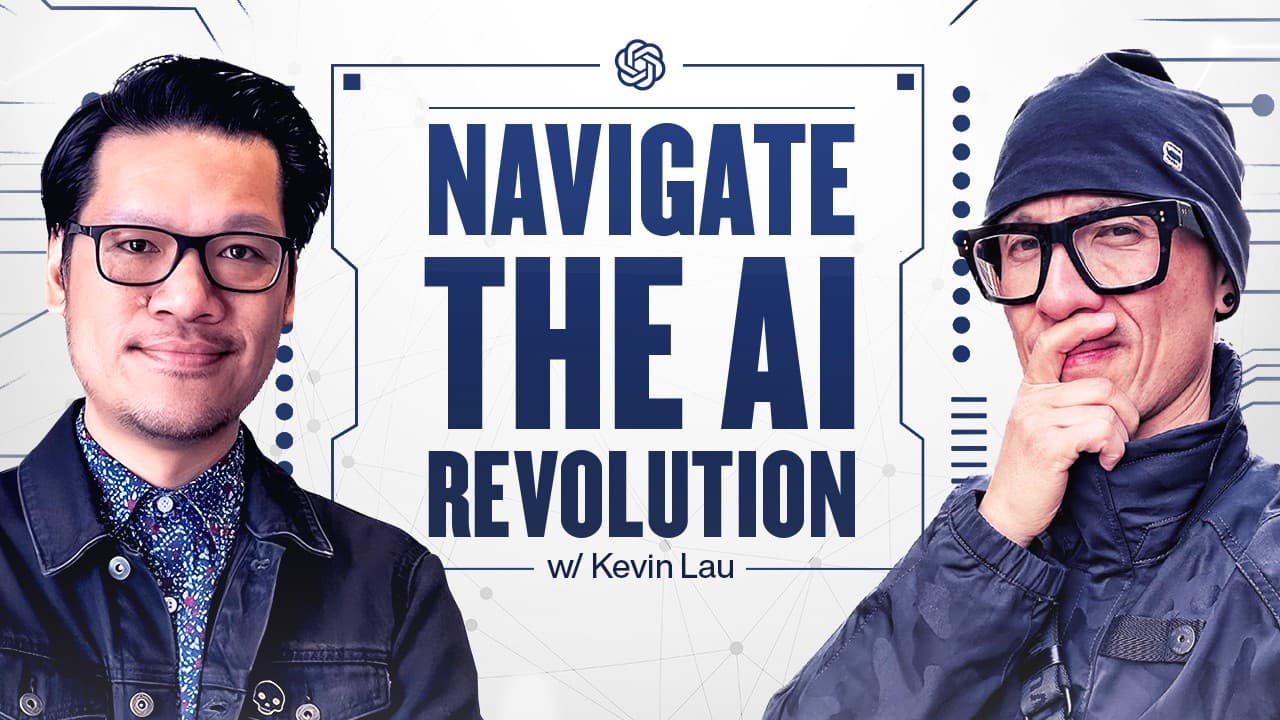
Kevin Lau on AI and the Future of Creative Work
TL;DR
Experienced creative professionals who can direct teams and lead projects are less threatened by AI than newcomers. AI is best at low-hanging work like stock-photography-level imagery and sitting through hours of footage. The bigger risk is that the next generation may skip the grunt work that once trained creatives in the fundamentals, so the industry has to find new ways to teach them.
Transcript
the people I know who are professionals who are creative who know how to to direct and Lead teams and put things together they're not as threatened by AI as the people who have yet to to kind of make their living doing it sort of the the lwh hanging fruit that AI is going to be really good at replacing is is kind of that stock photography level of ... Read More
Key Insights
- Creative professionals who know how to direct and lead teams are less threatened by AI than people who have not yet made a living from creative work, because AI mainly replaces lower-level tasks.
- The low-hanging fruit AI will replace is stock-photography-level imagery and tedious work such as sitting through hours of footage, which senior creatives do not aim to do but once had to do to advance.
- The main risk of push-button AI is that newer creatives may not be trained on the same fundamentals, since the repetitive groundwork that built earlier generations' skills could disappear.
- The key to a sustainable creative career is caring deeply about the work without losing yourself in it, so that rejected ideas or client changes do not feel like a mortal wound.
- Being able to judge your own work objectively is a major talent that helps creatives move to the next level of their careers, especially when clients do not love an idea.
- The late 1990s and early 2000s motion design era, with studios like Fuel and Brand New School, resembles today's AI moment: new tools arrived and young creatives experimented before any rules existed.
- Motion design was not yet an industry term when early practitioners started, and there were no design degrees teaching it, so people learned through trial, error, and invention.
- Creatives have used AI-like tools for a long time without calling them AI, such as content-aware fill and other predictive features in Photoshop.
Install to Summarize YouTube Videos and Get Transcripts
Explore YouTube Video Summarizer or Get YouTube Transcript Extractor
Questions & Answers
Q: Which creative jobs is AI most likely to replace?
According to Kevin Lau, AI will be best at replacing low-hanging work such as stock-photography-level imagery and tedious tasks like sitting through hours and hours of footage. Senior professionals do not aim to do that work, but it was the groundwork they had to complete to reach a higher level. Creatives who know how to direct and lead teams feel less threatened than those who have not yet made a living in the field.
Q: Why are experienced creatives less threatened by AI?
Experienced creatives who know how to direct teams, lead projects, and put things together work at a level AI does not easily replace. AI is strongest at repetitive, lower-level tasks like stock imagery and reviewing footage. People who have yet to make their living through creative work are more exposed, because those entry-level tasks are exactly what AI automates first.
Q: What is the risk of AI for the next generation of designers?
The risk is that newer creatives may never be trained on the same fundamentals earlier generations learned. Senior professionals got to a higher level by doing grunt work such as watching hours of footage. If that work becomes push-button through AI, younger designers could skip the training that built their judgment and craft, leaving gaps in their foundational skills.
Q: How should creatives handle client rejection of their ideas?
Kevin Lau describes a tightrope: creatives must care deeply about their work but not lose themselves in it. If they are too attached, they feel mortally wounded when an idea is not approved or clients ask for changes. Learning to unplug at the end of the day, avoid taking feedback personally, and look at the work more objectively is a valuable talent that helps creatives reach the next level.
Q: What was it like to work at Fuel in the early days of motion design?
Kevin joined Fuel as a ground-level designer just as it was splintering, with Brand New School spinning out of it. It was the dot-com era, and Fuel had been part of Razorfish. Young people broke the rules, competed to make the coolest work, distressed fonts, shot things practically, ran images through Xerox copiers, and pushed new tools like After Effects and early 3D software.
Q: How is the AI era similar to the early days of motion graphics?
Both periods put powerful new tools in the hands of creatives before rules existed. In the late 1990s, art school kids got desktop tools like After Effects, motion design was not yet a named field, and no instructors could teach it, so people learned by trial and error. Today, generative AI creates a similar wild-west moment, where creatives experiment and invent new ways of making images.
Q: How do creative professionals feel about generative AI images?
Kevin Lau describes the feeling as bouts of terror followed by complete wonder and awe, then the realization that AI has not solved everything yet. Chris Do notes that a young person can type a few prompts and generate a good-looking image that might take a seasoned artist days, because AI has learned composition and atmosphere, though good prompting still matters.
Q: Have designers been using AI tools before generative AI?
Yes. Kevin Lau points out that creatives have used tools that are effectively AI for a long time without calling them AI. Photoshop's content-aware fill and other predictive features are examples. He frames the desktop revolution as the first major shift and suggests AI is the latest step in a long history of tools that change how imagery is created and processed.
Summary & Key Takeaways
-
Kevin Lau, a motion graphics professional who started at the early studio Fuel, joins Chris Do to discuss AI. He argues that experienced creatives who direct teams are less threatened than newcomers, since AI targets stock-photography-level work and tedious tasks such as reviewing hours of footage, the very work that used to train beginners.
-
Kevin now works at Motion, a company around for about 35 years and known as a theatrical advertising agency and trailer house. After the pandemic shut down movie work, it pivoted toward graphics, design, and branding, and Kevin sees big tech brands becoming content providers, which makes content itself the product.
-
Both recall the late 1990s, when After Effects was new, motion design had no name, and no school taught it. They compare that wild-west experimentation to today's generative AI, which brings both terror and wonder, while Kevin notes that tools like content-aware fill were already AI in practice.
Read in Other Languages (beta)
Share This Summary 📚
Summarize YouTube Videos and Get Video Transcripts with 1-Click
Try YouTube Summary with ChatGPT & Claude or YouTube Transcript Generator
Explore More Summaries from The Futur 📚



Summarize YouTube Videos and Get Video Transcripts with 1-Click
Try YouTube Summary with ChatGPT & Claude or YouTube Transcript Generator