How Do Companies Get Rich Off America's Poor?
TL;DR
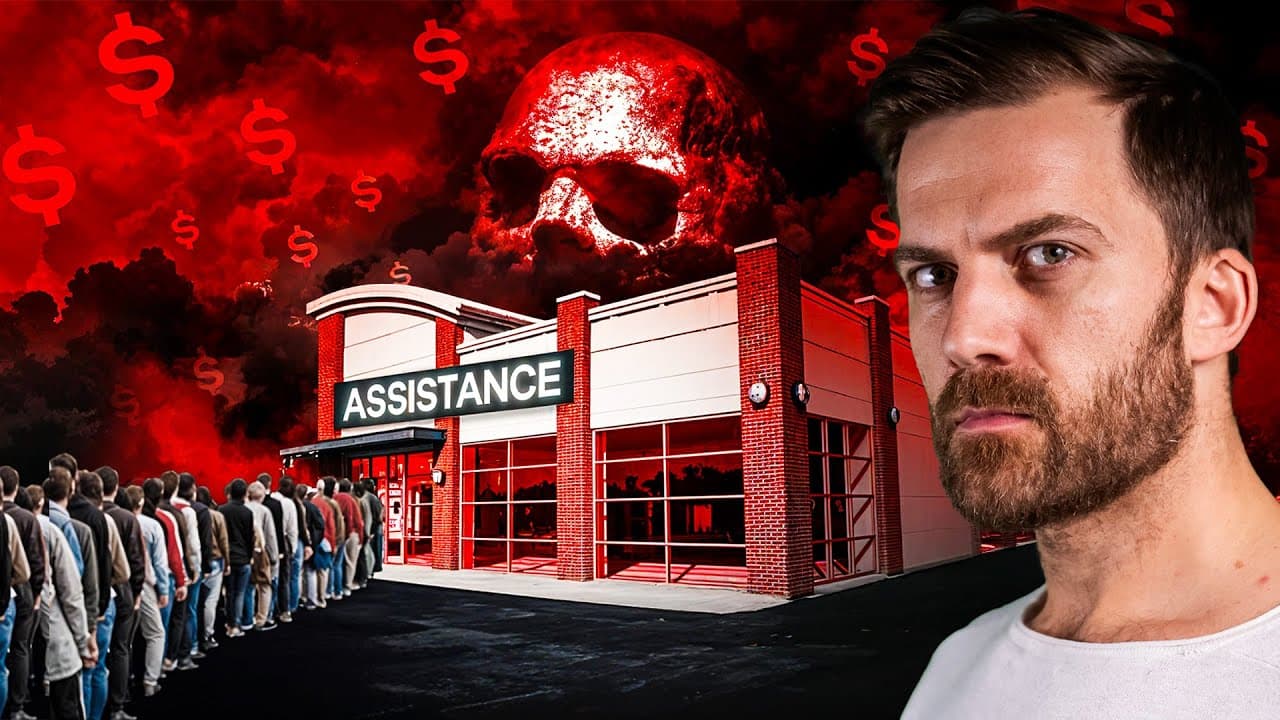
The U.S. government spends about a trillion dollars a year helping people in poverty meet basic needs, but since the 1980s much of it flows through private for-profit companies hired to distribute benefits. Starting under Reagan and accelerated by Clinton, this privatization was meant to boost efficiency, yet often enriches obscure corporations rather than the vulnerable people it targets.
Transcript
(film reel spooling) - There's people getting rich off this graph. (soft music) What we're looking at here is the number of Americans that don't make enough money for basic survival. So like a family of four, two parents, two kids, living off of $31,000 a year or less. That's considered poverty in the United States and there's millions of people wh... Read More
Key Insights
- Poverty in the United States is defined here as a family of four living on $31,000 a year or less, and millions of Americans live with that kind of income while the government spends roughly a trillion dollars annually to help them.
- Welfare has become big business, and the central irony is that enormous amounts of money can be made from poverty itself, with private corporations positioned as middlemen supposedly more efficient at administering public funds.
- Lyndon B. Johnson declared an 'unconditional war on poverty' in 1964, after which social spending as a share of GDP skyrocketed, funding Medicare, Medicaid, food stamps, and public education, and cutting poverty from 22% to 12-13%.
- The war on poverty initially worked, with poverty declining 30% in five years, but progress eventually slowed, the economy struggled, and Americans grew tired of subsidizing welfare programs.
- The 1980s mythologized the CEO, holding business leaders up as the ones who would make government as efficient as their own companies, which fueled the push to privatize social services.
- Privatization restructured benefit delivery so taxpayers fund the government, which routes money to states, which hire for-profit companies to determine eligibility, prevent abuse, and verify that applicants are working.
- Reagan started the privatization train and President Bill Clinton accelerated it toward total privatization of many American social services, aiming to reduce spending, waste, and over-reliance on welfare.
- Privatization produced some genuine wins, such as replacing paper food-stamp coupons with electronic debit cards that are more secure, more efficient, and ensure the money is spent on food.
Install to Summarize YouTube Videos and Get Transcripts
Explore YouTube Video Summarizer or Get YouTube Transcript Extractor
Questions & Answers
Q: What income level counts as poverty in the United States according to this video?
Poverty is illustrated as a family of four, two parents and two kids, living off of $31,000 a year or less. That is considered poverty in the United States, and the video notes there are millions of people who live with that kind of income. The graph shown tracks the number of Americans who don't make enough money for basic survival at that threshold.
Q: How much does the U.S. government spend helping people in poverty?
The U.S. government spends about a trillion dollars every year helping people in poverty meet their basic needs. In recent decades, a lot of that money has been flowing through a middleman: private corporations who are supposed to be more efficient in administering this money. This spending goes toward programs like Medicare, Medicaid, food stamps, and public education.
Q: Why is welfare described as big business?
Welfare is called big business because there is so much money to be made from poverty, which the video frames as the irony of the whole thing. Roughly a trillion dollars a year flows through the system, much of it via private corporations acting as middlemen. These companies profit from distributing government aid, creating incentives and loopholes that may not benefit the vulnerable people the money is designed to help.
Q: What was Lyndon B. Johnson's war on poverty?
In 1964, President Lyndon B. Johnson declared an unconditional war on poverty in America, vowing not to rest until it was won. After his speech, social spending as a share of GDP skyrocketed, funding programs like Medicare, Medicaid, food stamps, and public education. For a time it worked: poverty declined 30% in five years, dropping the rate from about 22% down to 12 or 13%.
Q: How did Ronald Reagan change the approach to poverty and welfare?
By the 1980s, Reagan argued that the federal government declared war on poverty and poverty won, and he wanted to rein in ballooning spending and reduce Americans' reliance on welfare. He kicked off changes to privatize government services, wanting to privatize Medicaid, Medicare, prisons, and air traffic control. This started a fundamental shift in how income support was delivered to low-income populations.
Q: How does the privatized welfare system distribute money today?
Under the reformed system, taxpayers give money to the government, which distributes it to the states rather than directly to citizens. The states then hire for-profit companies to do the complicated work of distributing money to eligible people, making sure no one abuses the system, determining who is eligible, and verifying that applicants are actually working in order to qualify for benefits.
Q: Did privatizing welfare actually make it more efficient?
The video says the answer is, in some cases, yes. There have been positive outcomes from outsourcing to contractors. A good example is food stamps, which used to come as paper coupons but are now delivered electronically on a debit card, making the system more secure, more efficient, and ensuring people use the benefit for food. However, many other instances left private companies rich without benefiting the most vulnerable.
Q: What role did Bill Clinton play in privatizing social services?
According to expert Anne Kim, Reagan started the privatization train, but it was President Bill Clinton who not only hopped on board but got it accelerating toward his destination, which was total privatization of a lot of social services in America. The privatization that began under Reagan continued and expanded significantly under Clinton, deepening the reliance on for-profit companies to administer welfare.
Summary & Key Takeaways
-
The video examines the number of Americans who don't earn enough for basic survival, defining poverty as a family of four on $31,000 or less, and notes the government spends about a trillion dollars a year helping them, increasingly through private corporate middlemen.
-
It traces the history from LBJ's 1964 war on poverty, which sent social spending soaring and cut poverty from 22% to about 12-13%, to Reagan's 1980s pushback framing the CEO as the model of efficiency government should adopt.
-
Privatization begun under Reagan and expanded by Clinton reroutes benefits through states and for-profit companies who decide eligibility and enforce work requirements, sometimes improving efficiency but often enriching obscure firms rather than the poor, elderly, children, and disabled.
Read in Other Languages (beta)
Share This Summary 📚
Summarize YouTube Videos and Get Video Transcripts with 1-Click
Try YouTube Summary with ChatGPT & Claude or YouTube Transcript Generator
Explore More Summaries from Johnny Harris 📚




Summarize YouTube Videos and Get Video Transcripts with 1-Click
Try YouTube Summary with ChatGPT & Claude or YouTube Transcript Generator