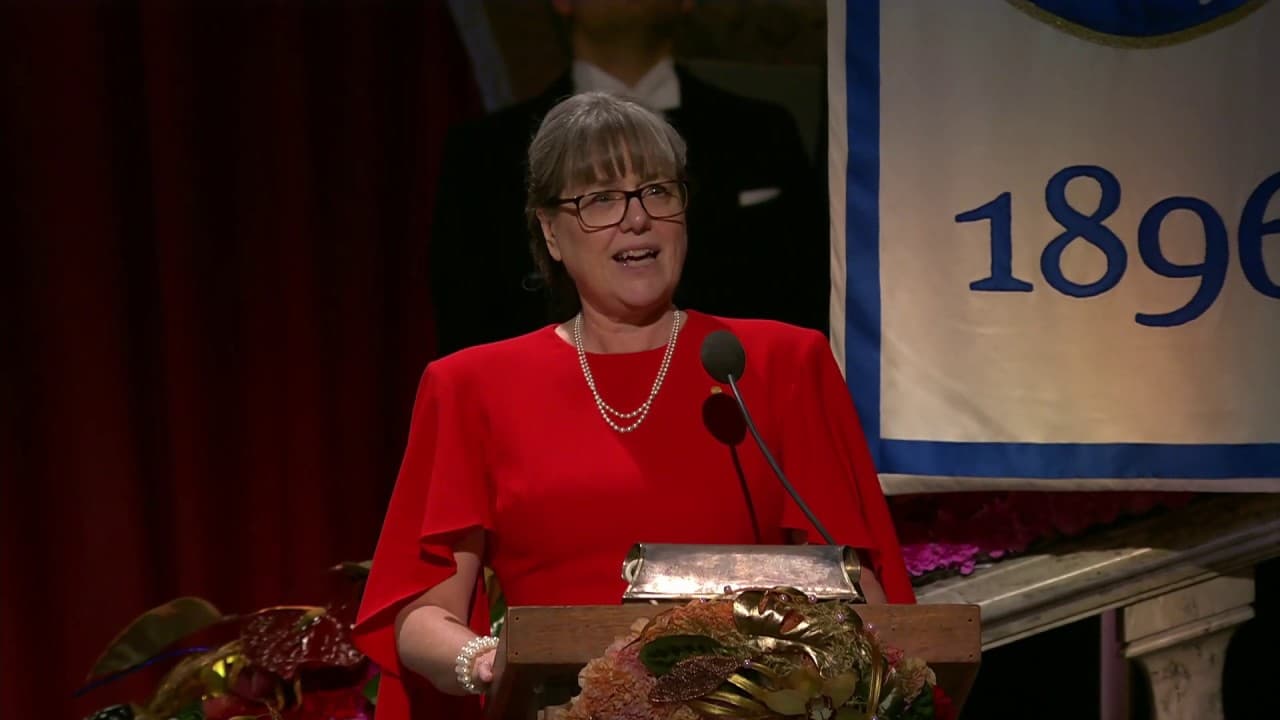
"Now, not everyone thinks physics is fun, but I do.” Donna Strickland, Nobel Prize in Physics 2018
Transcript
Read and summarize the transcript of this video on Glasp Reader (beta).
Install to Summarize YouTube Videos and Get Transcripts
Explore YouTube Video Summarizer or Get YouTube Transcript Extractor
Summary
In this speech, the Nobel Prize in Physics 2018 laureate speaks about their esteemed colleagues Arthur Ashkan and Gerrard Marui who were unable to join the celebration. They honor Arthur's invention of laser tweezers and congratulate him on his remarkable achievement. The speaker also acknowledges the significance of being one of the few women to win the Nobel Prize in Physics, joining the ranks of Marie Curie and Maria Gape Admired. They highlight the pioneering work of Marie Curie and Maria Gape Admired in their respective fields and express their admiration for their contributions. The speaker then talks about their own journey in experimental physics, emphasizing the enjoyment and excitement they find in solving puzzles about the universe and working with high-intensity lasers. They credit their PhD supervisor, Jordan Aru, for the idea of increasing laser intensity and describe the process of turning the idea into a reality. They conclude by expressing gratitude to the Royal Swedish Academy of Sciences and the Nobel Foundation for recognizing the field of laser physics with the Nobel Prize.
Questions & Answers
Q: Who are the esteemed colleagues mentioned in the speech?
The esteemed colleagues mentioned in the speech are Arthur Ashkan and Gerrard Marui, who share the Nobel Prize in Physics 2018 with the speaker.
Q: What is the remarkable invention of Arthur Ashe?
Arthur Ashkan invented laser tweezers that can trap living cells and wind up molecular motors.
Q: Who are Marie Curie and Maria Gape Admired?
Marie Curie is the first female Nobel Prize winner and the only person to win the Nobel Prize in two different science categories. Maria Gape Admired is a theoretical physicist who made the prediction of multi-photon physics without experimental evidence, which was later observed several decades later.
Q: Why does the speaker find experimental physics especially fun?
The speaker finds experimental physics fun because it involves solving puzzles about the universe and playing with cool toys in the lab. They particularly enjoy working with high-intensity lasers and witnessing magical phenomena like turning one color of laser light into a rainbow of colors.
Q: Who is Jordan Aru and what was their contribution?
Jordan Aru is the speaker's PhD supervisor. He came up with the idea of increasing laser intensity by orders of magnitude, which became a significant aspect of the speaker's work.
Q: What was the process of turning the idea of increasing laser intensity into reality?
To turn the idea of increasing laser intensity into reality, the speaker built a pulse stretcher, a laser amplifier, and a pulse compressor. They had to learn skills like cleaving optical fiber, machining parts, and doing plumbing. The speaker also had to measure pulse durations and frequency spectra, facing unexpected problems along the way and figuring out solutions.
Q: How did the speaker measure the duration of the compressed amplified pulses?
The speaker had no way to measure the duration of the compressed amplified pulses, but their colleague Steve Williamson had a historical camera, which they used together to measure the pulse width.
Q: How did the speaker feel when they realized they had built something unique and groundbreaking?
The speaker describes it as an amazing feeling to know that they had built something that no one else had before and that it actually worked. They express that there is no excitement quite like it, except perhaps for being woken up at 5:00 in the morning because the Royal Swedish Academy of Sciences also found it exciting.
Q: What does the speaker express gratitude for?
The speaker expresses gratitude to the Royal Swedish Academy of Sciences and the Nobel Foundation for honoring them, Arthur Ashkan, and Gerrard Marui, and for recognizing the field of laser physics with the Nobel Prize.
Q: What is the key message of the speech?
The key message of the speech is to honor Arthur Ashkan and his invention of laser tweezers while also acknowledging the significance of being one of the few women to win the Nobel Prize in Physics. The speaker highlights the contributions of Marie Curie and Maria Gape Admired and expresses their own enjoyment and excitement in the field of experimental physics. They also express gratitude to the Royal Swedish Academy of Sciences and the Nobel Foundation.
Takeaways
The speech highlights the achievements of Arthur Ashkan, the speaker, and Gerrard Marui in the field of laser physics. It also emphasizes the important contributions of Marie Curie and Maria Gape Admired to the scientific community. The speech showcases the enjoyment and excitement the speaker finds in experimental physics and working with high-intensity lasers. It is a celebration of groundbreaking discoveries, perseverance, and the recognition of laser physics by the Nobel Prize.
Read in Other Languages (beta)
Share This Summary 📚
Summarize YouTube Videos and Get Video Transcripts with 1-Click
Try YouTube Summary with ChatGPT & Claude or YouTube Transcript Generator
Explore More Summaries from Nobel Prize 📚

Summarize YouTube Videos and Get Video Transcripts with 1-Click
Try YouTube Summary with ChatGPT & Claude or YouTube Transcript Generator