What Is Simple Harmonic Motion and Its Key Terms?
TL;DR
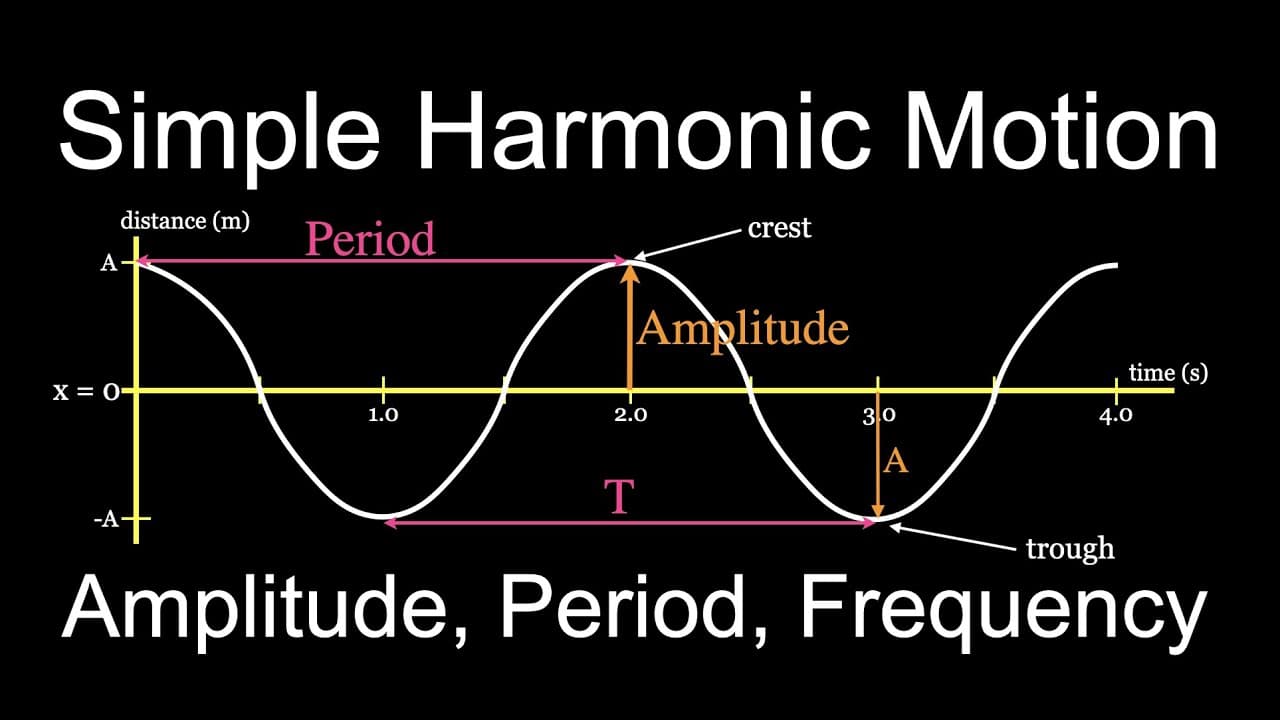
Simple harmonic motion (SHM) includes key concepts: amplitude, period, and frequency. Amplitude is the maximum displacement, the period is the time taken for one complete cycle, and frequency indicates the number of cycles completed per second. Understanding these terms is essential for graphing and analyzing SHM.
Transcript
okay in today's video we're going to be going over some very important terms that you should be aware of for simple harmonic motion that includes but is not limited to amplitude period and frequency now before we get started with all that great stuff don't forget to subscribe to my channel step by step science get all my excellent physics chemistry... Read More
Key Insights
- 🤩 Simple Harmonic Motion involves key terms like amplitude, period, and frequency.
- 🏍️ Amplitude is the maximum displacement, while the period is the time for one complete cycle.
- 🏍️ Frequency in SHM is the number of cycles completed in one second, measured in hertz (Hz).
- 🛀 Graphing SHM shows oscillatory motion from crest to trough over time.
- 🧘 The amplitude is measured from the equilibrium position to the crest or trough.
- ❓ Period can be measured from crest to crest, trough to trough, or equilibrium to equilibrium.
- ❓ The period and frequency in SHM have an inverse relationship.
Install to Summarize YouTube Videos and Get Transcripts
Explore YouTube Video Summarizer or Get YouTube Transcript Extractor
Questions & Answers
Q: What is the significance of the amplitude in simple harmonic motion?
The amplitude in SHM represents the maximum displacement from the equilibrium position, showing the extent of oscillation in the system.
Q: How is the period calculated in simple harmonic motion?
The period in SHM is the time taken to complete one cycle, measured from crest to crest, trough to trough, or equilibrium to equilibrium.
Q: Explain the relationship between period and frequency in simple harmonic motion.
Period and frequency in SHM are inversely proportional, with the period being equal to one over the frequency, and frequency measured in hertz (Hz).
Q: How is simple harmonic motion graphed to represent displacement over time?
SHM is graphed with time on the x-axis and displacement on the y-axis, showing oscillations from crest to trough over time in a sinusoidal pattern.
Summary & Key Takeaways
-
Simple Harmonic Motion (SHM) involves amplitude, period, and frequency.
-
Amplitude is the maximum displacement, period is time for one cycle, and frequency is cycles per second.
-
Graphing SHM shows displacement over time, with crest and trough representing maxima and minima.
Read in Other Languages (beta)
Share This Summary 📚
Summarize YouTube Videos and Get Video Transcripts with 1-Click
Try YouTube Summary with ChatGPT & Claude or YouTube Transcript Generator
Explore More Summaries from Step by Step Science 📚
Summarize YouTube Videos and Get Video Transcripts with 1-Click
Try YouTube Summary with ChatGPT & Claude or YouTube Transcript Generator